Spiders Guide
Jumping Spiders Salticidae
What are Jumping Spiders? Jumping spiders are a type of spider that gets its common name from its ability to jump, which it uses to catch prey. Jumping spiders belong to the Family Salticidae. There are more than 4,000 …
At a glance
What are Jumping Spiders?
Jumping spiders are a type of spider that gets its common name from its ability to jump, which it uses to catch prey. Jumping spiders belong to the Family Salticidae. There are more than 4,000 known species of jumping spiders in the world, with about 300 species found in the United States and Canada, including zebra spiders, as well as commonly identified black jumping spiders.
Many wonder do jumping spiders bite and are jumping spiders venomous? While jumping spiders do bite on occasion, it is rare, and their bite is not terribly venomous. You can read on to learn what to do if bitten by a jumping spider.
What Do Jumping Spiders Look Like?
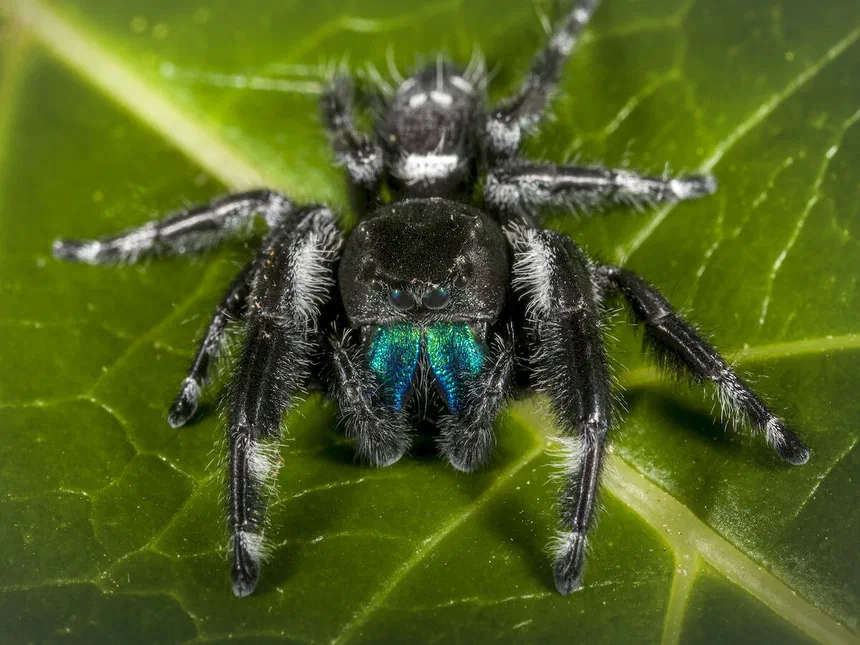
Jumping spiders are commonly mistaken for black widow spiders due to their compact black bodies with relatively short legs. However, black jumping spiders aren’t the only species of jumping spider. They can also be brown, tan or gray in color with pale white, gray, yellow, red, blue or green markings. Adult jumping spiders range in size from about 1/8-3/4” (4-18 mm) and are typically covered in dense hairs or scales that are brightly colored or iridescent. Their front legs are usually thicker and somewhat longer than their other legs.
Adult zebra spiders have gray bodies with white markings on their front and abdomen. Their legs are white or brown with gray rings, resembling a zebra. Female zebra spiders are 3/16-1/4” (4.3-6.4 mm), while males are 1/8-1/4” (4-5.5 mm).
All forms of this arachnid, from zebra to black jumping spiders, have eight eyes in three rows. The front row has four eyes with a very large middle pair.
Jumping Spiders Salticidae
Do Jumping Spiders Bite?
Jumping spider bites are uncommon, though it can occur. While jumping spiders are not venomous, their bites may cause redness, itching, stinging and swelling. If you suspect a jumping spider has bitten you, clean the site with soap and water. Then, apply a cold compress over the spider bite location. Adults can also take aspirin or acetaminophen and antihistamines to relieve minor symptoms.
If symptoms continue to worsen for more than 24 hours, it’s crucial to seek medical attention. If possible, bring the spider to the doctor for proper identification and treatment. Learn more about spider bites here .
Can Jumping Spiders Hurt You?
In some cases, jumping spiders will bite in defense, but their bite is not venomous. As such, jumping spiders are not considered a large danger to humans, especially given that these spiders are more likely to run away from people than attack them. Jumping spiders do possess fangs and produce venom, but the venom is not a medical threat.
Where Do Jumping Spiders Live?
Jumping spider retreats may be built under furniture, in drapery folds, between books on bookshelves, in cracks found in wood floors, around door and window molding, etc. Outside retreats may be found under loose bark, between leaves, etc. Indoors, spiders will usually be found hunting around windows and doors because more insects are attracted to these areas and their vision is best in sunlit areas. Outdoors, jumping spiders are commonly seen running over tree bark, under stones and boards, on bushes, fences, decks and the outside of buildings, especially sunny areas.
Jumping spiders are unlikely to infest a home, as they prefer outdoor environments with plentiful vegetation and sunlight, such as grassland and prairies. In these locations, they feast on bollworms, cotton leaf worms, webworms, cotton flea hoppers, stinkbugs, leafhoppers and mosquitoes. On occasion, jumping spiders might gain entry indoors via clothing or plants that are brought inside.
Jumping Spider Habits
Unlike most spiders, jumping spiders are active during the daytime and prefer sunshine. They are excellent hunters, due to their jumping ability and swift reflexes. Jumping spiders can rapidly move both sideways and backwards for short distances, and pounce on passing prey. When threatened, jumping spiders may jump 20 times their body length. They employ silk as a dragline when they jump, and the dragline acts as a safety line.
In general, jumping spiders have the best vision of any spider species, being able to detect and react to movement up to 18" (45 cm) in distance. However, their night vision is very poor.
Jumping spiders do not construct snare webs but do build web retreats, which are loosely woven, saclike and composed of several envelopes. These retreats are used for molting, hibernation, nighttime seclusion and laying eggs. The egg sacs are typically lens-shaped and suspended like a hammock from the retreat’s wall. Oftentimes, jumping spiders will build a new retreat for each activity – under furniture, in drapery folds, between books, in cracks of wood floors, around doors and window moldings, etc. Outside, jumping spider retreats are found under loose bark and between leaves.
In the New England States, zebra, black and other colored jumping spiders mate in May, and eggs are laid in June and July. Each egg sac contains 15-25 white eggs. It’s thought that the older spiderlings overwinter in a retreat and become adults in spring. Adult male jumping spiders are found in April through July, and females are spotted from mid-May to late October, usually around windows and doors because there are more insects attracted to these areas. They are also commonly seen in sunlight areas while running over tree bark, under stones, on bushes, and along fences and decks.
Signs of a Jumping Spider Infestation
The most common sign of a jumping spider infestation is seeing the spider itself. Jumping spiders will usually be found hunting around windows and doors because more insects are attracted to those areas.
How to Get Rid of Jumping Spiders
Need to know how to get rid of jumping spiders? If a jumping spider is found indoors, remove it with a vacuum and dispose of the vacuum bag outside. If you suspect an infestation, contact a licensed pest control professional . They will conduct a thorough inspection of the home or building and properly identify the spider species.
When it comes to preventing contact with jumping spiders, it’s important to eliminate the primary ways that these spiders can enter the home. Most often, jumping spiders enter through wall cracks or poorly screened windows and doors. If tackling DIY prevention, make sure to seal wall openings with a silicone-based caulk, and properly screen windows and doors. Watch this video to learn the proper technique to patch a screen. Another way that jumping spiders may gain entrance into the home is by accidentally hitchhiking inside boxes, grocery bags or other items that are brought from the outside in. Inspect these items before bringing them into the home to reduce the risk of a jumping spider infestation. You can learn more about DIY spider control from homeowners with these helpful tips .