Spiders Guide
Daring Jumping Spider Facts & Information
Appearance The daring jumping spider, also known as the bold jumping spider, has a distinctive black or dark-gray hairy abdomen. Spots : Most members of this species have three white spots on their abdomen, but in some …
At a glance
Appearance
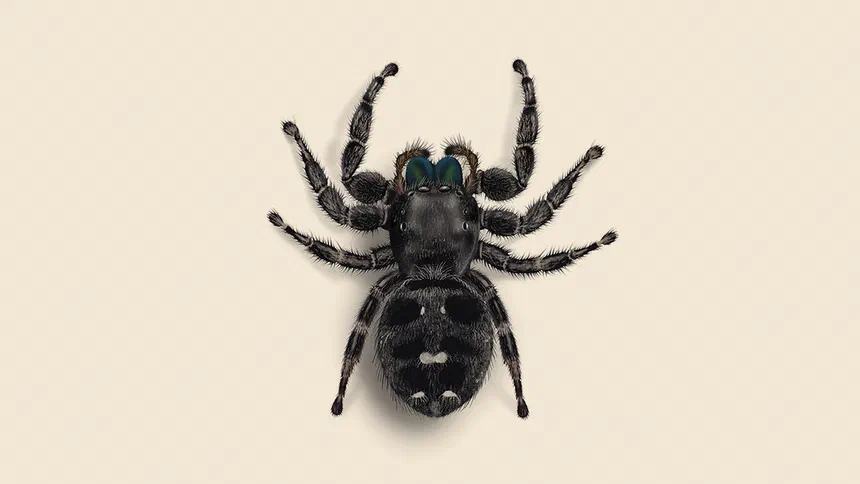
The daring jumping spider, also known as the bold jumping spider, has a distinctive black or dark-gray hairy abdomen.
- Spots : Most members of this species have three white spots on their abdomen, but in some species the spots may be red or orange.
- Size : The adult female is about 3/8 to ¾ inch long, and the adult male is about ¼ to ½ inch long.
- Hair : Tufts of hair over the male spider’s eyes give them the appearance of having “eyebrows”.
- Legs : Daring jumping spiders have eight legs with bands of white spaced up and down the legs
- Eyes : eight eyes (the center two are very large and prominent)
- Mouth : mouthparts that are iridescent blue or green in color
Diet
The daring jumping spider eats a range of insects and other spiders, and these spiders are known prey for dragonflies, birds and lizards.
Activity
Like most species of the jumping spider group, daring jumping spiders are solitary hunters who are active during the day. Jumping spiders have extremely good vision, a characteristic useful for observing both prey and predators.
Distribution
The daring jumping spider is one of the most common species found in North America. Phidippus audax is generally found in North America. Distribution ranges from southeastern Canada to British Columbia and as far south as northern Mexico to Florida.
Habitat
The daring jumping spiders are very diverse and are frequently seen in urban, suburban and agricultural habitats. Their natural habitats include grasslands, prairies old fields backyards, gardens and open woodlands. This species will enter homes and outdoor structures, but isn’t as likely to be seen in a home as it is in barns, storage sheds, on tree trunks and under limbs or ground litter.
Webs
These spiders do not build webs to catch prey, but they do build protective webs.
Reproduction & Life Cycle
Daring jumping spiders reach maturation in the springtime, and mating begins around late spring or early summer. Reproductive females will produce as many as eight eggs sacs per year with each egg sac containing from 30-170 eggs. The spiders living in the warmer portions of their distribution range usually live longer and produce more offspring.
Prevention Tips
Prevention of daring jumping spiders begins with making sure the population of insects that serves as food for the spiders is kept to a minimum and that holes, cracks and gaps in the home’s doors, windows and foundation are properly sealed to prevent entrance into the home’s living space. In addition, removing ground litter that serves as harborage for spiders is also helpful. Should the homeowner need assistance in control of these or any other spider, contact your pest management professional and request an inspection. Your pest management professional can then use his inspection findings to prepare a comprehensive pest management plan that will effectively and efficiently deal with the specific pest problem.