Mouse Facts & Information
Identification
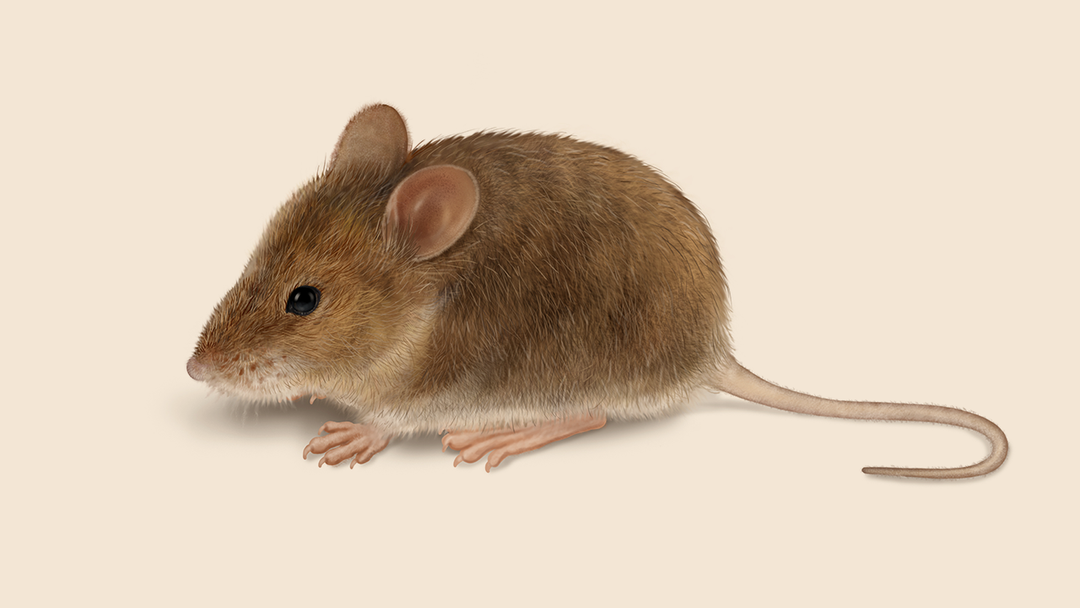
What do mice look like?
- The house mouse is gray-brown with an almost completely hairless tail that is as long or longer than the body. The house mouse is usually the smallest of these species.
- The deer mouse is grayish-brown to reddish-brown with white-colored undersides and feet and a tail that is less than half the body length.
- The white-footed mouse looks almost identical to the deer mouse, except for its larger size.
Mouse Habitats
Each of these three mouse species is primarily nocturnal and is quick to escape from dangerous situations. If mice are seen during the day, it is likely a house mouse. The house mouse and the white-footed mouse are good climbers and swimmers. House mice stay close to their nests and rarely travel more than 100 feet from the nest. The white-footed mouse and the deer mouse are more likely to venture farther from their nest.
Mice are likely to store food in their nest or burrow and are considered omnivores. In their wild, non-domestic settings, mice eat many kinds of plant leaves, stems, seeds, plant roots, fruits, berries and insects. Deer mice will also consume their own feces. When occupying areas close to humans, they will eat whatever is left lying around and easily available to them.
The house mouse prefers to live near where people live, but they also will live in fields and woods; however, they seldom stray too far from buildings and are the most likely mouse to infest urban areas. As the weather begins to cool, they seek shelter that is frequently a home, storage shed or barn. The deer mouse is found in many different habitats including forests, deserts, grasslands and agricultural fields. However, its most common habitats are prairies, bushy areas and woodlands. White-footed mice are most likely to inhabit woodland, suburban and agricultural environments. Rodent surveys have shown that white-footed mice are the most abundant small rodents in the mixed hardwood forests of the eastern part of our country and in brushy areas that grow up adjacent to agricultural fields.
How often do mice reproduce?
The house mouse breeds year-round inside structures such as homes. However, in its wild environment, the breeding period is generally from about April through September. Females generally have 5-10 litters per year and the litter size ranges from 3-12 pups, but normally about five or six. Females reach sexual maturity at five to six weeks old and will live for about one year in the wild and up to two years in protected areas.
In the typical deer mouse environment, reproduction does not occur or is drastically scaled back during the winter months. Litter size varies and may be from 1-11 offspring with a typical litter of 4-6. As one might expect, reproduction is greater in the warmer parts of the country than in the colder locations.
In the north, breeding and birthing of white-footed mice occurs mostly in the spring and late-summer or fall. Within the southern portion of its distribution, breeding and development occur for a longer period. Adults are ready to mate at about 38-44 days old, have from 2-4 litters per year, with each litter containing from 2-9 young. Interestingly, the female’s litter size increases as she gives birth to more generations; peaks at the fifth or sixth litter; and begins to decrease as she ages. White-footed mice live for only about a year in the wild.
How to Detect a Mouse Infestation
Seeing a mouse is an obvious sign of an infestation, especially given the fact that mice are very secretive and nocturnal. Thus, the appearance of a mouse can indicate a large population, since other adult mice already occupy the more protective, hidden places for mice to nest. Most often these animals are spotted scurrying along walls or running to and from areas normally not disturbed.
Mice droppings are found in locations where mice live, travel, or stop to eat or collect food. Removing droppings and reinspecting, later on, is a good way to determine whether a mouse population is still active inside a structure. ALWAYS USE RESPIRATORY PROTECTION WHEN REMOVING MICE DROPPINGS.
Footprints and tracks left in dusty locations can also be a sign of a mouse infestation.
Since mice are nest builders, seeing nests in burrows or wall voids that provide protection certainly indicates mouse activity.
Mice like to gnaw and chew on items in their habitat. Therefore, the appearance of chewed debris such as paper, bits of food, pieces of plastic, or bits of wood and gnaw marks along the edges of wood or other hard materials in frequently traveled areas indicate the presence of mice. If one sees food packages that appear to be chewed into, a mouse infestation may be a possibility.
Noises such as mice scurrying from one location to another or gnawing and scratching within walls or attics are also signs of an infection.
Odors from a dead mouse or urine and fecal deposit are very unpleasant indicators of a mouse infestation.
How to Prevent Mice in Your Home
To prevent mice from entering the home, all cracks, crevices, holes and gaps larger than a pen cap should be sealed with cement or a mixing compound. It is not advised that wood be used to seal these holes, as mice are capable of chewing through those surfaces.
Cleanliness may also have an effect on mouse infestations. Be sure to wash dishes immediately following use. Food should be stored in glass or metal containers with tight lids. Mice acquire most of their water from scavenged food particles, so no crumbs or morsels should be left on tabletops or floors.
When a home is already infested, prevention methods prove inefficient. The most effective mouse control methods are those administered by trained professionals.