Reptiles Guide
Common Snapping Turtle
What Is a Common Snapping Turtle? The common snapping turtle (Chelydra serpentina) is a large freshwater turtle native to North America, best known for its powerful jaws and rugged, prehistoric appearance. It belongs to …
At a glance
What Is a Common Snapping Turtle?
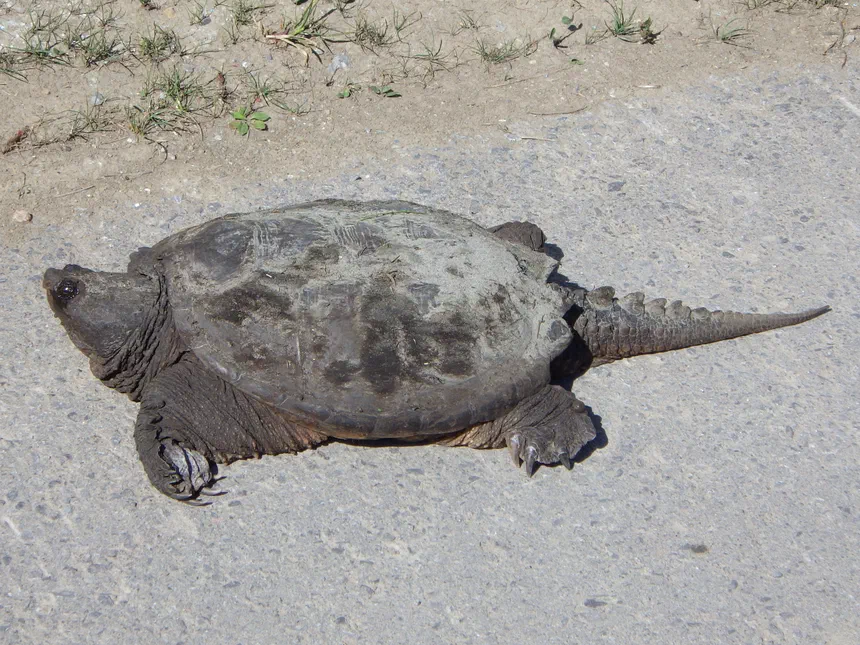
The common snapping turtle (Chelydra serpentina) is a large freshwater turtle native to North America, best known for its powerful jaws and rugged, prehistoric appearance. It belongs to the family Chelydridae and spends most of its life in and around slow-moving or still bodies of water. Despite its fearsome reputation on land, it is generally shy and unaggressive when encountered in the water.
Appearance and Identification
Snapping turtles have a broad, muscular body, a large head, and a long, saw-toothed tail that can be nearly as long as the shell. The upper shell, or carapace, is typically dark brown, olive, or black and often carries a coating of algae or mud that helps camouflage the animal. Unlike many turtles, snappers have a small plastron (lower shell) that leaves much of the legs and belly exposed, so they cannot fully withdraw into their shell. This reduced armor is one reason they rely on their strong beak-like jaws for defense. Adults commonly have a carapace length of roughly 8 to 14 inches, with heavier individuals reaching the upper end of the weight range.
Habitat and Range
The species is widespread across central and eastern North America, from southern Canada through the eastern and central United States. It favors permanent freshwater habitats such as ponds, lakes, slow rivers, marshes, and swamps, especially those with soft, muddy bottoms and abundant vegetation where it can bury itself. Snapping turtles tolerate a wide range of conditions and are sometimes found in brackish water near the coast. They are highly aquatic and usually leave the water only to nest or to move between wetlands.
Diet
Common snapping turtles are opportunistic omnivores. Their diet includes fish, frogs, insects, crayfish, snails, worms, small mammals, birds, and other turtles, as well as a substantial amount of aquatic vegetation. They also readily scavenge carrion. Much of their hunting is done by ambush: the turtle lies still on the bottom, partly buried, and lunges at prey that comes within reach. Because they consume both plant and animal matter and clean up dead animals, they play a useful role in the balance of freshwater ecosystems.
Behavior
In the water, snapping turtles are typically calm and prefer to retreat or hide rather than confront a perceived threat. On land, however, they cannot easily escape and may become defensive, striking quickly with their neck and jaws. They spend much of their time resting on the bottom or slowly walking along it, often surfacing only to breathe by extending their long neck to the surface. In colder parts of their range they overwinter buried in mud beneath the water, remaining dormant through freezing months and absorbing limited oxygen through their skin and mouth lining.
Life Cycle and Reproduction
Mating generally occurs in spring and early summer. Females travel over land, sometimes considerable distances, to find suitable nesting sites in sandy or loose soil. A female digs a nest cavity and lays a clutch of roughly 20 to 40 round, leathery eggs, then covers them and departs, providing no further care. Incubation lasts about 2 to 4 months, and as in many turtles, nest temperature influences the sex of the hatchlings. Newly hatched turtles are vulnerable to many predators, and only a small fraction survive to adulthood. Those that do can live several decades, with individuals sometimes exceeding 40 years.
Conservation Status
The common snapping turtle is currently listed as Least Concern by the IUCN, reflecting its broad range and adaptability. Even so, populations face pressures from road mortality, especially of nesting females, along with habitat loss, water pollution, and collection for food. Because turtles mature slowly and reproduce over many years, the loss of adult females can have a lasting impact on local populations, making road crossings and wetland protection important conservation concerns.
Frequently Asked Questions
Are common snapping turtles dangerous to people? They are not aggressive in the water and will usually swim away. On land they may snap defensively, so it is best to observe them from a distance and avoid handling them.
What should I do if one is crossing a road? If it is safe, you can help it across in the direction it was already heading. Handle it only if necessary, keeping well clear of the head, since the neck can reach surprisingly far.
How long do snapping turtles live? In the wild they commonly live around 30 to 45 years, and some individuals survive even longer under favorable conditions.