Reptiles Guide
Saltwater Crocodile
What Is a Saltwater Crocodile? The saltwater crocodile (Crocodylus porosus) is the largest living reptile on Earth and one of the most formidable predators in the tropics. Also called the “saltie” or estuarine crocodile, …
At a glance
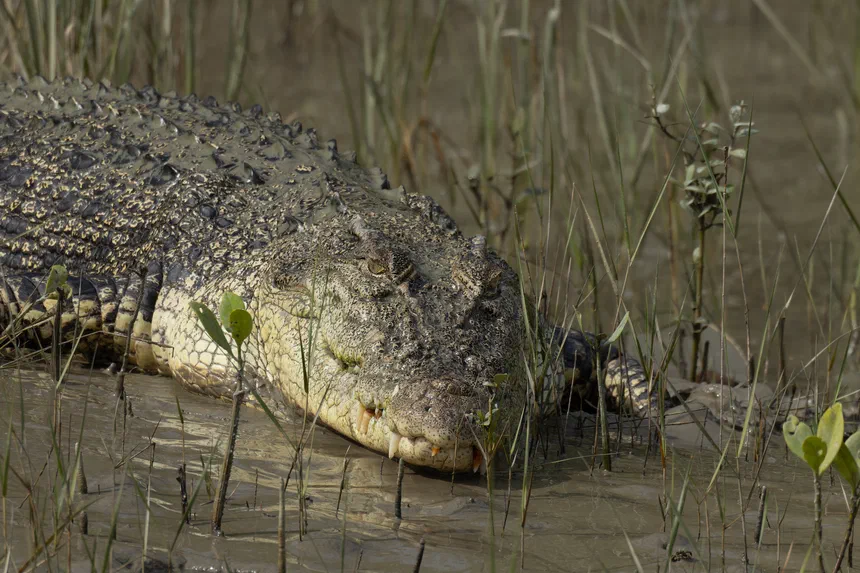
Image: Tisha Mukherjee — CC BY-SA 4.0 · source
What Is a Saltwater Crocodile?
The saltwater crocodile (Crocodylus porosus) is the largest living reptile on Earth and one of the most formidable predators in the tropics. Also called the “saltie” or estuarine crocodile, it ranges across coastal waters from eastern India through Southeast Asia to northern Australia. Despite its name, it thrives in both salt and fresh water.
Appearance and Identification
Saltwater crocodiles have broad, heavy bodies, a long muscular tail, and a relatively wide snout compared with other crocodilians. Adults are typically dark olive, gray, or brownish with faint darker banding on the body and tail, while juveniles are paler yellowish-tan with black markings. The species shows striking size differences between the sexes: mature males commonly reach 16 to 17 feet and can exceptionally approach 20 feet, whereas females rarely exceed about 10 feet. Large males may weigh 2,000 pounds or more. Bony ridges run from the eyes down the snout, and the powerful jaws carry roughly 60 conical teeth adapted for seizing and holding prey.
Habitat and Range
This crocodile occupies brackish and saltwater habitats such as estuaries, tidal rivers, mangrove swamps, coastal lagoons, and river deltas, and it readily moves into freshwater stretches upstream. Its range extends from the eastern coast of India and Sri Lanka through Bangladesh, Myanmar, and the islands of Southeast Asia to New Guinea and the northern coast of Australia. Saltwater crocodiles are strong swimmers and are known to travel long distances at sea, riding ocean currents, which has helped them colonize scattered islands across their vast range.
Diet
As an apex predator, the saltwater crocodile is a generalist carnivore that eats whatever it can overpower. Juveniles feed on insects, crustaceans, small fish, and amphibians, while adults take fish, turtles, birds, wild pigs, monkeys, and mammals as large as water buffalo or livestock that come to drink. It is an ambush hunter, lying nearly submerged before lunging with explosive speed. Prey is often seized at the water’s edge and dragged under, and large items may be dismembered using the powerful “death roll.”
Behavior
Saltwater crocodiles are largely solitary and highly territorial, with dominant males controlling prime stretches of waterway and driving off rivals. They regulate body temperature by basking on banks and retreating to water to cool down. Though capable of bursts of remarkable speed over short distances, they spend much of the day resting. The species is intelligent and can display complex behaviors, including cooperative feeding at times and a keen memory of seasonal food sources. Encounters with humans can be dangerous, and the saltwater crocodile is responsible for attacks across parts of its range.
Life Cycle and Reproduction
Breeding occurs mainly in the wet season. Females build large mounds of vegetation and mud on riverbanks, laying roughly 40 to 60 eggs per clutch. The decomposing nest material helps incubate the eggs, and, as in many reptiles, the temperature of the nest determines the hatchlings’ sex. The female guards the nest and, once the young call from inside the eggs, helps them emerge and carries them gently to the water in her mouth. Despite this care, hatchling survival is low because of predators and environmental hazards. Individuals grow slowly and can live around 70 years in the wild.
Conservation Status
The saltwater crocodile is listed as Least Concern by the IUCN, reflecting a broad recovery in several regions. Heavily hunted for its valuable hide through much of the twentieth century, populations crashed before legal protection and managed programs allowed numbers to rebound strongly in places like northern Australia. Populations remain depleted or threatened in parts of Southeast Asia, where habitat loss and illegal killing persist. Managed farming, ranching, and controlled trade now support conservation while reducing pressure on wild stocks.
Frequently Asked Questions
How big can a saltwater crocodile get? The largest verified males reach about 20 feet and can weigh over a ton, making this the biggest living reptile, though most adults are somewhat smaller.
Can saltwater crocodiles really live in the ocean? Yes. They tolerate salt water thanks to specialized glands that expel excess salt, and they routinely travel along coasts and between islands using ocean currents.
Are saltwater crocodiles dangerous to people? They are among the most dangerous crocodilians and are responsible for attacks on humans, so caution near their habitat is essential.