Reptiles Guide
Panther Chameleon
What Is a Panther Chameleon? The panther chameleon (Furcifer pardalis) is a large, brilliantly colored lizard native to the warm forests of Madagascar. It is one of the most recognizable chameleons in the world, prized …
At a glance
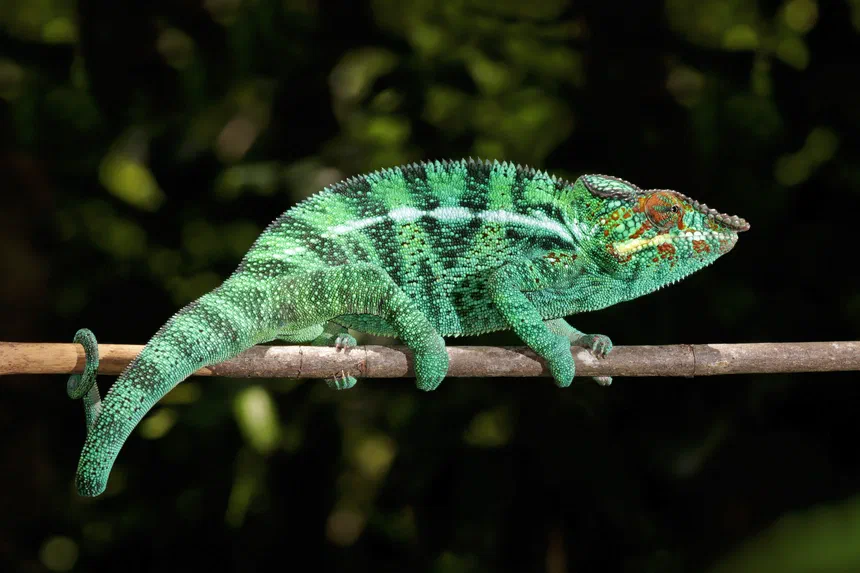
Image: Charles J. Sharp — CC BY-SA 4.0 · source
What Is a Panther Chameleon?
The panther chameleon (Furcifer pardalis) is a large, brilliantly colored lizard native to the warm forests of Madagascar. It is one of the most recognizable chameleons in the world, prized for the dramatic color variation shown by adult males. Like other chameleons, it is a slow-moving, arboreal hunter built for life among branches.
Appearance and Identification
Panther chameleons are among the larger members of the chameleon family. Adult males can reach roughly 15 to 20 inches (38 to 51 cm) in total length, including the long, prehensile tail, while females are considerably smaller, often around half that size. Males are famous for their intense coloration, which varies by geographic population, or “locale.” Depending on their origin, males may display electric blues, fiery reds, deep greens, oranges, or combinations of these, frequently marked with a pale vertical band along the flanks. Females are generally more subdued, showing tans, browns, peaches, and soft oranges. Both sexes have the classic chameleon body plan: independently moving turret-like eyes, a laterally compressed body, zygodactyl feet that grip like pincers, and a coiling tail used as a fifth limb.
Habitat and Range
This species is endemic to Madagascar, where it occupies the warm, humid lowlands of the island’s northern and eastern coasts. It has also been introduced to a few nearby islands, including Réunion and Mauritius. Panther chameleons favor forest edges, scrub, and disturbed areas with plenty of shrubs and small trees, and they are often found near human settlements, plantations, and roadside vegetation. Because color patterns differ so strikingly between regions, individual locales are frequently named after the towns or areas where they occur, such as Nosy Be, Ambanja, and Ambilobe.
Diet
Panther chameleons are primarily insectivores. In the wild they feed on a wide range of invertebrates, including crickets, grasshoppers, locusts, flies, and other insects. They hunt by stalking slowly and then firing out a long, muscular, sticky-tipped tongue that can extend beyond their own body length to snatch prey. Their independently rotating eyes allow them to track potential meals in nearly all directions before locking both eyes forward to judge distance just before the strike.
Behavior
These chameleons are diurnal and largely solitary, spending most of their time perched among branches. They are territorial, and males in particular react strongly to rivals, brightening their colors, flattening their bodies, and gaping to appear larger. Color change in this species serves several purposes beyond camouflage, including temperature regulation and communication of mood, dominance, or readiness to breed. Movement tends to be deliberate and rocking, mimicking a leaf swaying in the wind, which helps them avoid the notice of both predators and prey.
Life Cycle and Reproduction
Panther chameleons are egg-laying reptiles. After mating, a receptive female typically darkens and develops bold markings that signal she is gravid and no longer interested in males. She descends to the ground to dig a burrow, where she deposits a clutch that may range from roughly 10 to 40 eggs. The eggs incubate in the soil for a long period, often several months, before the tiny, independent hatchlings emerge. Young chameleons grow quickly and can reach maturity within their first year. Lifespans are relatively short: males commonly live around 5 to 7 years, while females tend to live less, in part because of the physical demands of repeated egg production.
Conservation Status
The panther chameleon is currently listed as Least Concern by the IUCN, reflecting a wide range and tolerance for disturbed habitats. It is a popular species in the international pet trade, and it is exported from Madagascar under regulated quotas. Ongoing habitat loss from deforestation and the pressures of collection are watched carefully, but at present the species remains relatively common across much of its range.
Frequently Asked Questions
Why are male panther chameleons so colorful? Their bright colors are influenced by their geographic locale and are used for communication, signaling dominance, and attracting mates, as well as for regulating body temperature.
Do panther chameleons change color to match their surroundings? Not exactly. Their color changes reflect mood, temperature, and social signaling more than background matching, though their base tones do provide camouflage.
How big do panther chameleons get? Males are the larger sex, reaching up to about 20 inches (51 cm) including the tail, while females are roughly half that length.