Reptiles Guide
Komodo Dragon
What Is a Komodo Dragon? The Komodo dragon (Varanus komodoensis) is the largest living lizard on Earth and a member of the monitor lizard family. Native to a handful of islands in eastern Indonesia, it is an apex …
At a glance
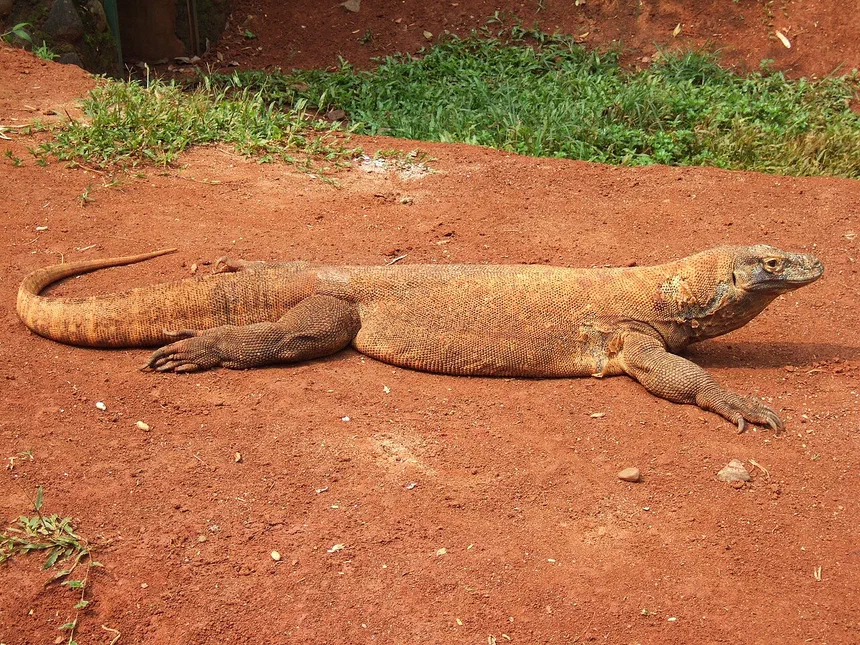
Image: Midori — CC BY-SA 3.0 · source
What Is a Komodo Dragon?
The Komodo dragon (Varanus komodoensis) is the largest living lizard on Earth and a member of the monitor lizard family. Native to a handful of islands in eastern Indonesia, it is an apex predator known for its immense size, powerful build, and formidable hunting ability. Despite the mythic name, it is a real reptile that has fascinated biologists since it was first described by Western scientists in the early twentieth century.
Appearance and Identification
Komodo dragons have a heavy, muscular body carried low on four sturdy legs, a long thick tail, and a broad head. Adults are typically gray to reddish-brown with rough, pebbled skin reinforced by small bony deposits called osteoderms. Large individuals can reach roughly 10 feet (3 meters) in length, though most fall a bit shorter, and heavy specimens may weigh between 150 and 300 pounds. Their curved, serrated teeth and long, deeply forked yellow tongue are among their most recognizable features. The tongue collects airborne scent particles, which a specialized organ in the roof of the mouth interprets to locate food.
Habitat and Range
Komodo dragons live on only a few Indonesian islands, chiefly Komodo, Rinca, Flores, and a couple of smaller neighbors. They favor hot, dry lowland environments such as tropical savanna, open dry forest, and coastal scrub, and they are also seen along beaches. This limited range makes the species especially vulnerable, since the entire wild population is concentrated in a small geographic area with distinct seasonal wet and dry periods.
Diet
As carnivores, Komodo dragons eat a wide range of animals depending on their size and age. Large adults take substantial prey such as deer, wild pigs, and water buffalo, while younger dragons rely more on insects, small reptiles, birds, and eggs. They are also efficient scavengers and will travel considerable distances toward the scent of carrion. A dragon can consume a remarkable amount in a single meal, and after a large feeding it may not need to eat again for weeks.
Behavior
Komodo dragons are mostly solitary and are active during daylight, resting in shade or shallow burrows during the hottest hours. They ambush prey with a sudden burst of speed, then deliver a powerful bite. Their saliva carries abundant bacteria, and they also possess venom glands that release compounds which lower blood pressure and hinder clotting, contributing to the decline of wounded prey. Young dragons spend much of their early life in trees, which helps them avoid larger cannibalistic adults.
Life Cycle and Reproduction
Mating generally occurs in the dry season, and females lay clutches that often contain around twenty eggs. Eggs are deposited in burrows or in the mounds built by megapode birds, where they incubate for roughly seven to eight months before hatching. Hatchlings are fully independent and immediately vulnerable to predators, including other Komodo dragons, so they take to the trees for safety. Females of this species are also capable of parthenogenesis, producing viable eggs without a mate under certain conditions. Komodo dragons grow slowly and can live for about three decades in the wild.
Conservation Status
The Komodo dragon is listed as Endangered by the IUCN. Its naturally small range, low overall population, and dependence on a few islands leave it exposed to habitat loss, human disturbance, poaching of its prey, and the longer-term threat of rising sea levels affecting coastal habitat. Much of its remaining habitat lies within Komodo National Park, where protection and monitoring efforts aim to safeguard the species and its ecosystem.
Frequently Asked Questions
Are Komodo dragons dangerous to humans? They are powerful wild predators and can be dangerous, so attacks on people do happen, though they are uncommon. Visitors in protected areas are required to keep a safe distance and stay with trained guides.
Is the Komodo dragon really venomous? Yes. Research has shown that Komodo dragons have venom glands producing proteins that reduce blood pressure and interfere with clotting, which works alongside their strong bite and bacteria-laden saliva.
Where can Komodo dragons be seen in the wild? They occur only on a few Indonesian islands, with the best-known populations protected inside Komodo National Park on islands such as Komodo and Rinca.