Reptiles Guide
Jungle Carpet Python
What Is a Jungle Carpet Python? The jungle carpet python (Morelia spilota cheynei) is a striking, non-venomous constrictor native to the tropical rainforests of far northeastern Australia. It is one of several regional …
At a glance
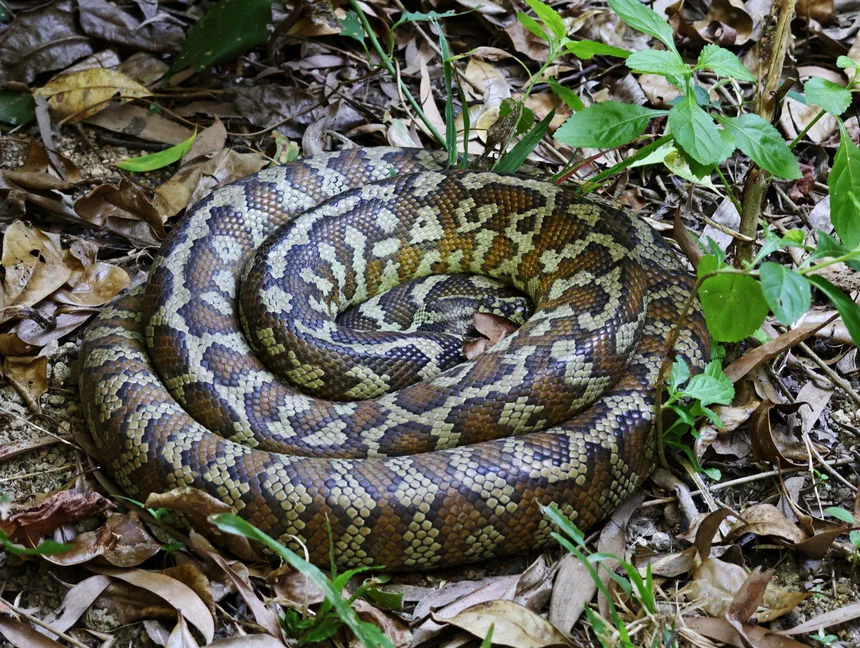
Image: Graham Winterflood — CC BY-SA 4.0 · source
What Is a Jungle Carpet Python?
The jungle carpet python (Morelia spilota cheynei) is a striking, non-venomous constrictor native to the tropical rainforests of far northeastern Australia. It is one of several regional subspecies of the widespread carpet python (Morelia spilota), and it is prized among reptile keepers for its bold black-and-gold patterning.
Appearance and Identification
This is a medium-sized python, most individuals measuring around 5 to 7 feet in length, with a slender, muscular body built for climbing. Its defining feature is the high-contrast coloration: a deep black background broken by bright yellow to golden-yellow blotches, bands, and reticulations. Captive selective breeding has intensified this contrast in many animals, though wild individuals tend to show somewhat more muted, olive-tinged tones. Like other pythons, it has a triangular head with heat-sensing labial pits, vertical pupils, and small, glossy scales. Hatchlings are often duller and darken and brighten with age.
Habitat and Range
The jungle carpet python occupies a relatively small natural range within the Wet Tropics of Queensland, particularly the rainforests and forest margins of the Atherton Tableland and surrounding uplands near Cairns. It favors humid, densely vegetated environments and is frequently found along the edges of watercourses and clearings, where prey is abundant. Being semi-arboreal, it makes use of both the forest floor and the lower canopy.
Diet
As an ambush predator, the jungle carpet python is entirely carnivorous. Its diet consists mainly of small mammals such as rodents and marsupials, along with birds and lizards. Young snakes take smaller prey, including frogs and small lizards, shifting toward warm-blooded prey as they grow. The python kills by constriction, seizing prey in its recurved teeth and coiling around it until the animal stops breathing, then swallowing it whole.
Behavior
This subspecies is largely nocturnal, hunting under the cover of darkness and resting in sheltered spots during the day. It is a capable climber and often waits in ambush, anchored by its tail, ready to strike passing prey. Jungle carpet pythons are generally solitary and can be defensive when disturbed, sometimes striking or musking, though they possess no venom. Their heat-sensing pits allow them to detect warm-bodied prey even in complete darkness.
Life Cycle and Reproduction
Jungle carpet pythons are oviparous, meaning they lay eggs. Mating typically occurs in the cooler months, after which the female produces a clutch that commonly ranges from around 10 to 25 eggs, though clutch size varies with the female’s size and condition. She coils protectively around the eggs and can generate warmth by rhythmically twitching her muscles, a behavior called shivering thermogenesis, helping to incubate them over roughly two months. Hatchlings are independent from birth and receive no further parental care. Individuals typically reach maturity within a few years.
Conservation Status
The jungle carpet python has not been assessed individually by the IUCN, but the carpet python as a whole is listed as Least Concern, reflecting a wide and stable overall population. Within its limited natural range, however, this subspecies can be vulnerable to habitat loss and to collection for the pet trade. It is protected under Australian wildlife legislation, and captive-bred animals now supply most of the international hobbyist demand.
Frequently Asked Questions
Is the jungle carpet python venomous? No. It is a non-venomous constrictor that subdues prey by coiling around it, though a defensive bite from a large individual can still be painful.
How big do jungle carpet pythons get? Most reach about 5 to 7 feet in length, making them a moderately sized python rather than a giant like the reticulated or Burmese python.
Where do they live in the wild? They are native to the tropical rainforests of far northeastern Queensland, Australia, especially the Atherton Tableland region near Cairns.