Reptiles Guide
Jararaca
What Is a Jararaca? The jararaca (Bothrops jararaca) is a venomous pit viper native to southeastern South America. It belongs to the genus Bothrops, a group of lanceheads responsible for the majority of serious …
At a glance
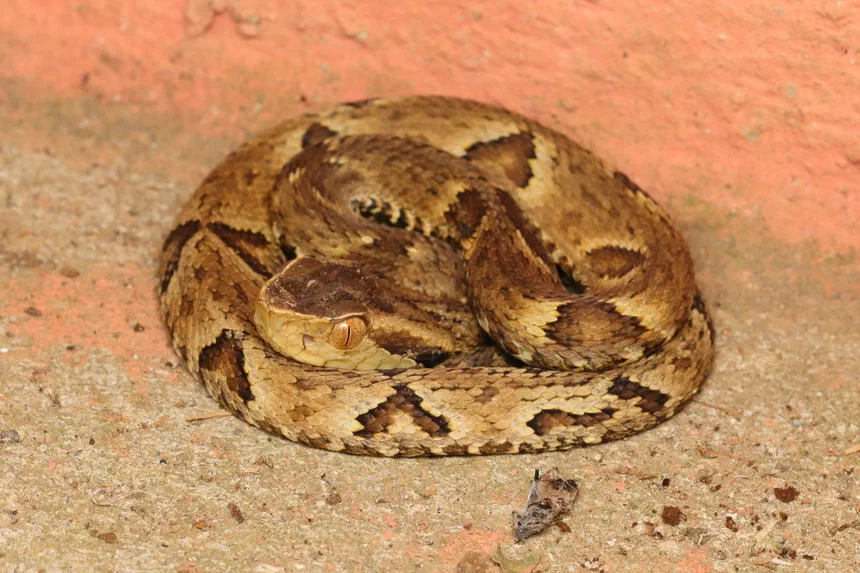
Image: Carlos Alexandre Mattos Raposo — CC BY-SA 4.0 · source
What Is a Jararaca?
The jararaca (Bothrops jararaca) is a venomous pit viper native to southeastern South America. It belongs to the genus Bothrops, a group of lanceheads responsible for the majority of serious snakebites across Central and South America. This slender, ground-dwelling serpent is both feared and scientifically celebrated, since its venom inspired one of the first modern blood-pressure medications.
Appearance and Identification
The jararaca is a moderately slender viper, most adults measuring roughly 60 to 120 centimeters, with large females occasionally approaching 160 centimeters. Its background color ranges from olive and tan to gray-brown, overlaid with a series of dark, roughly triangular or trapezoidal blotches edged in a paler shade along each flank. These markings often meet or alternate along the back, creating an irregular banded pattern that breaks up the snake’s outline among leaf litter. Like all pit vipers, it has a broad, arrow-shaped head that is clearly distinct from the narrow neck, vertical (cat-like) pupils, and a deep heat-sensing pit between each eye and nostril. Keeled scales give the body a matte, slightly rough texture.
Habitat and Range
This species occupies southeastern Brazil, eastern Paraguay, and far northeastern Argentina, thriving in the Atlantic Forest region and surrounding landscapes. It is highly adaptable, occurring in humid forests, forest edges, savanna, grassland, and increasingly in agricultural areas and the outskirts of towns. Because it tolerates disturbed and cultivated land, the jararaca frequently comes into contact with people in rural districts, which contributes to its status as a leading cause of snakebite in the region. It favors places with dense ground cover, moisture, and abundant prey.
Diet
The jararaca is a carnivore and an ambush predator. Adults feed mainly on small mammals, especially rodents, while juveniles rely more heavily on frogs, lizards, and small birds. Young snakes may use the pale tip of their tail as a lure, wiggling it to draw curious prey within striking range. The snake strikes rapidly, injecting venom through hinged front fangs, then releases larger prey and tracks it by scent as the venom takes effect. This strategy reduces the risk of injury from struggling animals and allows the viper to swallow its meal once it is subdued.
Behavior
Largely nocturnal and crepuscular, the jararaca spends daylight hours coiled and motionless among leaf litter, grass, or debris, where its cryptic coloring makes it easy to overlook. It is generally not aggressive but will defend itself vigorously if surprised or stepped on, and can strike quickly from a coiled posture. When threatened it may vibrate its tail against the substrate. The venom is primarily hemotoxic, disrupting blood clotting and damaging tissue; a bite is a genuine medical emergency requiring antivenom, though fatalities are uncommon with prompt treatment.
Life Cycle and Reproduction
The jararaca is viviparous, meaning females give birth to live young rather than laying eggs. After mating, typically in the warmer months, females carry developing embryos internally and produce a litter of around 5 to 20 neonates, with larger females bearing more offspring. Newborns are fully independent and venomous from birth, emerging already equipped to hunt small prey. There is no parental care once the young disperse. Growth is relatively rapid in the first years, and individuals may live roughly 10 to 15 years in the wild, sometimes longer in captivity.
Conservation Status
The jararaca has not been formally assessed by the IUCN, but it remains common and widespread across much of its range. Its tolerance of farmland and disturbed habitats has helped it persist where more specialized species decline. Ongoing loss and fragmentation of the Atlantic Forest could affect local populations, yet there is no evidence of a broad threat at present. The species is of enormous scientific value: study of its venom led to the development of ACE-inhibitor drugs used worldwide to treat high blood pressure.
Frequently Asked Questions
Is the jararaca dangerous to humans? Yes. It is one of the most medically important snakes in South America, and its bite can cause serious bleeding and tissue damage. Bites are rarely fatal when antivenom is given promptly.
Why is the jararaca famous in medicine? Research on its venom in the 1960s revealed peptides that lower blood pressure, leading directly to the creation of captopril and the ACE-inhibitor class of drugs.
Does the jararaca lay eggs? No. It gives birth to live young, producing a litter of independent, venomous neonates rather than laying eggs.