Reptiles Guide
Japanese Rat Snake
What Is a Japanese Rat Snake? The Japanese rat snake (Elaphe climacophora) is a medium-to-large, nonvenomous colubrid snake native to Japan, where it is one of the most familiar and widely encountered serpents. Known in …
At a glance
What Is a Japanese Rat Snake?
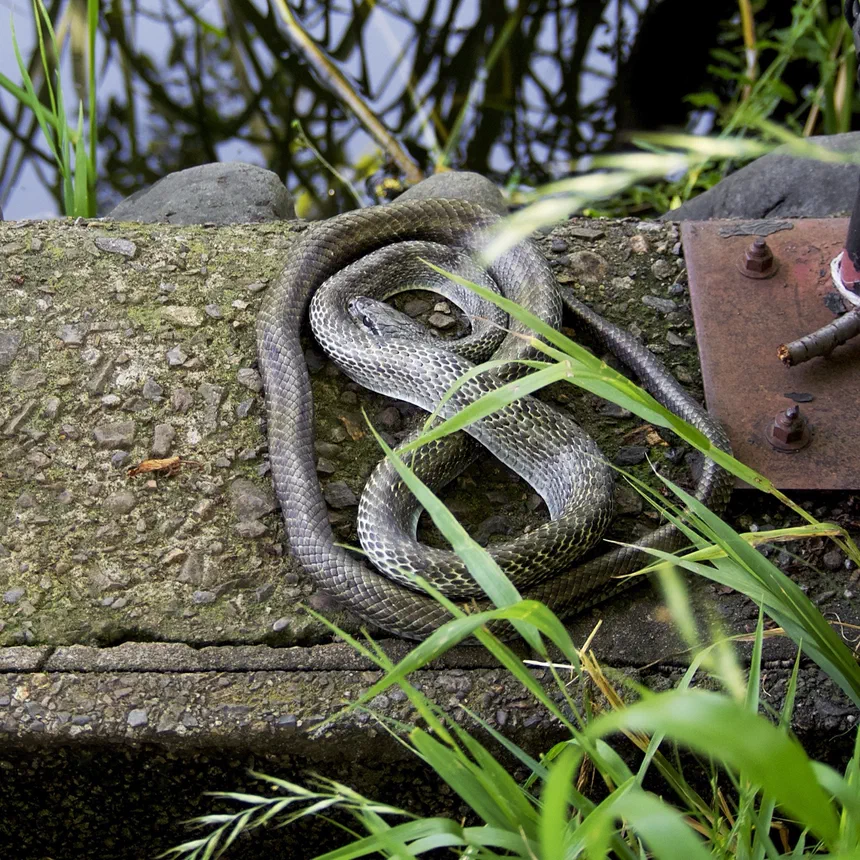
The Japanese rat snake (Elaphe climacophora) is a medium-to-large, nonvenomous colubrid snake native to Japan, where it is one of the most familiar and widely encountered serpents. Known in Japanese as aodaisho, meaning roughly “blue general,” it is a common sight around farms, woodlands, and even rural homes, where it hunts the rodents that give the species its English name.
Appearance and Identification
Adults typically measure around 3.3 to 6.6 feet (1 to 2 meters) in length, with a slender but muscular build. Coloration is variable, ranging from olive-green and yellowish-brown to bluish-gray, often with four faint darker stripes running lengthwise down the body. Juveniles look quite different, sporting a blotched or banded pattern that can cause them to be mistaken for young mamushi vipers. The scales are weakly keeled, giving the snake a slightly rough texture, and the head is relatively narrow with round pupils. A well-known population on Iwakuni is famous for its rare albino individuals, which are protected as a national treasure.
Habitat and Range
This species is endemic to Japan, occurring across the four main islands of Hokkaido, Honshu, Shikoku, and Kyushu, as well as smaller surrounding islands and the disputed island of Kunashir. It is a habitat generalist, thriving in deciduous and mixed forests, grasslands, agricultural fields, riverbanks, and the margins of human settlements. Its comfort around people means it is frequently found in barns, gardens, rice paddies, and the rafters of old buildings, where prey is abundant.
Diet
The Japanese rat snake is a carnivore and an effective predator of small vertebrates. Rodents such as mice and rats make up a large part of its diet, which is one reason it has long been tolerated, and even welcomed, around farms and homes. It also preys on birds and their eggs, frogs, and occasionally lizards. As a constrictor, it seizes prey and coils around it, using pressure to subdue the animal before swallowing it whole. Skilled climbers, these snakes will scale trees and structures to raid nests.
Behavior
Primarily diurnal, though active at dusk in warmer weather, the Japanese rat snake is an agile climber and a capable swimmer. It is generally not aggressive toward people, but when cornered it may flatten its body, release a foul-smelling musk from its cloaca, and strike defensively. In colder parts of its range, the snake enters a period of winter dormancy, sheltering underground or in rock crevices, tree hollows, and building foundations until temperatures rise in spring.
Life Cycle and Reproduction
Breeding takes place in spring, generally from April to June after the snakes emerge from dormancy. Females are oviparous, laying a clutch of roughly 7 to 20 eggs in early to mid-summer, often depositing them in leaf litter, rotting wood, compost, or other warm, humid sites. The eggs incubate for about six to eight weeks before hatching in late summer or early fall. Hatchlings are independent from birth and receive no parental care. Individuals may take a few years to reach sexual maturity and can live for well over a decade in favorable conditions.
Conservation Status
The Japanese rat snake is listed as Least Concern by the IUCN. It remains common and widespread throughout Japan, and its tolerance of human-modified landscapes has helped it persist even as habitats change. Localized threats include road mortality, persecution by people who mistake it for a venomous species, and habitat loss in some areas. The distinctive albino population near Iwakuni receives special legal protection as a designated natural monument.
Frequently Asked Questions
Is the Japanese rat snake venomous? No. It is a nonvenomous constrictor that subdues prey by coiling around it. A bite may be startling but is not dangerous to humans.
Why is it welcomed around Japanese farms? Because it preys heavily on mice and rats, the snake helps control rodent populations around barns, gardens, and rice stores, so it has traditionally been regarded as a helpful guardian.
How can you tell a juvenile from a viper? Young Japanese rat snakes have a blotched pattern that resembles the venomous mamushi, but they have round pupils, a slimmer head, and lack the mamushi’s heat-sensing pits and distinctive coin-shaped markings.