Reptiles Guide
Japanese Pond Turtle
What Is a Japanese Pond Turtle? The Japanese pond turtle (Mauremys japonica) is a small freshwater turtle found only in Japan. A member of the family Geoemydidae, it is one of the country’s most familiar native turtles …
At a glance
What Is a Japanese Pond Turtle?
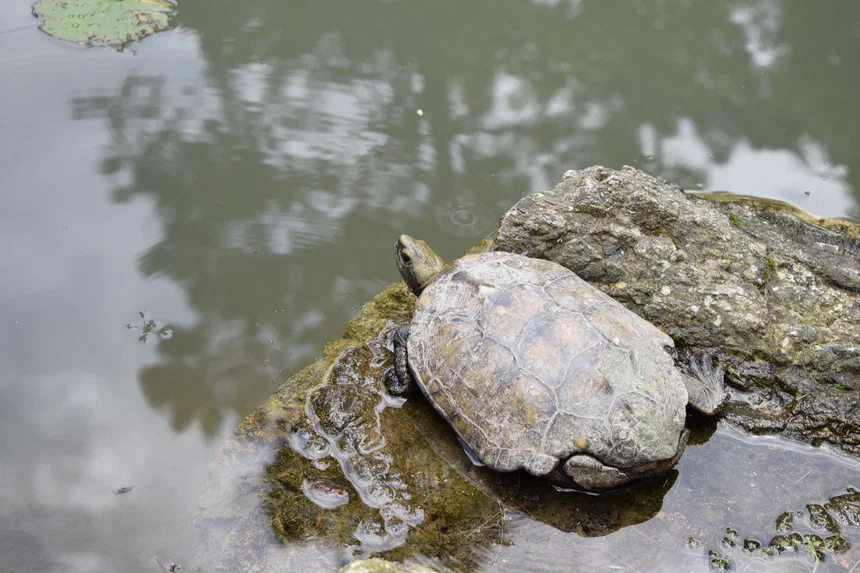
The Japanese pond turtle (Mauremys japonica) is a small freshwater turtle found only in Japan. A member of the family Geoemydidae, it is one of the country’s most familiar native turtles and spends much of its life in and around quiet, slow-moving waters.
Appearance and Identification
This is a modestly sized turtle with a low, oval carapace that typically measures roughly 4 to 8 inches (10 to 21 cm) long, with females generally larger than males. The upper shell ranges from brown to reddish-brown and often carries a weak central keel, while the plastron (lower shell) tends to be dark or yellowish with darker blotches. The head is relatively smooth and olive to brown, and the limbs bear webbed feet suited to swimming. Adult males are usually darker overall and have longer, thicker tails than females. Hatchlings and juveniles frequently show a more pronounced keel and brighter coloring that fades with age.
Habitat and Range
Mauremys japonica is endemic to Japan, occurring on the main islands of Honshu, Shikoku, and Kyushu as well as some smaller surrounding islands. It favors calm, shallow freshwater such as ponds, marshes, irrigation ditches, rice paddies, and the slow reaches of rivers and streams. These turtles prefer waters with soft, muddy bottoms and plenty of vegetation, along with basking sites like logs, rocks, or banks where they can warm themselves in the sun.
Diet
The Japanese pond turtle is an omnivore with a varied, opportunistic diet. It feeds on aquatic insects and their larvae, worms, snails, crustaceans, small fish, tadpoles, and carrion, and it also consumes aquatic plants, algae, fallen fruit, and seeds. Younger turtles tend to be more carnivorous, taking in the protein needed for growth, while adults generally shift toward a more mixed diet that includes greater amounts of plant material.
Behavior
Largely aquatic, this turtle spends most of its time in the water but regularly hauls out to bask, an important behavior for regulating its body temperature. It is generally shy and will slip quickly into the water when disturbed. In colder parts of its range it overwinters by burying into mud or leaf litter at the bottom of ponds and waterways, becoming inactive through the coldest months. Individuals are most active in the warmer seasons, foraging in the shallows and moving between connected water bodies.
Life Cycle and Reproduction
Breeding typically takes place in spring, and females come ashore to nest, usually in late spring or early summer. A female digs a chamber in soft soil near water and lays a clutch of several eggs, often somewhere in the range of a few up to around ten, and may produce more than one clutch in a season. Incubation lasts roughly two to three months depending on temperature, after which the small hatchlings dig out and make their way to water. Growth is slow, sexual maturity takes several years, and individuals can live around 20 to 30 years in the wild.
Conservation Status
The Japanese pond turtle is listed as Near Threatened on the IUCN Red List. Its populations face pressure from habitat loss as wetlands and natural waterways are drained or modified, along with water pollution and road mortality. A particular concern is competition and hybridization with introduced non-native turtles, especially the widely established red-eared slider, which can outcompete the native species and dilute its gene pool. Collection for the pet trade adds further pressure in some areas.
Frequently Asked Questions
Where is the Japanese pond turtle found? It is endemic to Japan, living on Honshu, Shikoku, Kyushu, and some nearby islands in ponds, marshes, rice paddies, and slow streams.
What does it eat? It is an omnivore, feeding on insects, worms, snails, crustaceans, small fish, and carrion as well as aquatic plants, algae, and fruit.
Is the Japanese pond turtle endangered? It is currently classified as Near Threatened, with the main threats being habitat loss, pollution, and competition from introduced turtles such as the red-eared slider.