Reptiles Guide
Jamaican Boa
What Is a Jamaican Boa? The Jamaican boa (Chilabothrus subflavus), also called the yellow snake or “nanka” in local dialect, is a non-venomous constrictor found only on the island of Jamaica. It is the largest native …
At a glance
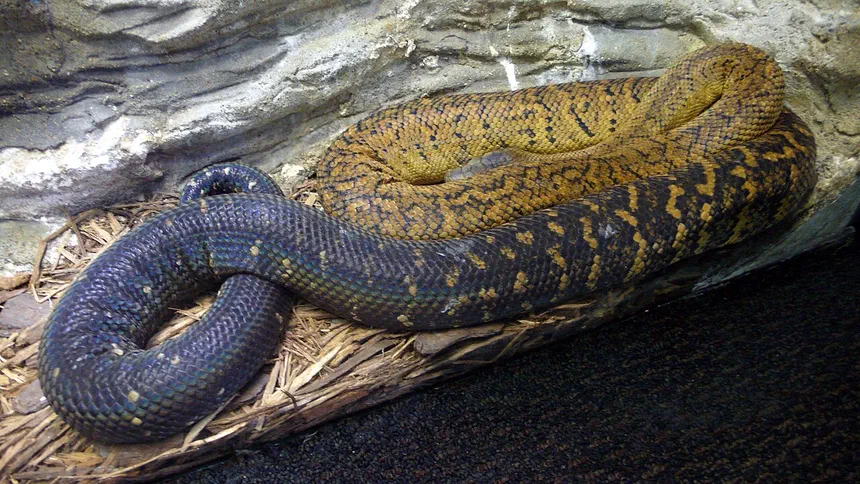
Image: TimVickers — Public domain · source
What Is a Jamaican Boa?
The Jamaican boa (Chilabothrus subflavus), also called the yellow snake or “nanka” in local dialect, is a non-venomous constrictor found only on the island of Jamaica. It is the largest native land predator remaining on the island and one of the Caribbean’s most striking boas, prized for its shifting golden-and-black coloration.
Appearance and Identification
This is a medium-to-large boa, with adults commonly reaching about 6 to 7 feet (roughly 2 meters) in length, though most individuals fall toward the smaller end of that range. Its most memorable feature is a color gradient that runs along the body: the head and forward portion are a warm golden-yellow to orange-tan patterned with dark crossbars, and the pattern darkens toward the tail until the rear third appears glossy black with an iridescent, oil-slick sheen in sunlight. The head is distinct from the slender neck, and the eyes have vertical pupils suited to a partly nocturnal life. Like other boas, it has heat-sensitive pits along the lips that help detect warm-blooded prey in darkness.
Habitat and Range
The Jamaican boa is endemic to Jamaica and a few surrounding cays, meaning it lives nowhere else on Earth. It favors the island’s wet limestone and karst forests, including the rugged Cockpit Country, along with mesic woodlands, caves, and forest edges. Fragmented populations persist across parts of the island, but the snake has disappeared from many areas where forest has been cleared. Caves and their entrances are especially important, since they concentrate one of the boa’s favorite foods.
Diet
As a carnivore and ambush constrictor, the Jamaican boa preys on a variety of small vertebrates. Bats are a signature part of its diet: individuals are known to station themselves at cave mouths and snatch bats from the air as the colony streams out at dusk. Beyond bats, it takes birds, rodents (including introduced rats), lizards, frogs, and other small animals. Prey is seized in the jaws, wrapped in coils, and killed by constriction before being swallowed whole. Young boas rely more heavily on lizards and frogs, shifting toward larger prey as they grow.
Behavior
The Jamaican boa is largely nocturnal and semi-arboreal, climbing readily through trees, vines, and rocky ledges in search of prey and basking sites. It is a solitary, slow-moving snake for much of the year, relying on camouflage and stillness rather than speed. When threatened it may hiss, coil defensively, or bite, but it is not venomous and poses little danger to people. During the day it typically shelters in tree hollows, rock crevices, or cave systems.
Life Cycle and Reproduction
Like all boas, the Jamaican boa is viviparous, giving birth to live young rather than laying eggs. Mating generally occurs in the cooler, drier months, and after a gestation of several months females produce a litter that may range from a handful to more than a dozen neonates, depending on the female’s size and condition. Newborns are independent from birth and receive no parental care. Growth is gradual, and individuals may take several years to reach breeding size. In captivity, where threats are removed, these boas can live roughly 20 to 30 years.
Conservation Status
The Jamaican boa is listed as Vulnerable by the IUCN and is protected under Jamaican law. Its decline stems chiefly from habitat loss as forests are converted to agriculture and development, compounded by predation from introduced mammals such as mongooses, cats, rats, and pigs, which take young snakes and eggs indirectly. Historic persecution driven by fear and folklore has also taken a toll. Zoo breeding programs, protected areas like Cockpit Country, and public-education efforts are central to ongoing recovery work for the species.
Frequently Asked Questions
Is the Jamaican boa venomous? No. It is a non-venomous constrictor that subdues prey by coiling around it. It can bite defensively, but it is not dangerous to humans.
Why is it called the “yellow snake”? The common name refers to the bright golden-yellow coloring across the front half of the body, which contrasts with the darker, glossy rear.
Where can it be found? Only in Jamaica. It is endemic to the island, with important populations in the limestone forests of Cockpit Country and other remaining woodland areas.