Reptiles Guide
Jackson's Chameleon
What Is a Jackson’s Chameleon? Jackson’s chameleon (Trioceros jacksonii) is a medium-sized, tree-dwelling lizard native to the cool highland forests of East Africa. It is best known for the three forward-pointing horns …
At a glance
What Is a Jackson’s Chameleon?
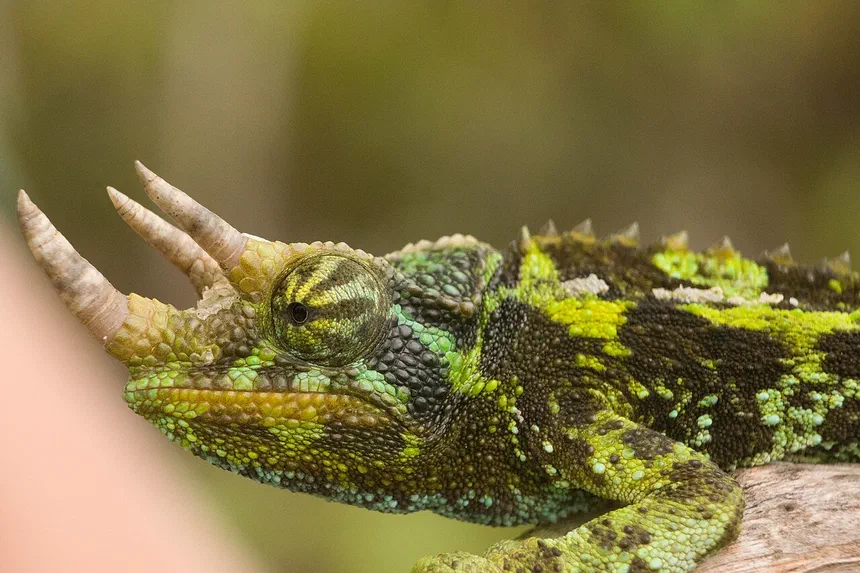
Jackson’s chameleon (Trioceros jacksonii) is a medium-sized, tree-dwelling lizard native to the cool highland forests of East Africa. It is best known for the three forward-pointing horns carried by males, a feature that has earned it comparisons to a miniature Triceratops. Like other chameleons, it can shift its color, grip branches with mitten-shaped feet, and swivel its eyes independently.
Appearance and Identification
Adults are generally bright green, though individuals can flush yellow, brown, or bluish depending on temperature, mood, and light. The species is unmistakable in mature males, which bear three brown, bony-based horns: one on the snout and one above each eye. Females usually lack horns or show only a small nasal bump. A serrated crest runs along the back and throat, the tail is long and prehensile, and the eyes sit in turret-like cones that move separately. Total length, including the tail, is commonly around 9 to 13 inches (23 to 33 cm), with males often slightly larger and more ornamented than females.
Habitat and Range
The natural range of Jackson’s chameleon lies in the highlands of Kenya and northern Tanzania, where it lives in cool, moist montane forest, woodland edges, and shrubby gardens at higher elevations. These animals prefer humid, mild conditions rather than hot lowlands. The species has also become established well outside its native range: populations introduced through the pet trade now thrive in parts of Hawaii, and smaller feral pockets have been reported elsewhere. It is largely arboreal, spending most of its life among branches and dense foliage.
Diet
Jackson’s chameleon is an insectivore that hunts a wide variety of small prey, including crickets, grasshoppers, flies, caterpillars, beetles, and spiders. It hunts by stealth, creeping slowly along a branch and fixing both eyes on a target before firing its long, sticky, projectile tongue to snatch the prey. The tongue can extend well beyond the animal’s body length and strikes in a fraction of a second. Larger individuals may occasionally take small snails or other invertebrates.
Behavior
This chameleon is solitary, slow-moving, and diurnal, relying on camouflage and stillness rather than speed to avoid predators. Color change serves several purposes: regulating body temperature, signaling to rivals or mates, and blending into surroundings. Males can be territorial, using their horns in pushing and shoving contests over branches or females, though serious injury is rare. Their independently rotating eyes give them a nearly all-around field of view, letting them track prey and threats without moving the body.
Life Cycle and Reproduction
Unlike most lizards, Jackson’s chameleon does not lay eggs. Females are ovoviviparous, retaining the eggs internally and giving birth to live young after a gestation of roughly five to six months. A single litter may contain anywhere from about 8 to 30 offspring, which are born fully formed and independent, immediately climbing into vegetation to hunt tiny insects. The young grow quickly and may reach breeding age within a year or so. In the wild, adults typically live around 5 to 10 years, with males often shorter-lived than females.
Conservation Status
The IUCN lists Jackson’s chameleon as Least Concern, reflecting a relatively wide range and stable populations in suitable highland habitat. Even so, it faces pressures from habitat loss, collection for the international pet trade, and the risks that come with fragmented forest. In places where it has been introduced, such as Hawaii, it can affect native insects and snails, making it a species of ecological concern outside its home range.
Frequently Asked Questions
Do female Jackson’s chameleons have horns? Usually not. The three prominent horns are characteristic of adult males; females typically have none or only a small nasal bump.
Are Jackson’s chameleons venomous or dangerous? No. They are harmless to people, with no venom. A cornered chameleon may hiss, gape, or deliver a mild bite, but it poses no real threat.
Why do they change color? Color shifts help with temperature regulation, communication with rivals and mates, and camouflage, rather than simply matching every background they sit on.