Reptiles Guide
Italian Wall Lizard
What Is a Italian Wall Lizard? The Italian wall lizard (Podarcis siculus) is a small, quick-moving lacertid lizard native to Italy and neighboring parts of the northern Mediterranean. Known for its adaptability and bold, …
At a glance
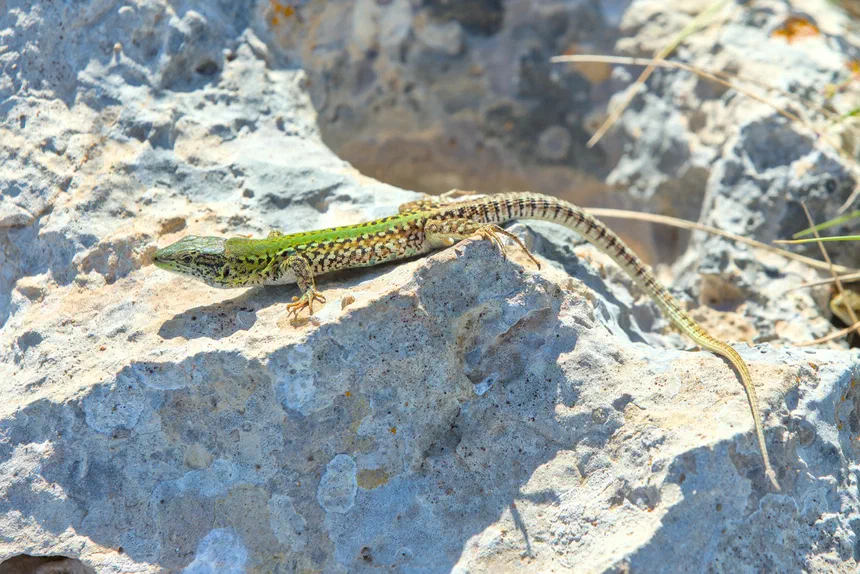
Image: Benjamin Smith — CC BY-SA 4.0 · source
What Is a Italian Wall Lizard?
The Italian wall lizard (Podarcis siculus) is a small, quick-moving lacertid lizard native to Italy and neighboring parts of the northern Mediterranean. Known for its adaptability and bold, sun-loving habits, it is one of the most familiar reptiles across much of its range and has become established in several regions far outside its natural home.
Appearance and Identification
This is a slender, agile lizard with a long tail that often accounts for well over half of its total length. Overall length typically falls between about 6 and 9 inches (15 to 23 centimeters), with the body itself usually measuring around 2 to 3 inches from snout to vent. Coloration is variable but commonly features green or brownish upperparts marked with dark mottling or reticulation; many individuals show vivid green along the back and flanks, especially breeding males, while others are more uniformly brown. The underside is typically pale, ranging from whitish to greenish. Males tend to be larger and more robust than females, with broader heads. Like most wall lizards, it has a pointed snout, well-developed limbs, and clawed toes suited for climbing.
Habitat and Range
The Italian wall lizard is native to Italy, the Adriatic coast, and adjacent areas of the northern Mediterranean, including parts of Slovenia, Croatia, and nearby islands. It thrives in warm, open, sun-exposed environments such as rocky hillsides, stone walls, ruins, hedgerows, vineyards, gardens, coastal scrub, and roadside verges. It is notably tolerant of human-modified landscapes and often lives close to people in towns and villages. The species has also been introduced beyond its native range, with established populations in places such as the United States, where it persists in urban and suburban settings.
Diet
Primarily insectivorous, the Italian wall lizard feeds on a wide variety of small invertebrates, including beetles, flies, ants, spiders, grasshoppers, and caterpillars. It is an opportunistic forager and will also take other small prey when available. Plant material such as fruit, seeds, and flowers can supplement the diet, particularly in island populations, making the species effectively omnivorous under some conditions. It hunts actively during the day, using keen eyesight to detect movement and short, rapid dashes to seize prey.
Behavior
This lizard is diurnal and strongly tied to warmth, basking on rocks, walls, and open ground to raise its body temperature before becoming active. It is fast, alert, and quick to dart into crevices or vegetation when threatened. Males can be territorial during the breeding season, engaging in displays and occasional scuffles with rivals. In cooler parts of its range the species overwinters, retreating to sheltered burrows or crevices during the coldest months and emerging again in spring. Like many lizards, it can shed its tail (autotomy) to escape a predator, later regrowing a shorter replacement.
Life Cycle and Reproduction
Breeding generally takes place in spring and early summer. Females lay clutches of eggs, often several eggs per clutch, in warm, moist soil or under stones and debris, and may produce more than one clutch in a favorable season. The eggs are left to incubate on their own, with hatchlings emerging after several weeks depending on temperature. Young lizards are independent from hatching and grow relatively quickly, reaching maturity within a year or two. In the wild, individuals typically live around three to six years, though survival is often limited by predation.
Conservation Status
The Italian wall lizard is listed as Least Concern by the IUCN. It is abundant across much of its native range, adaptable to disturbed and urban habitats, and not currently considered threatened. Its success as a colonizer means it can even become locally invasive where introduced, sometimes competing with native lizards. Localized pressures such as habitat loss exist, but overall the species remains common and widespread.
Frequently Asked Questions
Are Italian wall lizards dangerous to people? No. They are small, non-venomous, and harmless, and they typically flee rather than confront humans.
Can Italian wall lizards live in cities? Yes. They are highly adaptable and often thrive around walls, gardens, ruins, and other human-made structures.
Do they really grow their tails back? Yes. Like many lizards, they can drop the tail to escape a predator and later regrow a shorter, often differently shaped replacement.