Reptiles Guide
Inland Taipan
What Is a Inland Taipan? The inland taipan (Oxyuranus microlepidotus) is a large, slender elapid snake found in the dry heart of Australia. It is widely regarded as the most venomous land snake in the world, based on the …
At a glance
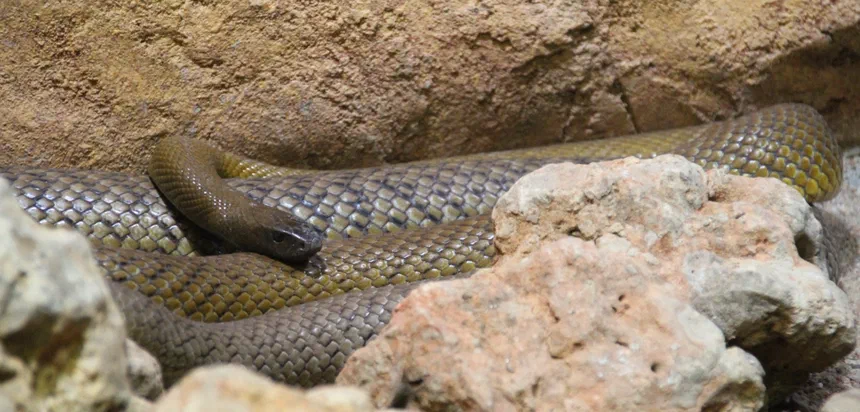
Image: Bjoertvedt — CC BY-SA 3.0 · source
What Is a Inland Taipan?
The inland taipan (Oxyuranus microlepidotus) is a large, slender elapid snake found in the dry heart of Australia. It is widely regarded as the most venomous land snake in the world, based on the toxicity of its venom in standardized laboratory tests. Despite this fearsome reputation, it is a shy, reclusive animal that people rarely encounter.
Appearance and Identification
The inland taipan is a long, athletic snake, typically reaching about 1.8 meters, with large individuals approaching 2.5 meters. Its body color shifts with the seasons, ranging from a rich dark brown in cooler months to a paler olive or straw brown in summer. This seasonal change is thought to help with temperature regulation, allowing the snake to absorb more heat when it is cold and reflect it when temperatures soar. The head is often darker than the body, sometimes appearing nearly black, and the smooth scales are small and closely arranged, which gives rise to the species name microlepidotus, meaning “small-scaled.” The eyes are moderately sized with rounded pupils.
Habitat and Range
This species is restricted to the semi-arid and arid interior of central Australia, mainly where the borders of Queensland, South Australia, the Northern Territory, and New South Wales meet. It favors the black-soil floodplains and cracking clay plains found in this remote region. The deep fissures and cracks that form in these clay soils, along with abandoned animal burrows, provide essential shelter from the extreme daytime heat and cold nights of the outback. Because much of its range is sparsely populated by people, sightings in the wild are uncommon.
Diet
The inland taipan is a specialist mammal hunter, feeding almost exclusively on small and medium-sized mammals, particularly native rodents such as the long-haired rat and the plague rat. It also takes other small mammals and occasionally birds. Rather than releasing prey after a strike, as some venomous snakes do, the taipan often holds onto its target with repeated rapid bites, delivering multiple doses of venom to subdue it quickly. Its population and breeding success tend to rise and fall in step with boom-and-bust cycles of its rodent prey.
Behavior
Contrary to what its potent venom might suggest, the inland taipan is generally calm and retiring. When it senses a person, it usually prefers to retreat into a crack or burrow rather than confront the intruder. It is most active in the morning, basking to warm up before hunting, and it shelters underground during the hottest and coldest parts of the day. If cornered and unable to escape, it can defend itself with astonishing speed, raising the forebody in a loose S-shape before striking accurately. Bites to humans are extremely rare, and recorded cases have generally involved snake handlers.
Life Cycle and Reproduction
Inland taipans reproduce by laying eggs. Mating typically occurs in the cooler months, and females deposit clutches of roughly a dozen or so eggs, often in abandoned burrows or deep soil cracks that offer stable humidity and temperature. The eggs hatch after about two months of incubation, and hatchlings are independent from birth, fully equipped with functional venom to hunt small prey. Reproductive output is closely tied to food availability, so females may produce more than one clutch in a good season when rodents are abundant. In the wild these snakes are thought to live on the order of 10 to 15 years.
Conservation Status
The inland taipan is listed as Least Concern by the IUCN. Its remote, thinly settled range means it faces relatively little direct pressure from humans, and its populations appear stable overall. However, its numbers fluctuate naturally with the availability of prey, and long-term changes to the arid interior, such as altered rainfall patterns or the spread of introduced predators, could affect the small mammals it depends on.
Frequently Asked Questions
Is the inland taipan the most venomous snake in the world? By the standard measure of venom toxicity in laboratory tests, its venom is the most toxic of any land snake. However, it very rarely bites people because it is shy and lives in remote areas.
Is the inland taipan dangerous to humans? In practice, encounters are extremely rare, and the snake almost always tries to flee. Recorded bites have mostly involved handlers, and with prompt antivenom treatment they are survivable.
Where can you find inland taipans? They live in the dry, cracking clay floodplains of central Australia, near where Queensland, South Australia, and neighboring territories meet.