Reptiles Guide
Indian Star Tortoise
What Is a Indian Star Tortoise? The Indian star tortoise (Geochelone elegans) is a small, strikingly patterned land tortoise native to the dry regions of the Indian subcontinent. It takes its name from the radiating, …
At a glance
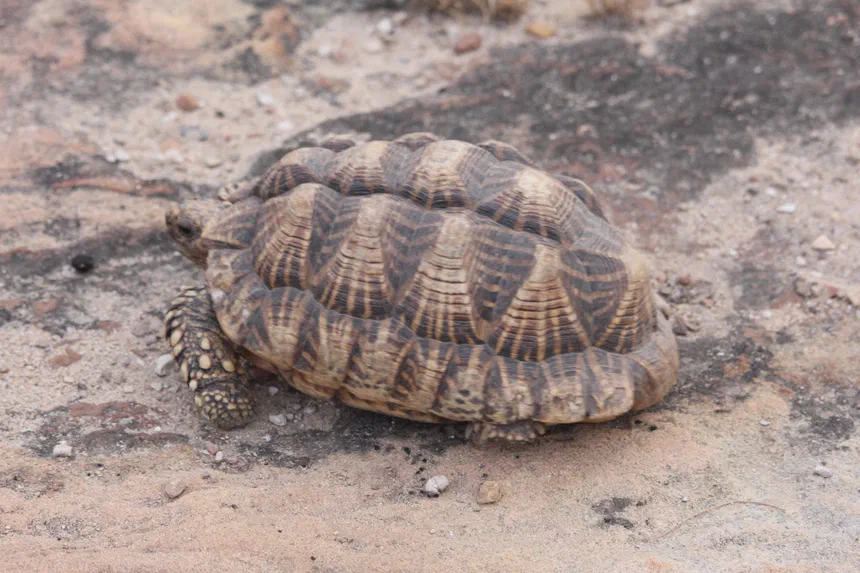
Image: Malaika the jackal researcher — CC BY-SA 4.0 · source
What Is a Indian Star Tortoise?
The Indian star tortoise (Geochelone elegans) is a small, strikingly patterned land tortoise native to the dry regions of the Indian subcontinent. It takes its name from the radiating, star-like yellow lines that spread across each raised scute of its high, domed shell. Prized for that ornate appearance, it is one of South Asia’s most recognizable and heavily trafficked tortoises.
Appearance and Identification
This tortoise has a tall, strongly domed carapace marked with the pale yellow starburst pattern that gives the species its name. Each scute tends to rise into a slight pyramid, especially in older animals, producing a bumpy, sculpted profile. The background color is dark brown to black, and the yellow lines radiate outward from the center of each plate. Adults generally reach a shell length of about 6 to 12 inches (15 to 30 cm). Females are noticeably larger and heavier than males, which stay slimmer with a longer tail; typical weights range from roughly 1 to 5 pounds (0.5 to 2.2 kg).
Habitat and Range
The species occurs across much of India, southeastern Pakistan, and Sri Lanka. It favors dry, seasonal landscapes such as thorn scrub, semi-arid grassland, and open deciduous forest, and it also turns up in coastal dune vegetation and areas of light cultivation. These tortoises are well adapted to environments with a pronounced wet and dry season, shifting their activity to match rainfall.
Diet
Indian star tortoises are herbivores. They graze on grasses and a range of low-growing plants, and also eat leaves, flowers, succulent stems, and fallen fruit. In dry scrub they browse whatever green vegetation is available, and captive animals do best on high-fiber grasses and leafy greens rather than rich or sugary foods. Much of their water comes from the plants they eat, though they will drink and soak when standing water is present.
Behavior
This is a generally solitary, ground-dwelling tortoise that spends its day foraging slowly and seeking shade. Activity is closely tied to weather: during the monsoon the tortoises become most active and often feed and move in the cooler, wetter conditions, while in the hottest, driest stretches they retreat beneath vegetation and reduce their movements. They are not strong burrowers but shelter under bushes, leaf litter, and grass clumps. Unlike some tortoises, they are not territorial, and males contest for mates mainly during the breeding season.
Life Cycle and Reproduction
Breeding is timed around the rainy season, when males follow and jostle females and may bob their heads during courtship. A female digs a flask-shaped nest in the soil and lays a clutch of roughly 3 to 10 eggs, and she may produce more than one clutch in a favorable year. Incubation is lengthy, commonly lasting several months and varying with temperature and moisture. Hatchlings emerge fully independent, already showing faint traces of the star pattern that grows bolder as they mature. Growth is slow, and individuals can live for several decades, with many reaching 30 to 60 years or more.
Conservation Status
The Indian star tortoise is listed as Vulnerable by the IUCN, and it is protected under CITES Appendix I, which bans international commercial trade. Despite these protections, the species is one of the most frequently seized tortoises in the illegal pet trade, with tens of thousands trafficked out of India and neighboring countries. Habitat loss from agriculture and development adds further pressure. Conservation efforts focus on curbing smuggling, repatriating confiscated animals, and protecting remaining dry-scrub habitat.
Frequently Asked Questions
Why is it called a star tortoise? The name comes from the yellow, star-shaped rays that radiate across each raised plate of its dark, domed shell, forming a distinctive starburst pattern.
Is the Indian star tortoise endangered? It is classified as Vulnerable and is heavily affected by illegal collection for the pet trade, which is why it receives the strictest level of international trade protection under CITES.
What do Indian star tortoises eat? They are herbivores that graze on grasses and low plants and also eat leaves, flowers, and fallen fruit, getting much of their moisture from this vegetation.