Reptiles Guide
Indian Python
What Is a Indian Python? The Indian python (Python molurus) is a large, nonvenomous constricting snake native to the Indian subcontinent and neighboring regions of South Asia. It is one of the heaviest and longest snakes …
At a glance
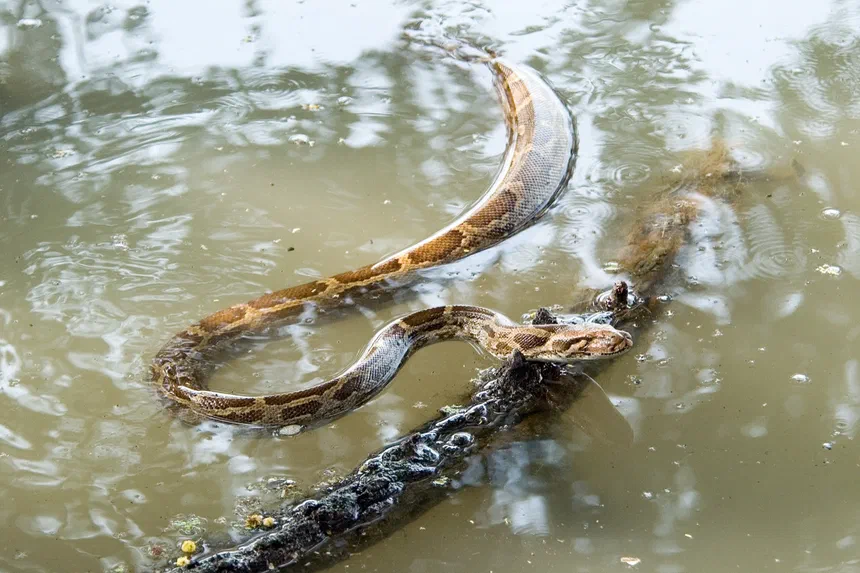
What Is a Indian Python?
The Indian python (Python molurus) is a large, nonvenomous constricting snake native to the Indian subcontinent and neighboring regions of South Asia. It is one of the heaviest and longest snakes in Asia, admired for its patterned skin and its role as a top predator in many ecosystems. It kills prey by constriction rather than venom, coiling around an animal and tightening until the prey can no longer breathe.
Appearance and Identification
The Indian python has a thick, muscular body covered in smooth, glossy scales. Its background color ranges from pale tan and cream to yellowish-brown, overlaid with a series of large, irregular dark brown blotches that run down the back and sides. A distinctive arrow-shaped or lance-shaped marking often appears on top of the head, and a dark stripe typically runs from the eye toward the jaw. Adults commonly reach 3 to 5 meters (about 10 to 16 feet), with exceptionally large individuals growing longer. Heavy-bodied adults can weigh roughly 45 to 70 kilograms. Like other pythons, it retains tiny remnants of hind limbs, visible as small spurs near the base of the tail, and it has heat-sensing pits along the lips that help detect warm-blooded prey.
Habitat and Range
This species occupies a wide variety of habitats across the Indian subcontinent, including Pakistan, India, Nepal, Bangladesh, and Sri Lanka. It favors areas near water, such as riverbanks, swamps, marshes, and mangrove fringes, but it also lives in open grasslands, scrub, rocky foothills, and moist forests. Indian pythons are strong swimmers and are frequently found close to ponds and streams. They shelter in mammal burrows, hollow trees, dense vegetation, rock crevices, and abandoned structures, using these retreats to escape heat and to remain hidden from predators and people.
Diet
The Indian python is a carnivore that ambushes and constricts its prey. Its diet consists mainly of mammals and birds, ranging from rodents and hares to larger animals such as deer, wild pigs, and monkeys, depending on the snake’s size. It seizes prey with backward-curving teeth, then quickly throws coils around the animal and squeezes until circulation and breathing stop. The python then swallows the prey whole, head first, and may take days or weeks to digest a large meal. After a substantial feeding, an adult may not need to eat again for a considerable time.
Behavior
Indian pythons are generally slow-moving and secretive, relying on camouflage rather than speed. They are most active around dawn, dusk, and at night, spending much of the day resting in cover or basking to regulate body temperature. Although primarily terrestrial, they climb well and swim readily, sometimes lying submerged with only the nostrils exposed. They are typically solitary and non-aggressive toward humans, preferring to flee or remain motionless when disturbed. In cooler parts of their range, they may become inactive during colder months, retreating to sheltered spots until temperatures rise.
Life Cycle and Reproduction
Indian pythons are egg-laying snakes. After mating, usually in the cooler season, the female lays a clutch that can number from a couple dozen to around one hundred eggs, depending on her size and condition. She coils protectively around the clutch and can raise her body temperature through rhythmic muscular contractions, a form of shivering that helps incubate the eggs. Incubation lasts roughly two to three months. Hatchlings emerge fully independent, already capable of hunting small prey, and they grow rapidly in their first years. Individuals may live 20 to 30 years in the wild, and often longer in captivity.
Conservation Status
The Indian python is listed as Near Threatened by the IUCN. Its populations face pressure from habitat loss, hunting for skins and meat, collection for the pet trade, and killing due to fear or perceived threat to livestock. The species is protected under national laws in much of its range and is listed on international trade agreements that regulate its commercial use. Conservation depends heavily on preserving wetland and forest habitats and reducing conflict between pythons and people.
Frequently Asked Questions
Is the Indian python dangerous to humans? Indian pythons are nonvenomous and generally shy, posing little danger to people. Large individuals can deliver a powerful bite or constrict if provoked, so they should be observed from a respectful distance.
How is the Indian python different from the Burmese python? The two are closely related and were once considered the same species. The Burmese python (Python bivittatus) tends to be larger and darker with more contrasting markings, while the Indian python is usually lighter in color and somewhat smaller.
What does the Indian python eat? It preys mainly on mammals and birds, from rodents and hares to deer and wild pigs, killing them by constriction and swallowing them whole.