Reptiles Guide
Indian Cobra
What Is a Indian Cobra? The Indian cobra (Naja naja) is a venomous snake native to the Indian subcontinent and one of the most recognizable reptiles in the region. It belongs to the elapid family and is famous for the …
At a glance
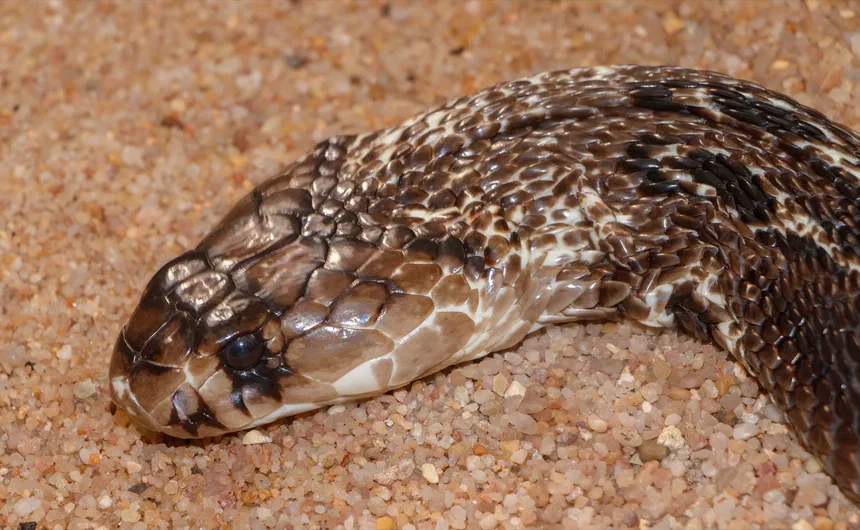
Image: H. Zell — CC BY-SA 3.0 · source
What Is a Indian Cobra?
The Indian cobra (Naja naja) is a venomous snake native to the Indian subcontinent and one of the most recognizable reptiles in the region. It belongs to the elapid family and is famous for the broad hood it spreads when threatened. Deeply woven into South Asian culture and folklore, it is also one of the medically important “big four” snakes responsible for many snakebite cases across India.
Appearance and Identification
The Indian cobra is a medium to large snake, typically about 1 to 1.5 meters long, with some individuals approaching 2 meters. Its coloration is highly variable, ranging from pale tan and yellowish brown to dark gray or glossy black, which helps it blend into local surroundings. The species’ most striking feature is the expandable hood, formed by elongated ribs behind the head, which the snake flattens and raises when alarmed. Many individuals display a distinctive marking on the back of the hood, often shaped like spectacles or a single ring, though some populations lack clear patterning. The scales are smooth, and the body is moderately slender with a rounded head only slightly wider than the neck.
Habitat and Range
This adaptable snake occurs across much of the Indian subcontinent, including India, Pakistan, Bangladesh, Nepal, Sri Lanka, and Bhutan. It thrives in a wide variety of habitats, from dense forests and open grasslands to agricultural fields, wetlands, and rocky terrain. Notably, the Indian cobra is often found near human settlements, where rodents attracted to grain stores and refuse provide easy prey. It shelters in termite mounds, rodent burrows, tree hollows, rock crevices, and abandoned buildings, and it can occur from lowland plains up into moderate hill elevations.
Diet
The Indian cobra is a carnivore that feeds primarily on rodents such as rats and mice, making it a valuable natural check on crop pests. Its diet also includes frogs, toads, lizards, birds and their eggs, and other snakes. Prey is subdued using potent venom delivered through fixed front fangs; the venom contains neurotoxins and other components that immobilize the animal before it is swallowed whole. Because rodents flourish around farms and villages, cobras are frequently drawn into these areas in search of food.
Behavior
Indian cobras are active by day and night, though they often become more nocturnal during hot weather to avoid extreme heat. When confronted, a cobra typically tries to flee, but if cornered it raises the front of its body, spreads its hood, and may hiss loudly as a warning display. This posturing is largely defensive, intended to intimidate rather than attack. The species is generally not aggressive and will bite mainly when threatened, stepped on, or handled. Despite this, its close association with human environments means encounters are relatively common, and its venom makes it medically significant.
Life Cycle and Reproduction
Indian cobras are egg-laying reptiles. Mating usually occurs in the warmer months, and the female typically lays a clutch of around 10 to 30 eggs, often in a sheltered spot such as a burrow, termite mound, or leaf litter. Females may remain near the eggs to guard them during the incubation period, which generally lasts about 50 to 70 days depending on temperature. Hatchlings emerge fully independent and already venomous, capable of spreading a small hood and fending for themselves from birth. Young cobras grow quickly and reach maturity within a few years, and wild individuals may live roughly 15 to 25 years under favorable conditions.
Conservation Status
The Indian cobra is listed as Least Concern by the IUCN, reflecting its wide distribution and adaptability. It is nonetheless protected under wildlife legislation in India, in part to curb exploitation for the skin trade and the snake-charming practice. Localized threats include habitat loss, road mortality, and killing by people out of fear. Because the species helps control rodent populations, it plays a beneficial ecological and agricultural role, and conservation efforts increasingly emphasize reducing human-snake conflict through awareness and safe relocation.
Frequently Asked Questions
Is the Indian cobra dangerous to humans? Yes. It is highly venomous and one of India’s medically important snakes, but it usually bites only when threatened, and effective antivenom exists.
Why does the Indian cobra spread its hood? The hood is a defensive display. By flattening elongated neck ribs, the snake appears larger and more intimidating to deter potential predators or threats.
What does the Indian cobra eat? It mainly eats rodents, along with frogs, lizards, birds, eggs, and other snakes, which is why it is often found near farms and villages.