Reptiles Guide
Green Iguana
What Is a Green Iguana? The green iguana (Iguana iguana) is a large, tree-dwelling lizard native to the tropics of the Americas. It is one of the most recognizable reptiles in the pet trade and one of the biggest lizards …
At a glance
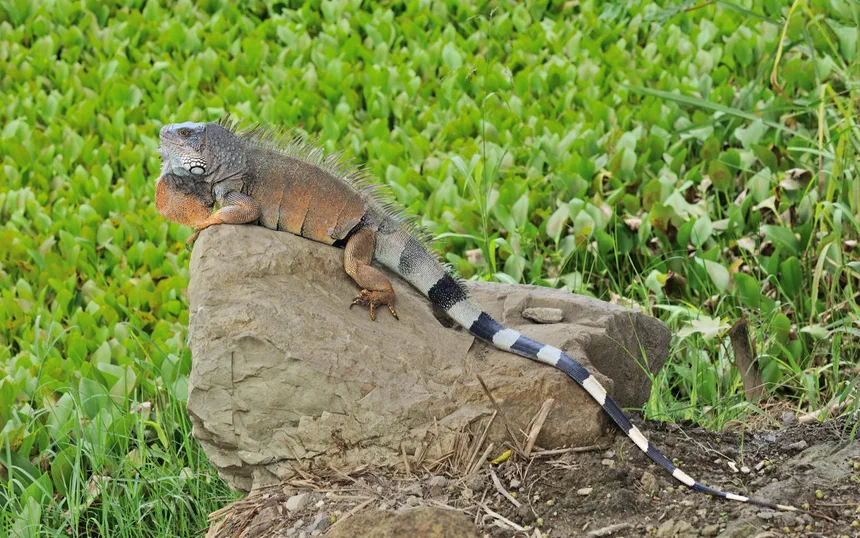
Image: Cayambe — CC BY-SA 3.0 · source
What Is a Green Iguana?
The green iguana (Iguana iguana) is a large, tree-dwelling lizard native to the tropics of the Americas. It is one of the most recognizable reptiles in the pet trade and one of the biggest lizards in its range, prized for its striking crest of spines and long, banded tail. Despite its name, its color can range from bright green to dull gray or even orange.
Appearance and Identification
Green iguanas are unmistakable among American lizards. Adults commonly reach 5 to 6 feet (1.5 to 1.8 m) in total length, with the tail accounting for well over half of that measurement. Large males may weigh 8 to 11 pounds (3.5 to 5 kg), while females are typically smaller and lighter. A row of tall, comb-like spines runs down the neck, back, and tail, and a prominent flap of skin called the dewlap hangs beneath the chin. One of their most distinctive features is a large, round scale beneath the eardrum known as the subtympanic plate. Mature males often develop heavier jowls and can take on orange or coppery tones, especially during the breeding season.
Habitat and Range
The species occurs naturally from Mexico south through Central America and into much of tropical South America, including parts of the Amazon basin, as well as on many Caribbean islands. Green iguanas favor lowland tropical rainforest and are strongly associated with rivers, streams, and other water bodies, since they are capable swimmers that dive to escape predators. They are highly arboreal and spend much of their time in the forest canopy, basking on branches that overhang water. Introduced populations have become well established in places such as southern Florida, Hawaii, and several islands, where they are often considered an invasive pest.
Diet
Adult green iguanas are almost entirely herbivorous. Their diet is dominated by leaves, along with flowers, fruit, and tender new growth. They rely on a specialized hindgut and gut microbes to ferment tough plant material, which means a warm body temperature is important for proper digestion. Hatchlings and juveniles sometimes consume small amounts of insects or other animal matter, but the emphasis shifts toward a fully plant-based diet as they mature.
Behavior
These lizards are diurnal, active during daylight and relying on external heat to warm their bodies. They spend long stretches basking to raise their temperature before feeding or moving about. Green iguanas are generally solitary but use body language to communicate, bobbing their heads, extending the dewlap, and posturing to signal dominance or court mates. When threatened, they may flee into water or drop from a branch, and they can defend themselves with sharp claws, a whipping tail, and biting. A tail lost to a predator can partially regenerate.
Life Cycle and Reproduction
Green iguanas reproduce sexually, and breeding is often tied to seasonal patterns in their environment. After mating, the female digs a burrow in sun-warmed soil or sand and lays a clutch that can range from around 20 to more than 50 eggs, depending on her size and condition. The eggs are left to incubate on their own, warmed by the surrounding earth, and hatch after roughly 10 to 15 weeks. Hatchlings are independent from birth and must fend for themselves immediately. Young iguanas grow quickly and typically reach breeding age within a few years.
Conservation Status
The green iguana is listed as Least Concern by the IUCN, reflecting its wide distribution and large overall numbers. It is, however, heavily harvested in parts of its range for meat and eggs and is collected extensively for the international pet trade, which can pressure local populations. Where it has been introduced outside its native range, it can damage gardens, crops, and infrastructure, making it a management concern rather than a conservation one in those regions.
Frequently Asked Questions
Are green iguanas dangerous to people? They are not aggressive by nature, but a frightened or cornered adult can inflict painful bites, scratches, and tail lashes, so they should be handled with care.
Do green iguanas really eat only plants? Adults are essentially herbivorous, feeding on leaves, flowers, and fruit. Young iguanas may occasionally take small invertebrates, but plants form the core of the diet throughout life.
Why are green iguanas a problem in places like Florida? Introduced iguanas thrive in warm climates without natural controls, where they burrow into banks, eat ornamental plants, and multiply rapidly, so they are treated as an invasive species there.