Reptiles Guide
Common House Gecko
What Is a Common House Gecko? The common house gecko (Hemidactylus frenatus) is a small, nocturnal lizard best known for clinging to the walls and ceilings of homes in warm climates. Native to South and Southeast Asia, …
At a glance
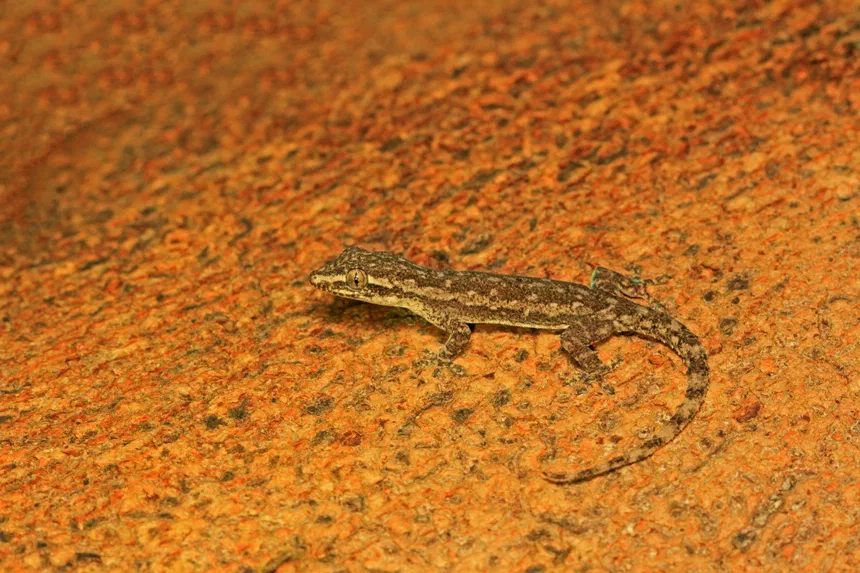
What Is a Common House Gecko?
The common house gecko (Hemidactylus frenatus) is a small, nocturnal lizard best known for clinging to the walls and ceilings of homes in warm climates. Native to South and Southeast Asia, it has spread across much of the tropical and subtropical world, often hitchhiking on ships and cargo. Its familiar chirping call and habit of hunting insects near lights have made it one of the most widely recognized reptiles living alongside people.
Appearance and Identification
This is a slender, soft-bodied gecko usually measuring 3 to 6 inches (7.5 to 15 cm) from snout to tail tip, with the tail making up roughly half that length. Its skin is typically pale gray, tan, or pinkish and can appear almost translucent, often with faint mottling or darker bands that help it blend against light-colored walls. Like many geckos, it has large, lidless eyes with vertical pupils and specialized toe pads covered in microscopic bristles called setae, which let it walk up smooth vertical surfaces and across ceilings. The tail can be shed to escape predators and later regrown, though the replacement is usually shorter and less patterned.
Habitat and Range
The species is native to the Indo-Pacific region of South and Southeast Asia but is now genuinely pantropical, established across parts of Africa, Australia, the Pacific islands, Central and South America, and the warmer parts of North America. In its natural range it occupies tropical forests, rock faces, and vegetation, but it thrives especially well in and around human structures. Warm walls, porches, and outdoor lights offer both shelter and a steady supply of insect prey, which is a major reason the gecko has colonized new regions so successfully.
Diet
The common house gecko is an insectivore. It feeds on a wide variety of small invertebrates, including moths, mosquitoes, flies, ants, cockroaches, spiders, and other arthropods. It commonly hunts near artificial lights at night, where flying insects gather in abundance. This diet makes the gecko a welcome guest in many households, since it helps reduce populations of pest insects.
Behavior
Primarily nocturnal, house geckos spend the day hidden in crevices, behind furniture, or under bark and emerge at night to forage. They are territorial, and males in particular defend feeding and resting sites, sometimes engaging in displays or brief scuffles with rivals. The species is notably vocal for a lizard, producing a distinctive chirping or clicking call used in territorial and mating contexts. Where it has been introduced, the common house gecko is often an aggressive competitor and can displace other gecko species from prime habitat around buildings.
Life Cycle and Reproduction
Reproduction occurs year-round in suitably warm climates. Females typically lay clutches of two hard-shelled eggs, and a single female may produce several clutches over a breeding season. The eggs are often deposited in sheltered spots such as wall cracks, behind loose bark, or in stored materials, which further aids the animal’s spread through human transport. Incubation lasts roughly one to three months depending on temperature, and hatchlings are independent from birth. Individuals generally reach maturity within about a year and live around five years in the wild, sometimes longer in protected conditions.
Conservation Status
The common house gecko is listed as Least Concern by the IUCN. It is abundant, adaptable, and expanding its range rather than declining. In fact, its main conservation relevance is as an invasive species: in several introduced regions it competes with and can outcompete native geckos, raising concerns for local biodiversity even as its own populations remain secure.
Frequently Asked Questions
Are common house geckos dangerous to people? No. They are harmless, non-venomous, and shy, and they benefit households by eating pest insects such as mosquitoes and cockroaches.
Why do house geckos make chirping sounds? The chirps are vocal signals used mainly by males to defend territory and attract mates, which is unusual behavior among lizards.
Can house geckos really walk on ceilings? Yes. Their toe pads are covered in millions of tiny hairlike setae that create weak molecular adhesion, allowing them to cling to smooth surfaces and hang upside down.