Reptiles Guide
Desert Horned Viper
What Is a Desert Horned Viper? The desert horned viper (Cerastes cerastes) is a small, venomous snake of the family Viperidae that is superbly adapted to life in the deserts of North Africa and the Middle East. It is …
At a glance
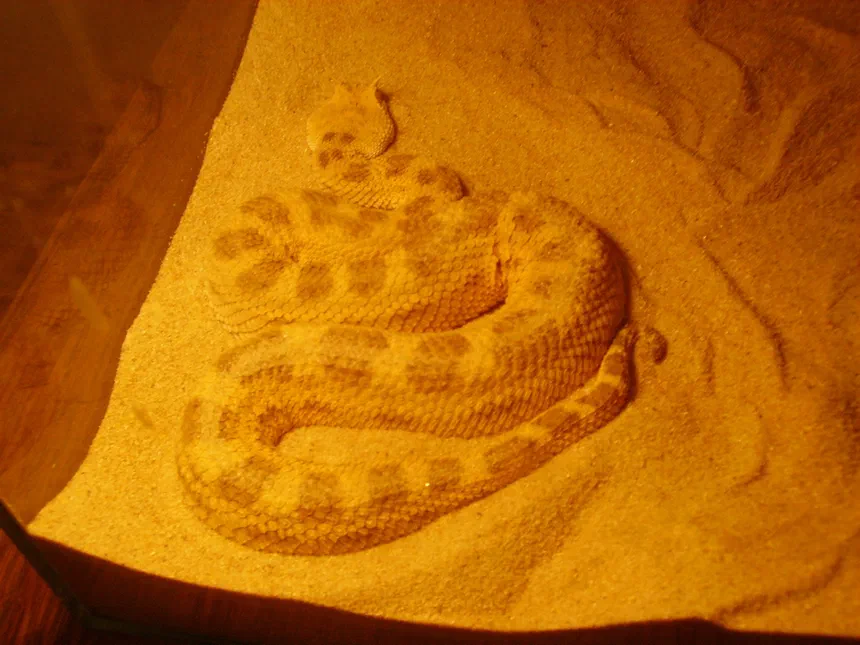
Image: J. Polák — CC BY-SA 4.0 · source
What Is a Desert Horned Viper?
The desert horned viper (Cerastes cerastes) is a small, venomous snake of the family Viperidae that is superbly adapted to life in the deserts of North Africa and the Middle East. It is most easily recognized by the pair of hornlike scales that often project above its eyes, giving the species its common name.
Appearance and Identification
This is a stout, relatively short viper, with most adults measuring roughly 30 to 60 cm in length; females tend to be larger than males. The body color closely matches the surrounding sand, ranging from pale yellow and sandy tan to grayish or reddish tones, usually overlaid with rows of darker brown blotches that help break up the snake’s outline. The head is broad, triangular, and distinct from the neck. Many individuals carry a single upright, hornlike scale above each eye, though some populations and individuals lack these “horns” entirely. The keeled scales along the flanks are angled, producing a slightly serrated appearance that assists with movement and burrowing.
Habitat and Range
The desert horned viper occupies arid and semi-arid environments across a wide belt of North Africa, from Morocco and Mauritania eastward through the Sahara, and into the Arabian Peninsula and parts of the Middle East. It favors sandy plains and dunes but also uses rocky desert, gravel flats, and dry scrubland, often near sparse vegetation or oases where prey gathers. Loose, wind-blown sand is especially important, as the snake relies on it to conceal itself.
Diet
As a carnivore, the desert horned viper preys mainly on small desert animals. Its diet includes rodents and other small mammals, lizards, and occasionally ground-dwelling or roosting birds. It is primarily an ambush hunter: the snake buries itself in the sand with only its eyes and the top of its head exposed, then strikes rapidly when prey wanders within reach. Its venom immobilizes prey, which is then swallowed whole. Like many desert reptiles, it can survive long intervals between meals and obtains much of its water from the bodies of its prey.
Behavior
The species is largely nocturnal, especially during the hot summer months, becoming active at dusk and through the night when temperatures drop. During the day it shelters beneath the sand or in the shade of rocks and burrows. To bury itself, the viper rocks its body from side to side and shuffles downward until only a thin layer of sand covers it. On open dunes it frequently moves by sidewinding, a looping, sideways motion that reduces contact with hot sand and provides traction on shifting surfaces. When threatened, it may rub its coiled body segments together, producing a rasping, hissing sound as a warning before it strikes.
Life Cycle and Reproduction
The desert horned viper is oviparous, meaning females lay eggs rather than giving live birth. Mating generally occurs in the spring, and females deposit a clutch of roughly 8 to 20 eggs, often hidden beneath rocks or in abandoned burrows where conditions are more stable. The eggs incubate for several weeks before hatching. Young emerge as miniature versions of the adults, fully equipped with venom and capable of hunting small prey on their own. Under favorable conditions, wild individuals may live for a decade or more.
Conservation Status
The desert horned viper is currently listed as Least Concern by the IUCN. It has a broad geographic range and remains common across much of its habitat, and its cryptic, burrowing lifestyle in remote desert terrain buffers it from many human pressures. Localized threats can include collection for the pet trade and habitat disturbance, but no major range-wide population decline has been documented.
Frequently Asked Questions
Is the desert horned viper venomous to humans? Yes. Its bite delivers venom that can cause pain, swelling, and tissue damage, and bites should always receive prompt medical attention, though fatalities are uncommon with proper treatment.
Why does it have horns? The hornlike scales above the eyes may help shade or protect the eyes and shed sand, but not every individual has them; some populations are hornless.
How does it move across loose sand? It commonly uses sidewinding, a sideways looping motion that limits contact with hot sand and prevents slipping on unstable dune surfaces.