Reptiles Guide
Hermann's Tortoise
What Is a Hermann’s Tortoise? The Hermann’s tortoise (Testudo hermanni) is a small, land-dwelling Mediterranean tortoise well known for its brightly patterned shell and gentle, slow-moving habits. It belongs to the genus …
At a glance
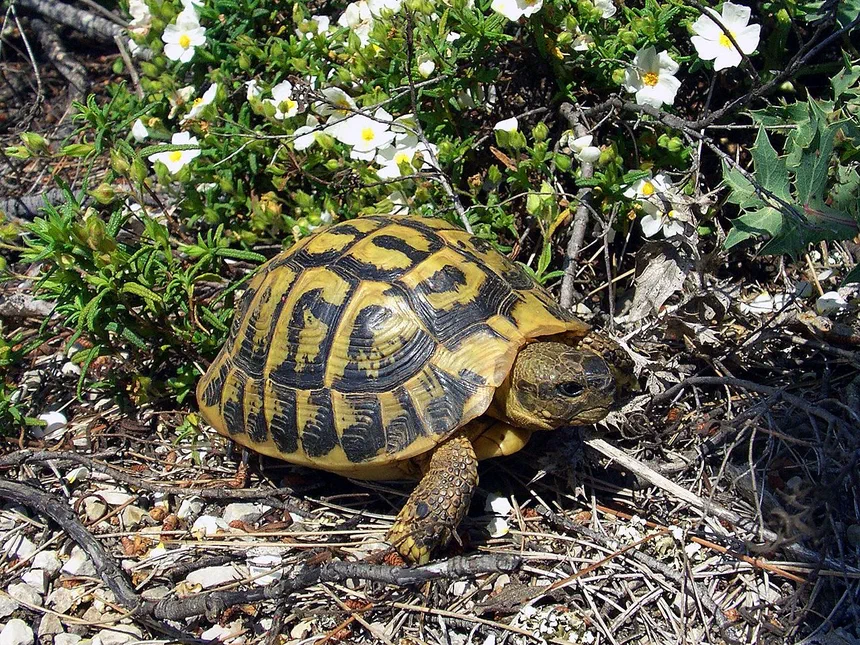
Image: Orchi — CC BY-SA 3.0 · source
What Is a Hermann’s Tortoise?
The Hermann’s tortoise (Testudo hermanni) is a small, land-dwelling Mediterranean tortoise well known for its brightly patterned shell and gentle, slow-moving habits. It belongs to the genus Testudo, a group of true tortoises native to Europe, North Africa, and western Asia, and is one of the most familiar tortoises kept in captivity.
Appearance and Identification
Hermann’s tortoises have a domed, oval carapace marked with a striking mosaic of yellow and dark-brown to black blotches, though the exact pattern fades and varies with age. Adults typically measure about 6 to 8 inches (15 to 20 cm) in shell length, with animals from the western part of the range tending to be smaller than their eastern relatives. The head and limbs are covered in tough, scaly skin, and the forelimbs bear stout claws for digging and walking. A distinctive feature is the horny, slightly upturned tip at the end of the tail, and most individuals have a divided plate above the tail. Males generally have longer, thicker tails and a slightly concave underside, while females are often a little larger overall.
Habitat and Range
This species is found across southern Europe in a band around the Mediterranean, including parts of Spain, France, Italy, the Balkans, and Greece, as well as several Mediterranean islands. Two main forms are usually recognized: a western population and a larger eastern population. Hermann’s tortoises favor warm, dry landscapes such as evergreen Mediterranean scrub, grassy meadows, hillsides, and open woodland with plenty of low vegetation for cover and grazing. They rely on sunny, well-drained ground where they can bask and forage.
Diet
Hermann’s tortoises are herbivores that graze on a wide variety of low-growing plants. Their natural diet centers on leafy greens, wildflowers, clover, dandelions, and other broadleaf herbs, supplemented by the occasional fruit or flower. This high-fiber, low-protein forage suits their slow metabolism, and they obtain much of their moisture from the plants they eat. On rare occasions they may nibble on carrion or invertebrates, but plant material makes up nearly all of what they consume.
Behavior
These tortoises are active by day, especially in the milder hours of spring and autumn, and they spend much of their time slowly foraging and basking to raise their body temperature. During the hottest part of summer they may become less active, and in the cool months they dig into loose soil or leaf litter to brumate, a reptilian form of winter dormancy, through the coldest weather. Hermann’s tortoises are generally solitary, though males can become territorial and combative during the breeding season, sometimes ramming and nipping at rivals or at females during courtship.
Life Cycle and Reproduction
Mating typically takes place in spring after tortoises emerge from brumation, and sometimes again in autumn. A female digs a shallow nest in warm soil and lays a clutch of roughly 2 to 12 eggs, occasionally producing more than one clutch in a season. The eggs incubate for around 8 to 12 weeks, and as in many reptiles the temperature of the nest influences the sex of the hatchlings. Newly hatched tortoises are only a couple of inches long and must fend for themselves immediately, facing heavy predation from birds and mammals. Growth is slow, and individuals may take a decade or more to reach breeding maturity, after which they can live for many decades.
Conservation Status
The Hermann’s tortoise is listed as Near Threatened by the IUCN, with populations declining in much of its range. The main threats include habitat loss from agriculture, development, and wildfire, along with collection for the pet trade and mortality on roads and from farm machinery. Both the western and eastern forms are protected under international and regional wildlife laws, and conservation efforts focus on habitat protection, captive breeding, and controlling illegal trade.
Frequently Asked Questions
How big does a Hermann’s tortoise get? Most adults reach a shell length of about 6 to 8 inches (15 to 20 cm), with eastern animals often larger than western ones.
What do Hermann’s tortoises eat? They are herbivores that graze on leafy greens, wildflowers, clover, and dandelions, with the occasional piece of fruit.
How long do Hermann’s tortoises live? In the wild they commonly live around 30 to 50 years, and well-cared-for captive animals can live even longer.