Reptiles Guide
Hawksbill Sea Turtle
What Is a Hawksbill Sea Turtle? The hawksbill sea turtle (Eretmochelys imbricata) is a small-to-medium marine turtle named for its narrow, pointed beak, which resembles a bird of prey’s bill. It ranges across tropical …
At a glance
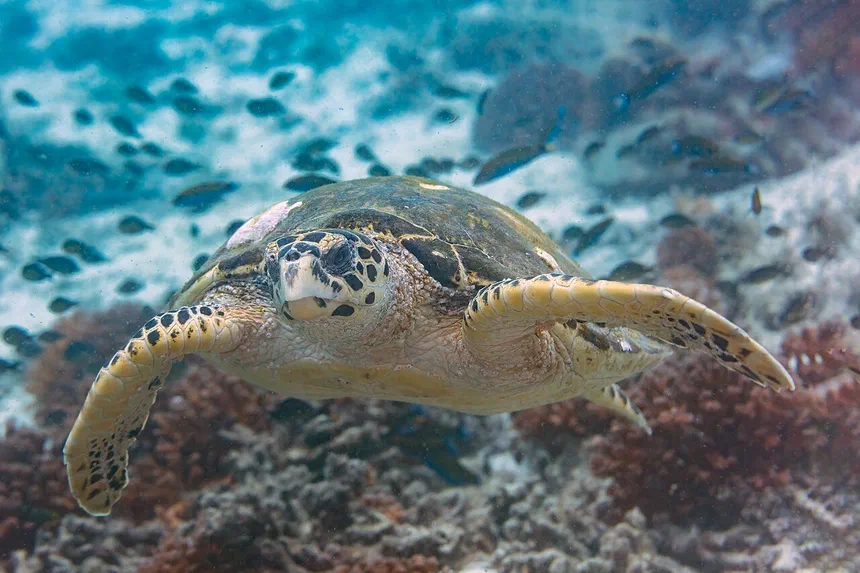
Image: Diego Delso — CC BY-SA 4.0 · source
What Is a Hawksbill Sea Turtle?
The hawksbill sea turtle (Eretmochelys imbricata) is a small-to-medium marine turtle named for its narrow, pointed beak, which resembles a bird of prey’s bill. It ranges across tropical reefs worldwide and is one of the most visually striking of the seven living sea turtle species.
Appearance and Identification
The hawksbill is easily recognized by its beautifully patterned shell, marbled with amber, brown, orange, and black in a “tortoiseshell” mosaic. Unlike most sea turtles, the scutes (plates) on its carapace overlap like roof shingles, giving the rear edge a distinctly serrated, saw-toothed look. Adults typically measure about 25 to 35 inches (65 to 90 cm) in shell length and weigh roughly 100 to 150 pounds (45 to 70 kg). The head tapers to a slender, hawk-like beak, and each front flipper carries two claws. Its striking shell, long prized for jewelry and ornaments, has made the species a target of illegal trade.
Habitat and Range
Hawksbills inhabit tropical and subtropical waters of the Atlantic, Indian, and Pacific oceans. They are closely tied to coral reefs, but also frequent rocky areas, shallow lagoons, mangrove-fringed estuaries, and seagrass beds. Juveniles often drift in the open ocean among floating vegetation before settling onto reefs as they mature. Because they favor reef environments, hawksbills tend to stay in coastal, relatively shallow waters compared with more open-ocean species.
Diet
The hawksbill is best described as an omnivore with a highly specialized preference for sea sponges, which can make up a large portion of its diet in many regions. Its narrow beak lets it reach into crevices and pry prey from reef structures. Some of the sponges it eats contain glass-like silica spicules and toxins that would deter most other animals, making the hawksbill one of the few predators able to exploit them. It also consumes sea anemones, jellyfish, mollusks, small crustaceans, and marine algae. By grazing on sponges, hawksbills help maintain the balance and health of coral reef ecosystems.
Behavior
Hawksbills are generally solitary outside of mating periods. They are agile swimmers that navigate the complex three-dimensional space of reefs with ease, often tucking into caves and overhangs to rest. Individuals show strong site fidelity, returning repeatedly to favored feeding areas. Like other reptiles, they must surface to breathe, but they can remain submerged for extended periods when resting. Hawksbills undertake migrations between feeding grounds and nesting beaches, though these journeys are often shorter than those of some larger sea turtles.
Life Cycle and Reproduction
Hawksbills reach breeding age slowly, generally taking around 20 to 30 years to mature. Females return to nesting beaches, often near where they hatched, typically every two to three years. A nesting female comes ashore at night, digs a pit with her rear flippers, and lays a clutch that commonly contains around 100 to 160 eggs; she may nest several times in a season. Incubation lasts roughly two months, and, as in other sea turtles, nest temperature influences the sex of the hatchlings, with warmer sand producing more females. Emerging hatchlings scramble to the sea and face heavy predation, so only a small fraction survive to adulthood.
Conservation Status
The hawksbill is listed as Critically Endangered by the IUCN. Its populations have declined sharply, driven largely by centuries of hunting for its ornate shell, known in trade as “tortoiseshell.” Additional threats include the loss and degradation of coral reefs, coastal development that destroys nesting beaches, entanglement in fishing gear, plastic pollution, and the effects of climate change on nesting temperatures and reef health. International trade in hawksbill products is banned under CITES, and protection of nesting beaches and reef habitats remains central to recovery efforts.
Frequently Asked Questions
Why is the hawksbill sea turtle endangered? The main historical cause is hunting for its patterned shell to make combs, jewelry, and ornaments. Ongoing threats include reef degradation, nesting-beach loss, bycatch in fisheries, and pollution.
What do hawksbill turtles eat? They feed mainly on sea sponges, using their narrow beaks to reach into reef crevices, and also eat anemones, jellyfish, mollusks, and algae.
How can you tell a hawksbill from other sea turtles? Look for the sharp, hawk-like beak, the richly patterned amber-and-brown shell, and the overlapping scutes that give the shell’s rear edge a serrated, saw-toothed outline.