Reptiles Guide
Green Sea Turtle
What Is a Green Sea Turtle? The green sea turtle (Chelonia mydas) is one of the largest hard-shelled sea turtles and a familiar sight on tropical reefs and seagrass meadows around the world. Its common name refers not to …
At a glance
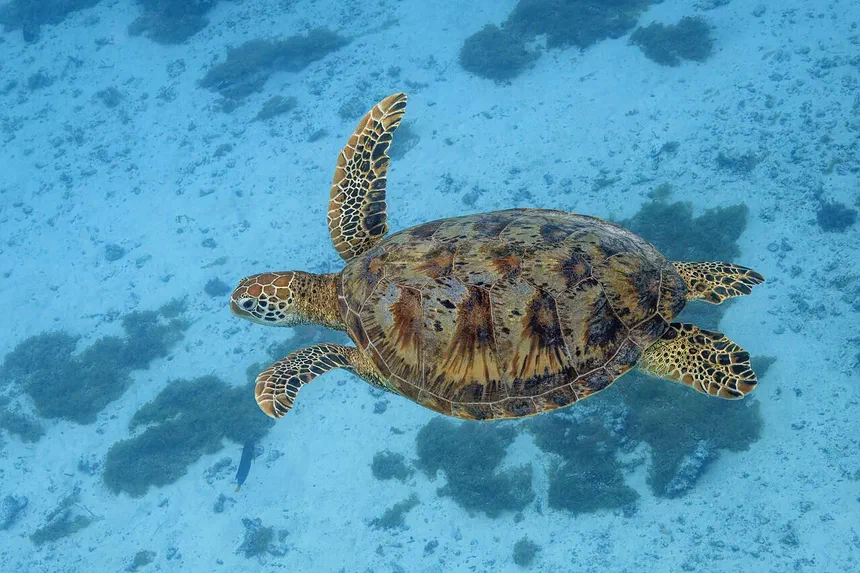
Image: Charles J. Sharp — CC BY-SA 4.0 · source
What Is a Green Sea Turtle?
The green sea turtle (Chelonia mydas) is one of the largest hard-shelled sea turtles and a familiar sight on tropical reefs and seagrass meadows around the world. Its common name refers not to the color of its shell but to the greenish tint of the fat beneath it, a trait linked to its plant-rich diet. As a long-lived, wide-ranging marine reptile, it plays an important role in the health of coastal ecosystems.
Appearance and Identification
Green sea turtles have a broad, low, teardrop-shaped shell, or carapace, that is smooth and streamlined for efficient swimming. The upper shell ranges from olive and brown to gray or nearly black, often marked with radiating or mottled patterns, while the underside is pale yellow to cream. Adults commonly reach shell lengths of three to four feet and weigh a few hundred pounds.
Several features help distinguish this species from other sea turtles. Its rounded head is relatively small, with a single pair of scales between the eyes and a serrated lower jaw suited to cropping vegetation. The front limbs are modified into long, paddle-like flippers, each typically bearing a single visible claw, which the turtle uses to glide gracefully through the water.
Habitat and Range
Green sea turtles inhabit warm tropical and subtropical waters in the Atlantic, Pacific, and Indian oceans. They favor shallow coastal areas rich in seagrass beds and algae, and they are also found around coral reefs, bays, lagoons, and estuaries where food is abundant.
The species leads a complex life across several habitats. Hatchlings and young turtles spend their early years drifting in the open ocean, while older juveniles and adults settle into coastal feeding grounds. Mature turtles often migrate long distances between these feeding areas and the specific beaches where they nest, sometimes crossing hundreds or even thousands of miles.
Diet
Diet changes dramatically as green sea turtles grow. Young turtles are largely omnivorous, feeding on small invertebrates, jellyfish, and other drifting prey along with plant matter. As they mature, they shift toward a mostly herbivorous diet, making them unusual among sea turtles.
Adults graze primarily on seagrasses and marine algae, using their finely serrated jaws to clip and tear vegetation. This constant grazing helps keep seagrass meadows healthy and productive, much as grazing animals maintain grasslands on land, and it supports the many other species that depend on those habitats.
Behavior
Green sea turtles are generally solitary but may gather in numbers at rich feeding grounds or near nesting beaches. They are strong, efficient swimmers, and although they spend most of their lives underwater, they must surface regularly to breathe. When resting, they can remain submerged for long periods, tucking beneath ledges or on the seafloor.
Like other reptiles, they rely on external conditions to regulate body temperature, and in some regions they are known to bask on quiet beaches. Navigation is one of their most remarkable abilities: individuals can travel across vast stretches of open ocean and return to the same nesting and feeding sites, apparently guided in part by the Earth’s magnetic field.
Life Cycle and Reproduction
Green sea turtles mature slowly, often taking decades to reach breeding age. Females return to nest on or near the beaches where they themselves hatched, coming ashore at night during the nesting season. A nesting female digs a chamber in the sand with her rear flippers and lays a clutch of roughly 100 eggs, and she may produce several clutches in a single season before migrating back to her feeding grounds.
The eggs incubate for about two months, and the temperature of the sand influences the sex of the developing hatchlings. Emerging young scramble to the sea under cover of darkness, facing heavy predation from birds, crabs, and fish. Only a small fraction survive to adulthood, which makes the survival of nesting beaches and adult turtles especially important.
Conservation Status
The green sea turtle is classified as Endangered on the IUCN Red List, and populations have declined in many regions. Major threats include the loss of hatchlings to poaching of eggs, the harvesting of adults, accidental capture in fishing gear, coastal development that degrades nesting beaches, pollution, and boat strikes. Climate change poses additional risks by altering nesting beaches and skewing hatchling sex ratios.
Conservation efforts have helped some populations recover. Protected nesting beaches, fishing gear designed to release turtles, legal safeguards, and international cooperation have all contributed to gains in certain areas, though continued protection remains essential.
Frequently Asked Questions
Why is it called a green sea turtle if its shell is not green? The name comes from the greenish color of the fat and tissue under its shell, a result of its plant-based diet, rather than from the color of the carapace itself.
What do green sea turtles eat? Adults feed mainly on seagrasses and algae, while younger turtles also eat invertebrates and other small prey before shifting to a largely herbivorous diet.
How long do green sea turtles live? They are long-lived animals that can survive for 60 to 70 years or more in the wild, though they mature slowly and take many years to reach breeding age.