Reptiles Guide
Green Basilisk
What Is a Green Basilisk? The green basilisk (Basiliscus plumifrons) is a striking tropical lizard native to the rainforests of Central America. Also called the plumed basilisk or double-crested basilisk, it is best …
At a glance
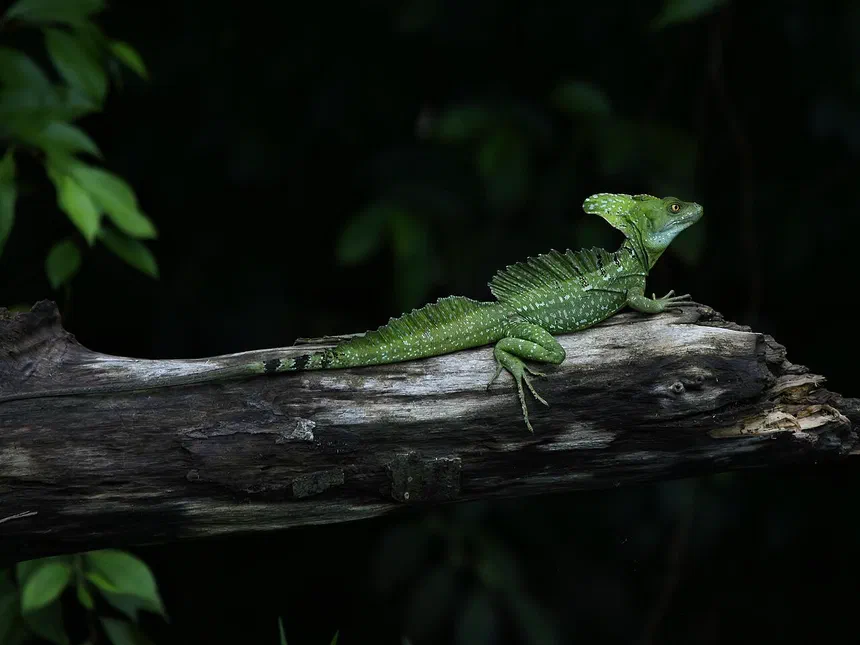
Image: Hans Hillewaert — CC BY-SA 4.0 · source
What Is a Green Basilisk?
The green basilisk (Basiliscus plumifrons) is a striking tropical lizard native to the rainforests of Central America. Also called the plumed basilisk or double-crested basilisk, it is best known for its remarkable ability to sprint across the surface of water, a talent that has earned it the nickname “Jesus Christ lizard.”
Appearance and Identification
Green basilisks are among the most vivid of the basilisk lizards, dressed in a brilliant emerald green often speckled with pale blue and white spots along the flanks. Adults typically reach 60 to 90 centimeters (24 to 36 inches) in total length, though the slender, whip-like tail accounts for well over half of that measurement. Mature males are especially ornate, sporting three prominent crests: one on the head, one along the back, and one on the tail. Females and juveniles have much smaller crests or lack them entirely. The lizard’s long toes are fringed with flaps of skin that help distribute its weight and are central to its famous water-running ability.
Habitat and Range
This species inhabits the humid lowland and foothill rainforests of Central America, ranging from Honduras and Nicaragua south through Costa Rica and into Panama. Green basilisks are strongly associated with water and are almost always found near rivers, streams, ponds, and other permanent water sources within the forest. They are semi-arboreal, spending much of their time perched on branches and vegetation overhanging the water, where they can drop and flee quickly if threatened.
Diet
Green basilisks are opportunistic omnivores. The bulk of their diet consists of insects and other invertebrates such as beetles, grasshoppers, and worms, but they also take small vertebrates including tiny fish, other lizards, and the occasional small mammal or nestling. Plant matter rounds out the menu, with the lizards eating a variety of fruits, flowers, and fresh shoots. Juveniles tend to feed more heavily on insects, gradually incorporating more plant material and larger prey as they grow.
Behavior
The green basilisk’s most celebrated behavior is its ability to run across water on its hind legs. When alarmed, it drops from its perch and dashes across the surface at high speed, its wide, fringed hind toes slapping the water to create momentary pockets of air that keep it from sinking. Smaller, lighter individuals can cover greater distances this way, sometimes traveling many meters before the lizard settles into swimming. Basilisks are also strong swimmers and capable divers, able to remain submerged for extended periods to evade predators. They are diurnal, active during daylight hours, and tend to be shy and quick to flee rather than confront a threat.
Life Cycle and Reproduction
Green basilisks are egg-laying reptiles. Following mating, a female digs a shallow nest in warm, moist soil or leaf litter and deposits a clutch of roughly 5 to 15 eggs. She may produce several clutches over the course of a breeding season. The eggs are left to incubate on their own, with the warmth of the environment determining development, and typically hatch after about two to three months. Hatchlings emerge fully independent and are capable of running, climbing, and swimming almost immediately, receiving no parental care. In the wild, green basilisks generally live around 7 to 10 years.
Conservation Status
The green basilisk is currently classified as Least Concern, as it remains widespread and locally common throughout much of its range. Its adaptability and broad diet help it persist in a variety of forested habitats. Nonetheless, ongoing deforestation and the degradation of streamside habitats pose localized threats, and the species is also collected for the international pet trade. Maintaining healthy, connected rainforest along waterways is the key to keeping populations secure.
Frequently Asked Questions
Can a green basilisk really run on water? Yes. Using its long, fringed hind toes and rapid strides, it can sprint across the surface of ponds and streams for a short distance before it begins to sink and swims the rest of the way.
Are green basilisks dangerous to people? No. They are shy, non-venomous lizards that prefer to flee from any perceived threat rather than bite or attack.
How can you tell a male from a female? Adult males carry much larger and more elaborate crests on the head, back, and tail, while females and young have greatly reduced crests or none at all.
References
The conservation status and key facts in this profile are supported by these sources:
- Animal Diversity Web — Basiliscus plumifrons (accessed 2026-08-06)
- GBIF — Basiliscus plumifrons (accessed 2026-08-06)
Found an error, source problem, or image concern? Report this page.