Reptiles Guide
Green Anole
What Is a Green Anole? The green anole (Anolis carolinensis) is a small, agile lizard native to the southeastern United States and one of the most familiar reptiles in the region’s gardens and woodlands. It is often …
At a glance
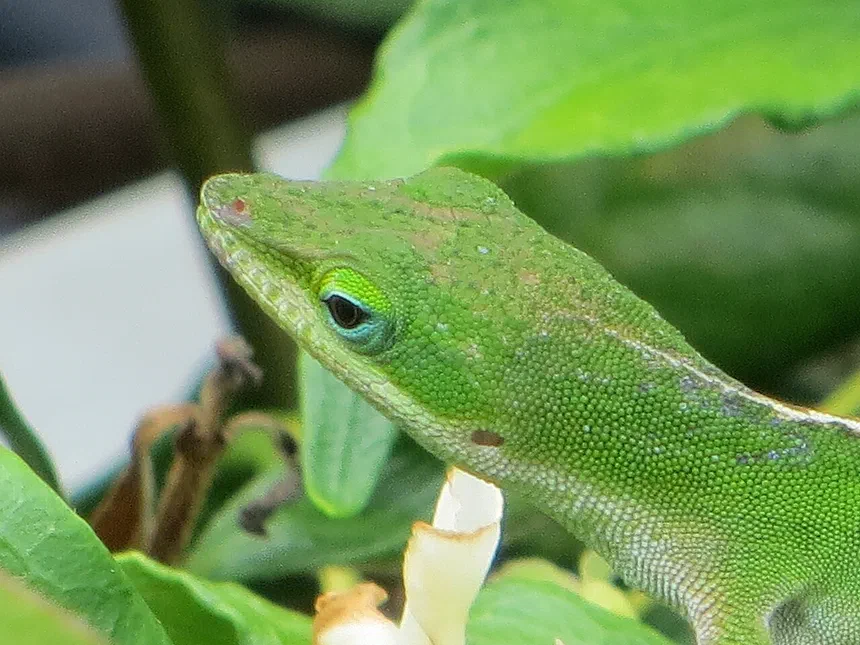
Image: Mgoodyear — CC BY-SA 3.0 · source
What Is a Green Anole?
The green anole (Anolis carolinensis) is a small, agile lizard native to the southeastern United States and one of the most familiar reptiles in the region’s gardens and woodlands. It is often called the “American chameleon” because of its ability to change color, though it is not a true chameleon. Slender and quick, it spends much of its life climbing among leaves, stems, and sunlit walls in search of insects.
Appearance and Identification
Green anoles are lightweight lizards, typically measuring five to eight inches from snout to tail tip, with the tail making up more than half of that length. Their bodies are slim and their heads are long and pointed, giving them a delicate, streamlined look well suited to moving through vegetation.
The most striking feature is their changeable color. These lizards can shift between bright green and various shades of brown or gray, depending on temperature, mood, activity, and light rather than simply matching their background. A pale stripe often runs along the side, and males possess a colorful throat fan, or dewlap, that is usually pink to reddish. Expanded pads on their toes allow them to grip smooth surfaces, and like many lizards they can shed the tail to escape a predator, later regrowing a shorter replacement.
Habitat and Range
The species is found across much of the southeastern United States, from the Carolinas and Florida west toward Texas, and it has been introduced to other warm regions, including parts of the Pacific islands. It favors warm, humid environments with plenty of vertical surfaces to climb.
Typical habitats include open woodlands, forest edges, brushy fields, and wetland margins, as well as suburban gardens, fences, and the walls of buildings. Green anoles are strongly arboreal, spending much of their time perched on branches, broad leaves, shrubs, and vines where they can bask and watch for prey.
Diet
Green anoles are insectivorous, feeding on a wide variety of small invertebrates. Their diet includes crickets, flies, beetles, moths, spiders, and other small arthropods that they encounter while foraging among foliage.
They hunt by sight, remaining still until suitable prey comes within range and then striking quickly. By preying on large numbers of insects, they help control populations of many garden and household pests, making them a welcome presence in yards throughout their range.
Behavior
These lizards are active during the day and depend on outside warmth to stay energetic, so they are often seen basking in patches of sun. As cold-blooded animals, they become sluggish in cool weather and may shelter under bark or in crevices during chilly periods.
Green anoles are territorial, especially the males, which defend perches and display to rivals and potential mates. A displaying male bobs his head, does push-up-like movements, and extends his bright dewlap to signal ownership of a territory or to court a female. Color also plays a role in these interactions, with stress and social conflict often prompting a shift toward darker tones.
Life Cycle and Reproduction
Breeding generally takes place through the warmer months of spring and summer. After mating, a female lays a single egg at a time, tucking it into moist soil, leaf litter, or other sheltered spots, and she may repeat this every couple of weeks over the course of the season.
The eggs receive no parental care and hatch after several weeks, producing tiny, fully independent young that resemble small adults. These hatchlings must fend for themselves immediately, facing predators such as birds, snakes, and larger lizards. Individuals that survive typically live only a few years in the wild.
Conservation Status
The green anole is listed as Least Concern on the IUCN Red List, reflecting its wide distribution and generally stable numbers. It adapts well to gardens and other human-altered landscapes, which helps it persist near people.
Even so, it faces local pressures. In parts of its range, competition from introduced lizards such as the brown anole can push green anoles higher into the trees and reduce their numbers, and habitat loss and pesticide use may affect local populations. Overall, however, the species remains common across much of the Southeast.
Frequently Asked Questions
Can green anoles really change color like chameleons? They can shift between green and brown, but the change is driven by factors such as temperature, stress, and activity rather than by matching their surroundings, and they are not related to true chameleons.
Are green anoles dangerous to people? No. They are small, shy, and harmless, feeding only on insects and other tiny invertebrates. At most, a handled individual may deliver a light, painless nip.
What is the pink flap under the throat? That is the dewlap, a throat fan most developed in males. They extend it during territorial displays and courtship to communicate with other anoles.
References
The conservation status and key facts in this profile are supported by these sources:
- Animal Diversity Web — Anolis carolinensis (green anole) (accessed 2026-08-06)
- GBIF — Anolis carolinensis (Voigt, 1832) (accessed 2026-08-06)
Found an error, source problem, or image concern? Report this page.