Reptiles Guide
Green Anaconda
What Is a Green Anaconda? The green anaconda (Eunectes murinus) is a massive, semi-aquatic snake of tropical South America and one of the heaviest snakes in the world. A member of the boa family, it is non-venomous and …
At a glance
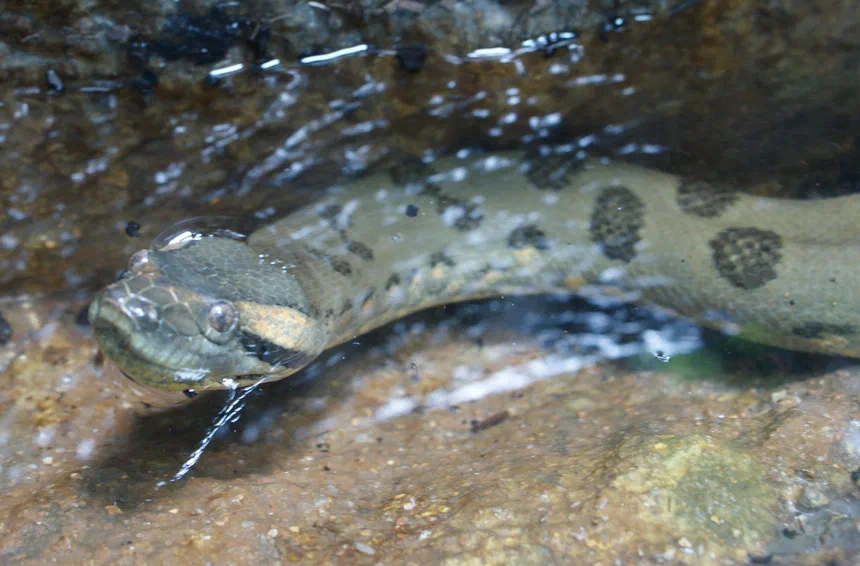
Image: TimVickers — Public domain · source
What Is a Green Anaconda?
The green anaconda (Eunectes murinus) is a massive, semi-aquatic snake of tropical South America and one of the heaviest snakes in the world. A member of the boa family, it is non-venomous and kills its prey by constriction. Its bulk, aquatic lifestyle, and reputation as a top predator have made it one of the most storied reptiles of the Amazon basin.
Appearance and Identification
Green anacondas are thick-bodied, powerful snakes with a base color of olive to dark green, patterned with large black oval blotches along the back. Along the flanks these blotches often form eye-like spots ringed with yellow, and the belly is a paler yellow marked with black. The eyes and nostrils sit high on the head, allowing the snake to see and breathe while most of its body remains submerged.
This species shows pronounced size difference between the sexes, with females growing considerably larger and heavier than males. While exceptional individuals are sometimes reported, typical adults reach lengths of roughly 15 to 20 feet. Their sheer girth, rather than record length, is what makes them among the most massive of all living snakes.
Habitat and Range
The green anaconda lives across tropical northern South America, east of the Andes, including the Amazon and Orinoco river basins and the seasonally flooded grasslands of the Llanos. Its range spans countries such as Brazil, Venezuela, Colombia, Ecuador, Peru, Bolivia, Guyana, and neighboring regions.
It is strongly tied to water and favors swamps, marshes, oxbow lakes, and slow-moving rivers and streams. Its heavy body is awkward on land but buoyant and agile in water, so the snake spends much of its time partly submerged, often lying in wait among vegetation at the water’s edge.
Diet
As an ambush predator, the green anaconda feeds on a wide variety of animals and adjusts its prey to its own size. Younger snakes take fish, birds, and small mammals, while large adults are capable of overpowering substantial prey such as capybaras, deer, caimans, and other reptiles.
The snake seizes prey with its backward-curving teeth and quickly coils around it, tightening its grip each time the animal exhales until circulation stops. It then swallows the meal whole, head first. After a large kill, an anaconda may go weeks or even months before needing to feed again.
Behavior
Green anacondas are generally solitary and secretive, spending long hours motionless in or near water. Being reptiles, they depend on their surroundings to regulate body temperature and may bask where sunlight reaches the water. Despite their fearsome image, they usually avoid people and retreat when disturbed.
Their high-set eyes and nostrils let them float almost invisibly at the surface while watching for prey. Excellent swimmers, they can also stay submerged for extended periods. On land they move slowly, relying on concealment and explosive strikes rather than speed to catch a meal.
Life Cycle and Reproduction
Breeding often centers on the wet season, when several males may gather around a single large female, sometimes forming a slow-moving “breeding ball” as they compete to mate. Green anacondas are ovoviviparous, meaning the female retains the developing eggs inside her body and gives birth to live young.
After a gestation of several months, a female produces a litter that can range widely in number, with larger females bearing more offspring. The newborns are already a couple of feet long and fully independent, receiving no parental care. From the start they must fend for themselves, and many fall prey to birds, caimans, and other predators before reaching maturity.
Conservation Status
The green anaconda has not been formally assessed on the IUCN Red List, and it remains relatively widespread across its range. Even so, it faces pressures from habitat loss and drainage of wetlands, hunting for its skin and meat, and killing out of fear. Its dependence on healthy freshwater habitats makes it sensitive to pollution and to the degradation of the rivers and marshes it calls home.
Frequently Asked Questions
Is the green anaconda the largest snake in the world? It is generally considered the heaviest and most massive snake, though the reticulated python of Asia can grow longer in total length.
Is the green anaconda venomous? No. It is a non-venomous constrictor that subdues prey by coiling around it and cutting off circulation.
Do green anacondas lay eggs? No. Females give birth to live young, retaining the eggs inside the body until the offspring are ready to emerge.
References
The conservation status and key facts in this profile are supported by these sources:
- Animal Diversity Web — Eunectes murinus (Green Anaconda) (accessed 2026-08-06)
- GBIF — Eunectes murinus (Linnaeus, 1758) (accessed 2026-08-06)
- ITIS — Eunectes murinus (TSN 634802) (accessed 2026-08-06)
Found an error, source problem, or image concern? Report this page.