Reptiles Guide
Gopher Snake
What Is a Gopher Snake? The gopher snake (Pituophis catenifer) is a large, nonvenomous constrictor native to western North America. It belongs to the family Colubridae and is one of the most widespread and frequently …
At a glance
What Is a Gopher Snake?
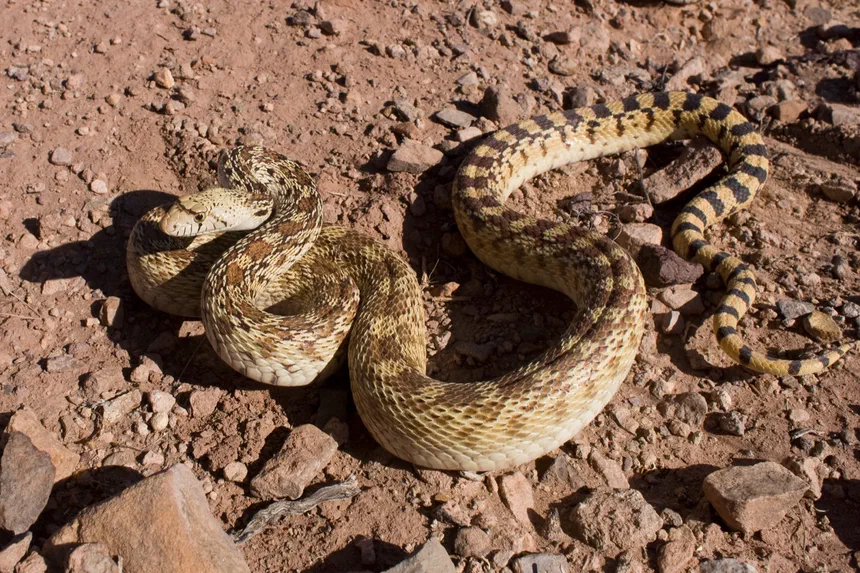
The gopher snake (Pituophis catenifer) is a large, nonvenomous constrictor native to western North America. It belongs to the family Colubridae and is one of the most widespread and frequently encountered snakes across its range. Several recognized subspecies, including the bullsnake and the Pacific and Sonoran gopher snakes, differ modestly in color and pattern.
Appearance and Identification
Gopher snakes are heavy-bodied snakes with a base color ranging from tan and cream to yellowish or straw, marked by a series of dark brown, reddish, or black saddle-shaped blotches down the back and smaller spots along the sides. The head is relatively narrow with a pointed snout, and the scales are keeled, giving the body a slightly rough texture. Adults typically measure 3 to 7 feet in length, with most individuals falling in the 4-to-5-foot range. Their coloring and blotched pattern often lead people to mistake them for rattlesnakes, a resemblance reinforced by their defensive behavior.
Habitat and Range
This adaptable species occupies a broad swath of western North America, from southwestern Canada through the western United States and into northern Mexico. Gopher snakes thrive in a wide variety of open habitats, including grasslands, prairies, deserts, sagebrush flats, agricultural fields, and open pine woodlands. They tolerate elevations from sea level to mountain foothills and are frequently found near farmland, where abundant rodents provide a reliable food source. They shelter in rodent burrows, under rocks and logs, and in brush piles.
Diet
Gopher snakes are carnivores and skilled constrictors. Their diet is dominated by small mammals, especially pocket gophers, ground squirrels, mice, and rats, which they pursue into burrows. They also take birds and their eggs, lizards, and occasionally insects, particularly when young. Prey is seized in the jaws and quickly wrapped in coils, where constriction stops circulation before the snake swallows the animal whole. Because they consume large numbers of rodents, gopher snakes are valued by farmers as natural pest controllers.
Behavior
Primarily active during the day, gopher snakes shift toward dawn, dusk, and nighttime activity during the hottest parts of summer. They are strong climbers and capable burrowers but spend much of their time foraging on the ground. When threatened, a gopher snake puts on a convincing rattlesnake impression: it flattens its head, hisses loudly, vibrates its tail against dry vegetation, and may strike. Despite this bluff, the species is nonvenomous and harmless to humans. In colder parts of the range, gopher snakes brumate through winter, often sharing communal dens.
Life Cycle and Reproduction
Gopher snakes are oviparous, meaning they lay eggs. Mating occurs in spring, usually shortly after emerging from winter brumation. In early to midsummer, the female deposits a clutch of roughly 2 to 24 eggs in a burrow, under rocks, or in other sheltered, humid sites. The eggs receive no parental care and hatch after about 65 to 75 days. Hatchlings measure around 12 to 18 inches and are fully independent, capable of hunting small prey soon after emerging. Sexual maturity is typically reached at 3 to 5 years of age.
Conservation Status
The gopher snake is listed as Least Concern by the IUCN, reflecting its wide distribution, large population, and tolerance of human-altered landscapes. Localized threats include road mortality, habitat loss, and deliberate killing by people who mistake the snake for a venomous rattlesnake. Overall, however, the species remains common and faces no serious range-wide risk.
Frequently Asked Questions
Are gopher snakes venomous? No. Gopher snakes are nonvenomous constrictors. They kill prey by squeezing rather than by injecting venom, and they pose no venom threat to humans.
Why do gopher snakes act like rattlesnakes? When frightened, they hiss, flatten their heads, and vibrate their tails to mimic rattlesnakes. This bluff deters predators, though the snake is entirely harmless.
Are gopher snakes good for the environment? Yes. As prolific rodent hunters, they help control populations of gophers, mice, and rats, making them beneficial neighbors around farms and gardens.