Reptiles Guide
Gila Monster
What Is a Gila Monster? The Gila monster (Heloderma suspectum) is a large, slow-moving lizard native to the deserts of the American Southwest and adjacent Mexico. It is one of only a handful of venomous lizards in the …
At a glance
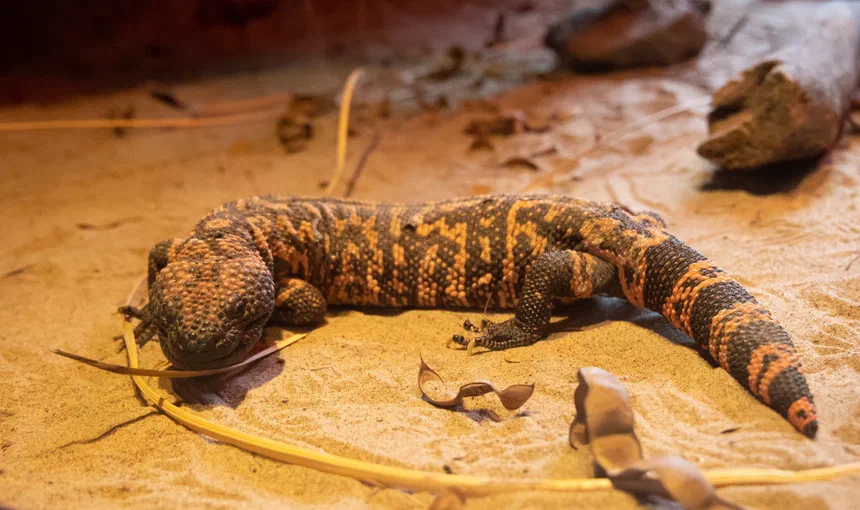
Image: Theo Kruse / Burgers' Zoo — CC BY-SA 4.0 · source
What Is a Gila Monster?
The Gila monster (Heloderma suspectum) is a large, slow-moving lizard native to the deserts of the American Southwest and adjacent Mexico. It is one of only a handful of venomous lizards in the world and is instantly recognizable by its stout body and bold, beaded skin. Named after the Gila River basin of Arizona, it spends most of its life hidden underground.
Appearance and Identification
Gila monsters are heavy-bodied lizards with short, thick tails, blunt snouts, and stubby legs ending in strong claws. Adults typically reach 30 to 56 centimeters (about 12 to 22 inches) in total length and weigh somewhere between 350 and 700 grams, making them the largest lizards native to the United States. Their skin is covered in small, rounded, bead-like scales called osteoderms, which are reinforced with bony deposits. The striking pattern of black blotches or bands against a background of pink, orange, or yellow serves as a warning to potential predators. The fat-storing tail swells when food is plentiful and shrinks during lean periods.
Habitat and Range
This species inhabits arid and semi-arid landscapes including desert scrub, rocky foothills, canyon bottoms, and dry grassland. It favors areas with rocky outcrops and access to burrows, which provide shelter from extreme heat. The range extends across parts of Arizona, southern Nevada, southeastern California, southern Utah, and southwestern New Mexico, continuing south into the Mexican states of Sonora and Sinaloa. Gila monsters rely heavily on underground refuges and are seldom found far from suitable shelter.
Diet
Gila monsters are carnivores that specialize in raiding nests. Their diet consists largely of the eggs of birds and reptiles, along with newborn rabbits, rodents, and other small vertebrates. Because they eat infrequently, they can consume a large meal at once and then store surplus energy as fat in the tail. A well-fed adult may eat only a handful of substantial meals in an entire year. They locate prey and nests using a keen sense of smell, flicking the tongue to sample chemical cues.
Behavior
Gila monsters are famously sluggish and spend an estimated 90 percent or more of their lives underground in burrows. They are most active in the spring and become surface-active around dawn and dusk to avoid the searing midday sun, retreating to cooler months underground during the hottest and coldest parts of the year. Although venomous, they are not aggressive toward people and bite only when handled or provoked. The venom is delivered through grooved teeth in the lower jaw as the lizard chews and holds on, rather than through fangs. While a bite is painful, it is very rarely fatal to healthy humans.
Life Cycle and Reproduction
Mating generally occurs in the spring following emergence from winter dormancy. Females lay a clutch of roughly 2 to 12 eggs, usually in summer, burying them in a sheltered underground chamber. The eggs incubate for several months before hatching, and the young emerge fully formed and independent, already equipped with venom. Gila monsters grow slowly and are long-lived, commonly surviving 20 to 30 years, with individuals in captivity sometimes living even longer.
Conservation Status
The Gila monster is listed as Near Threatened by the IUCN. Habitat loss from urban expansion and agriculture, road mortality, and illegal collection for the pet trade are the primary threats. It is legally protected across much of its U.S. range, and Arizona was among the first states to grant a venomous lizard legal protection. Compounds derived from its venom have contributed to medical research, including drugs used to manage type 2 diabetes.
Frequently Asked Questions
Is a Gila monster venomous? Yes. It is one of the few venomous lizards, delivering venom through grooved teeth in the lower jaw while chewing. Bites are painful but rarely dangerous to healthy people.
What does a Gila monster eat? It feeds mainly on eggs from bird and reptile nests, plus small mammals such as young rabbits and rodents, storing surplus fat in its tail.
How long do Gila monsters live? In the wild they commonly live 20 to 30 years, and captive individuals can live even longer.