Reptiles Guide
Gharial
What Is a Gharial? The gharial (Gavialis gangeticus) is a large, fish-eating crocodilian instantly recognizable by its extremely long, slender snout. It belongs to the family Gavialidae and is one of the longest of all …
At a glance
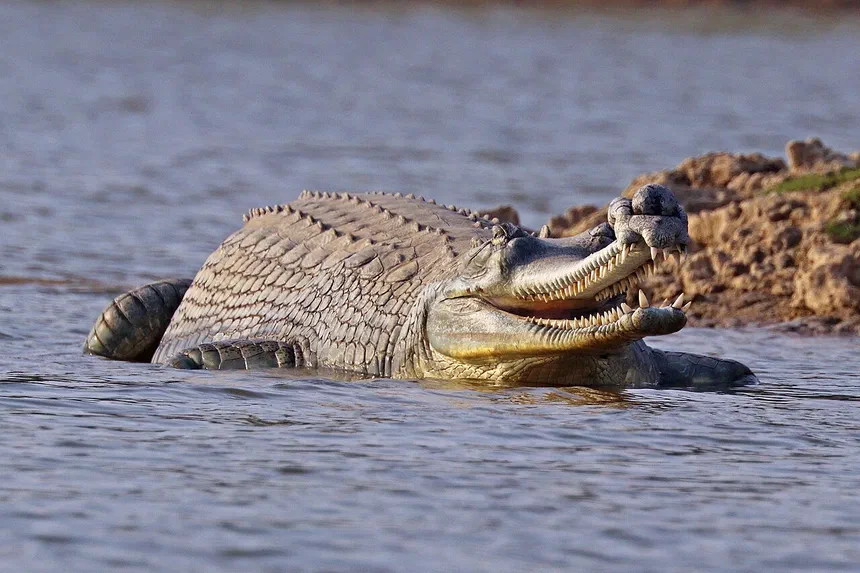
Image: Charles J. Sharp — CC BY-SA 4.0 · source
What Is a Gharial?
The gharial (Gavialis gangeticus) is a large, fish-eating crocodilian instantly recognizable by its extremely long, slender snout. It belongs to the family Gavialidae and is one of the longest of all living crocodilians, though it is also among the most endangered. Native to the river systems of the northern Indian subcontinent, it is highly specialized for life in water.
Appearance and Identification
The gharial’s most distinctive feature is its narrow, elongated snout lined with more than 100 sharp, interlocking teeth. This delicate jaw is perfectly shaped for snapping sideways through water to catch fish. Adult males develop a bulbous growth of cartilage at the tip of the snout called a “ghara,” named after the Indian earthenware pot it resembles; this structure is used to produce sounds and visual signals during courtship. Adults are olive to grayish-brown above, often marked with darker crossbands, and paler underneath. Mature gharials commonly reach 11.5 to 15 feet (3.5 to 4.5 meters) in length, with large old males occasionally exceeding this. Their limbs are relatively weak compared to other crocodilians, and their splayed, poorly developed leg muscles make them awkward on land, so they rarely leave the water except to bask or nest.
Habitat and Range
Gharials are found in deep, clear, fast-flowing freshwater rivers with steep, sandy banks. They favor calm river bends and deep pools where fish concentrate, along with exposed sandbanks used for basking and nesting. Historically they ranged widely across the river systems of the Indian subcontinent, including the Indus, Ganges, Brahmaputra, and Mahanadi. Today their range has collapsed dramatically, and viable populations survive in only a handful of rivers in India and Nepal, most notably the Chambal River. The species is very rarely seen outside these fragmented strongholds.
Diet
The gharial is a specialized fish-eater, and its slender snout and needle-like teeth are ideal tools for this diet. It hunts by lying still or moving slowly through the water, then whipping its head to the side to seize passing fish. The narrow jaw offers little water resistance, allowing lightning-fast strikes. Young gharials also eat insects, crustaceans, and small frogs. Unlike broad-snouted crocodilians, the gharial is not equipped to tackle large land mammals, and it poses very little danger to people despite its size.
Behavior
Gharials are strongly aquatic and spend most of their time in the water, hauling out onto sandbanks mainly to bask in the sun and regulate their body temperature. They are generally shy and non-aggressive toward humans. During the breeding season, males become territorial and gather groups of females, using the ghara to make buzzing sounds and blow bubbles as part of their displays. Basking groups of several individuals may share favorable stretches of riverbank.
Life Cycle and Reproduction
Breeding takes place during the cooler, dry months. After mating, females dig nest holes in sandbanks above the waterline and lay a clutch that can number several dozen eggs, among the largest of any crocodilian. The eggs incubate for roughly two to three months. Females guard their nests against predators, and when the hatchlings emerge they call out to the adults. Unlike some crocodilians, the mother’s slender jaws cannot carry young, so hatchlings make their own way to the water while the female stays nearby to protect them. Gharials grow slowly and may take many years to reach breeding size, and they are believed to live for several decades in the wild.
Conservation Status
The gharial is classified as Critically Endangered by the IUCN, having suffered a catastrophic decline over the past century. The main threats include the loss of river habitat to dams and irrigation, sand mining that destroys nesting banks, entanglement and drowning in fishing nets, and declining fish stocks. Egg collection and pollution have added further pressure. Conservation efforts include captive breeding and release programs, protected sanctuaries such as those along the Chambal River, and community initiatives, though the species remains at serious risk.
Frequently Asked Questions
Are gharials dangerous to humans? No. Their narrow snouts and small teeth are built for catching fish, and they are not capable of, or inclined toward, attacking people.
What is the bump on a male gharial’s snout? It is a cartilage growth called a “ghara,” found only on mature males. It is used to make sounds and visual signals during courtship.
Why are gharials so endangered? Dam building, sand mining, fishing-net entanglement, and shrinking fish populations have devastated their river habitats, leaving only small, scattered populations in India and Nepal.