Reptiles Guide
Common Garter Snake
What Is a Common Garter Snake? The common garter snake (Thamnophis sirtalis) is a slender, non-venomous colubrid snake and one of the most widespread reptiles in North America. Recognizable by the long stripes running …
At a glance
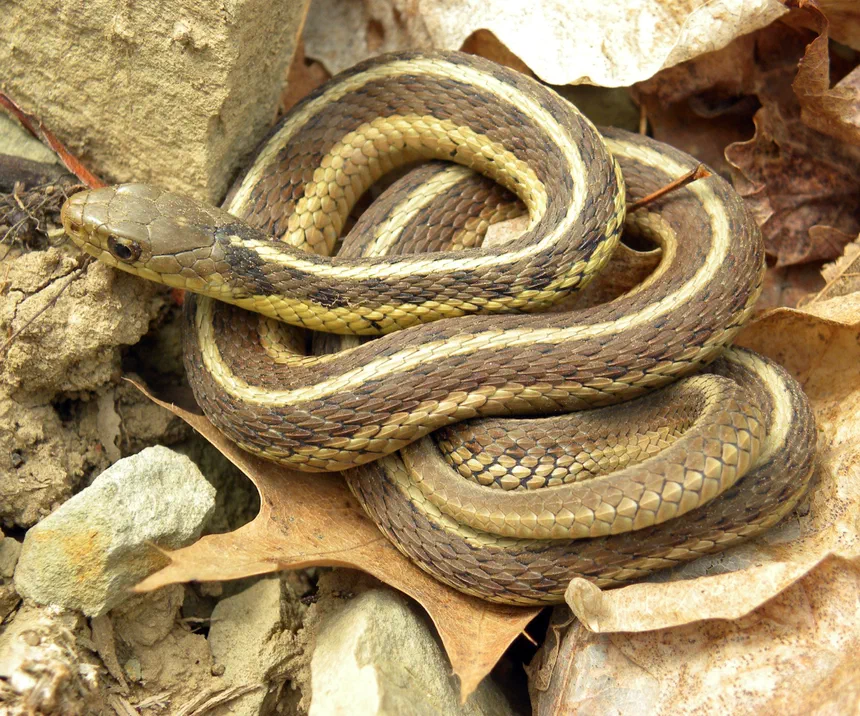
Image: Wilson44691 — Public domain · source
What Is a Common Garter Snake?
The common garter snake (Thamnophis sirtalis) is a slender, non-venomous colubrid snake and one of the most widespread reptiles in North America. Recognizable by the long stripes running down its body, it is a familiar sight in backyards, fields, and along the edges of ponds and streams across much of the continent.
Appearance and Identification
Garter snakes are small to medium-sized snakes, typically ranging from about 46 to 90 cm (18 to 36 inches), though large individuals can reach 130 cm or more. Their most distinctive feature is a pattern of three light stripes, usually yellow, greenish, or cream, set against a darker background of brown, olive, gray, or black. Between the stripes, many individuals show a checkerboard pattern of dark spots. Coloration varies widely across the species’ large range, and numerous regional subspecies exist, including brightly marked red-sided forms. The head is slightly wider than the neck, and the eyes are relatively large. Females tend to grow longer and heavier than males.
Habitat and Range
This adaptable snake occupies an enormous range, from the Gulf Coast and Florida north through nearly all of the United States and into much of Canada. It thrives in a variety of habitats, including grassy meadows, forest edges, marshes, ditches, and suburban gardens. Garter snakes are strongly associated with moist environments and are often found near water, but they also tolerate drier upland areas. Their tolerance for cold allows them to live farther north than most other North American snakes.
Diet
Garter snakes are active carnivores that hunt a broad menu of small prey. Common foods include earthworms, amphibians such as frogs, toads, and salamanders, slugs, leeches, small fish, and occasionally small rodents or nestling birds. They locate prey largely by scent, flicking the tongue to detect chemical cues, and swallow it whole. Interestingly, some populations are resistant to the toxins of prey such as newts, allowing them to eat animals that would sicken other predators. Their saliva contains a mild toxin that helps subdue small prey but is harmless to humans.
Behavior
Common garter snakes are active mostly during the day, especially in cooler weather, and may shift toward dawn and dusk activity in hot conditions. They are quick and alert, relying on speed and cover to escape danger rather than aggression. When threatened, a garter snake may flatten its body, release a foul-smelling musk from glands near the tail, or, as a last resort, deliver a harmless bite. In the northern parts of their range, large numbers gather in communal dens, called hibernacula, to spend the winter in a dormant state known as brumation, sometimes emerging in spectacular mass numbers in spring.
Life Cycle and Reproduction
Garter snakes give birth to live young rather than laying eggs, a trait known as being ovoviviparous. Mating typically occurs in spring shortly after emergence from winter dens, sometimes in large writhing clusters called mating balls, where many males compete for a single female. After a gestation of roughly two to three months, the female gives birth in late summer to a litter that can range from a handful to several dozen young, occasionally more. The newborns are fully independent from birth and receive no parental care. They grow quickly and may reach breeding age within a couple of years.
Conservation Status
The common garter snake is listed as Least Concern by the IUCN, reflecting its wide distribution, large population, and adaptability to human-altered landscapes. It remains common across most of its range. Localized declines can occur from habitat loss, road mortality, pollution, and pesticide use that reduces prey, and a few specialized subspecies face greater pressure. As a harmless and beneficial predator of pests, the garter snake is a welcome presence in many gardens and natural areas.
Frequently Asked Questions
Are common garter snakes dangerous to people? No. They are non-venomous and harmless to humans. A bite may cause minor irritation, but garter snakes prefer to flee and rarely bite unless handled.
What do garter snakes eat? They feed mainly on earthworms, amphibians, slugs, small fish, and other small animals, hunting by scent and swallowing prey whole.
Do garter snakes lay eggs? No. Females give birth to live young in late summer, producing litters that can range from a few to a few dozen fully independent offspring.