Reptiles Guide
Galapagos Tortoise
What Is a Galapagos Tortoise? The Galapagos tortoise (Chelonoidis niger) is the largest living tortoise on Earth and one of the most iconic animals of the Galapagos Islands. It is a long-lived, land-dwelling reptile made …
At a glance
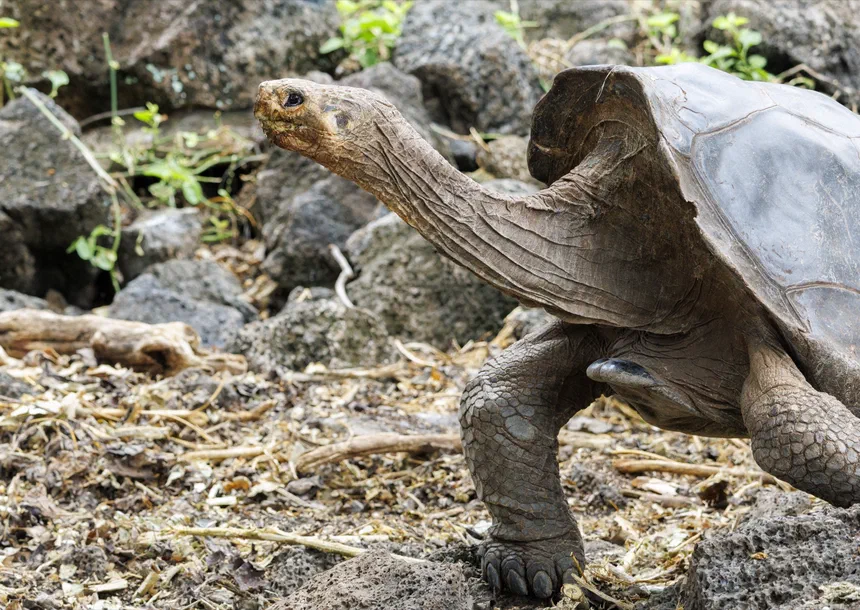
Image: E bailey — CC BY-SA 4.0 · source
What Is a Galapagos Tortoise?
The Galapagos tortoise (Chelonoidis niger) is the largest living tortoise on Earth and one of the most iconic animals of the Galapagos Islands. It is a long-lived, land-dwelling reptile made up of several distinct populations, often treated as subspecies or closely related species, each shaped by the island it inhabits. These gentle giants helped inspire early ideas about evolution and remain a symbol of island wildlife.
Appearance and Identification
Galapagos tortoises are massive reptiles with a domed or saddle-shaped bony shell (carapace) that ranges from brown to grayish. Large adults can reach a shell length of roughly 4 to 5 feet (about 1.2 to 1.5 meters) and weigh up to around 550 pounds (250 kilograms), with males typically larger than females. Two broad shell shapes exist: high, “saddleback” shells with a raised front edge that lets the tortoise stretch its neck upward, and larger “domed” shells. The legs are thick and column-like, and the skin is tough, scaly, and gray.
Habitat and Range
This species is found only on the Galapagos Islands, an isolated volcanic archipelago off the coast of Ecuador in the eastern Pacific Ocean. Different populations occupy different islands and elevations. Saddleback forms tend to live in drier, low-lying areas with sparse vegetation, while domed forms are more common in cooler, wetter highlands with lush grasses and shrubs. Tortoises may migrate seasonally between zones, following food and water.
Diet
Galapagos tortoises are strict herbivores. They graze on grasses, leafy plants, and low shrubs, and they browse on cactus pads, fruit, flowers, and lichens. The prickly pear cactus (Opuntia) is an important food on many islands, and saddleback shells are thought to help those tortoises reach higher vegetation. Because they get much of their water from food and dew, tortoises can survive long dry periods, and they can store water and fat to endure months without drinking.
Behavior
These tortoises are slow-moving, mostly solitary, and active during the day. They spend much of their time grazing, resting, and basking in the sun to warm their bodies. On hot days they may wallow in mud or shallow pools to stay cool and reduce parasites. They have a well-known relationship with small birds such as finches, which pick ticks and parasites from their skin. Despite their lumbering pace, tortoises can travel steadily over long distances along worn trails between feeding and nesting grounds.
Life Cycle and Reproduction
Breeding usually peaks during the warmer, wetter season. Males compete by facing off and stretching their necks upward, with the taller reach often winning without a serious fight. After mating, a female travels to dry, sandy lowland areas to dig a nest and lay a clutch of eggs, typically ranging from a few up to around a dozen or more. She covers the eggs and leaves them to incubate for several months. As in many reptiles, nest temperature influences the sex of the hatchlings. Young tortoises are vulnerable to introduced predators such as rats, and only a fraction survive to adulthood, but those that do can live extraordinarily long lives.
Conservation Status
Galapagos tortoises declined sharply after the arrival of humans, who once took huge numbers for meat, while introduced animals such as goats, pigs, and rats damaged habitat and destroyed eggs and young. Several populations were driven to very low numbers, and at least one lineage became famous through “Lonesome George,” the last of his kind. Overall the species complex is considered threatened, and various populations carry IUCN ratings up to Vulnerable, Endangered, or Critically Endangered. Intensive conservation, including captive breeding, egg protection, and removal of invasive species, has helped several populations recover.
Frequently Asked Questions
How long do Galapagos tortoises live? They are among the longest-lived land animals, commonly reaching well over 100 years, and some individuals have lived even longer in captivity.
Why are they so large? Island isolation and a lack of large natural predators allowed these tortoises to evolve into giants, a pattern known as island gigantism.
What is the difference between saddleback and domed tortoises? Saddleback tortoises have a raised front shell edge suited to reaching tall plants in dry habitats, while domed tortoises are larger and live in wetter, greener highlands.