Reptiles Guide
Gaboon Viper
What Is a Gaboon Viper? The Gaboon viper (Bitis gabonica) is a large, heavy-bodied venomous snake native to the forests of sub-Saharan Africa. It is famous for having the longest fangs and one of the highest venom yields …
At a glance
What Is a Gaboon Viper?
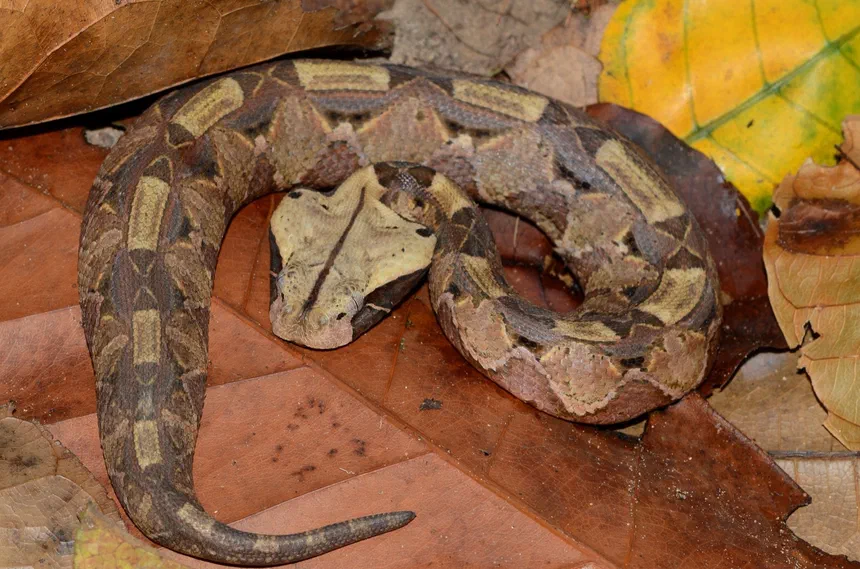
The Gaboon viper (Bitis gabonica) is a large, heavy-bodied venomous snake native to the forests of sub-Saharan Africa. It is famous for having the longest fangs and one of the highest venom yields of any snake, yet it is also known for its remarkably calm, sedentary temperament.
Appearance and Identification
The Gaboon viper is among the bulkiest vipers in the world. Adults typically reach 4 to 6 feet (about 1.2 to 1.8 meters) in length, and large individuals can weigh 20 pounds (roughly 9 kilograms) or more, making this one of the heaviest venomous snakes in Africa. The body is broad and thick, tapering to a short tail, and the head is unusually large and triangular. Two small horn-like scales sit between the nostrils in the eastern form of the species.
The snake’s most striking feature is its intricate color pattern: a series of pale buff, tan, purple-brown, and cream geometric shapes arranged in interlocking rectangles and hourglass figures along the back. On the shadow-dappled leaf litter of a forest floor, this bold pattern dissolves into near-perfect camouflage. The fangs are the longest of any snake, sometimes reaching around 2 inches (5 centimeters).
Habitat and Range
Gaboon vipers occur across Central, West, and parts of East Africa, from Guinea and Ghana through the Congo Basin and into Tanzania. They favor the floor of tropical rainforests and adjacent woodlands, but they also turn up in secondary forest, cocoa and cashew plantations, and grassy clearings near forest edges. They generally prefer humid, lowland environments with abundant leaf litter for concealment.
Diet
This species is a strict carnivore and an ambush predator. It lies motionless, sometimes for days, waiting for prey to wander within striking range. The diet consists largely of rodents and other small mammals, along with ground-dwelling birds, frogs, and occasionally larger prey such as small antelope or hares taken by exceptionally big individuals. After a lightning-fast strike, the viper often holds onto its prey rather than releasing it, relying on its potent venom to subdue the meal.
Behavior
Despite its formidable weaponry, the Gaboon viper is famously placid and slow to anger. It relies on camouflage rather than flight, and will typically remain still even when approached closely, which is one reason bites, though rare, tend to happen when the snake is accidentally stepped on or handled. It is mainly nocturnal and terrestrial, moving in a slow, caterpillar-like rectilinear crawl. When threatened, it may hiss loudly as a warning before striking. Its venom is not the most toxic drop-for-drop, but the enormous quantity delivered through long fangs makes a bite a serious medical emergency.
Life Cycle and Reproduction
Gaboon vipers are ovoviviparous, meaning females retain the eggs internally and give birth to live young. Breeding often coincides with the rainy season, and gestation can last roughly seven months to a year. Litters are large, commonly ranging from around 8 to 40 or more neonates, each already equipped with functional fangs and venom. The young measure roughly 10 to 12 inches (25 to 30 centimeters) at birth and are independent immediately. In the wild these snakes are thought to live around 15 to 20 years, with some individuals reaching greater ages in captivity.
Conservation Status
The Gaboon viper has not been formally assessed on the IUCN Red List, and it remains widespread across its range. Nonetheless, it faces pressures from habitat loss as rainforest is cleared for agriculture, as well as collection for the skin trade, the pet trade, and traditional uses. Because the species is slow-moving and reluctant to flee, it is also frequently killed on roads and by people who encounter it. Continued protection of intact forest habitat is important for its long-term security.
Frequently Asked Questions
Are Gaboon vipers aggressive toward people? No. They are among the most docile of large vipers and rarely bite unless stepped on or handled. Most encounters end with the snake simply staying still.
How dangerous is a Gaboon viper bite? Very dangerous if it occurs. The snake delivers a large volume of venom through the longest fangs of any snake, so a bite requires urgent medical care and antivenom, though such bites are uncommon.
Why is it so hard to spot in the wild? Its geometric brown, tan, and cream pattern mimics the light and shadow of the forest floor, letting it blend almost seamlessly into dead leaves and remain hidden from both prey and predators.