Reptiles Guide
Frilled Lizard
What Is a Frilled Lizard? The frilled lizard (Chlamydosaurus kingii), also called the frill-necked lizard, is a large agamid reptile famous for the wide, ruffled collar of skin around its neck. It is native to the …
At a glance
What Is a Frilled Lizard?
The frilled lizard (Chlamydosaurus kingii), also called the frill-necked lizard, is a large agamid reptile famous for the wide, ruffled collar of skin around its neck. It is native to the tropical woodlands of northern Australia and southern New Guinea, where it spends much of its life in the trees.
Appearance and Identification
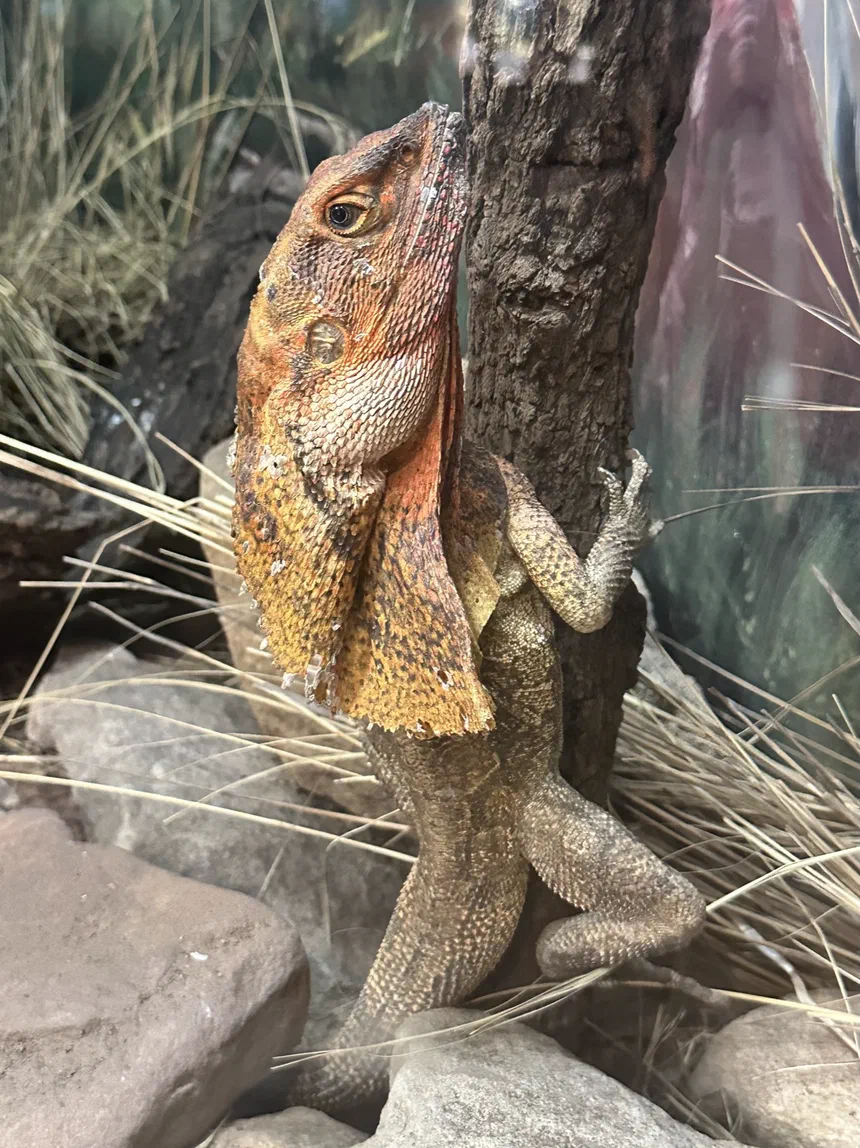
This lizard is best known for its namesake frill, a broad membrane of skin supported by long, cartilage-stiffened spurs connected to the jaw. Normally the frill folds neatly against the shoulders, but when the animal opens its mouth wide it flares outward like an umbrella, sometimes reaching 20 to 30 cm across. The body is slender, with long limbs, sharp claws, and a whip-like tail that can make up more than half of the animal’s total length of roughly 60 to 90 cm. Coloration ranges from gray and brown to rusty orange, often mottled to blend with bark and leaf litter, and the frill itself may show patches of red, orange, black, or white.
Habitat and Range
Frilled lizards occur across the tropical and subtropical north of Australia, from the Kimberley region through the Top End and into Queensland, as well as parts of southern New Guinea. They favor humid to dry woodland and savanna where scattered trees provide both perches and cover. Highly arboreal, they cling to trunks and branches for much of the day, descending to the ground mainly to feed or move between trees.
Diet
As active carnivores, frilled lizards feed largely on invertebrates. Insects such as ants, beetles, termites, cicadas, and moths make up the bulk of the diet, along with spiders and other arthropods. Larger individuals will also take small vertebrates, including lesser lizards and the occasional small mammal. Feeding activity rises sharply during the wet season, when insect prey is abundant.
Behavior
The species is best known for its dramatic threat display. When cornered by a predator, it rears onto its hind legs, gapes its bright mouth, and snaps the frill open to appear much larger and more intimidating. If bluffing fails, it often turns and sprints away on its hind legs in a distinctive bipedal dash toward the nearest tree. Frilled lizards are strongly seasonal in their activity: they are lively and conspicuous through the warm, wet months but become far less active, resting quietly in the canopy, during the cooler dry season.
Life Cycle and Reproduction
Breeding is tied to the onset of the wet season. Males use the frill in courtship and in contests with rivals, and after mating females dig a nest in warm, moist soil. A clutch typically contains around 8 to 20 eggs, though larger clutches are possible. As in many reptiles, incubation temperature influences the sex of the hatchlings. The young emerge fully independent after a couple of months and must fend for themselves immediately. Frilled lizards may live roughly 10 to 20 years, with individuals in captivity often reaching the upper end of that range.
Conservation Status
The frilled lizard is listed as Least Concern by the IUCN, reflecting its wide distribution and generally stable numbers. Even so, it faces pressures from habitat clearing, altered fire regimes, and introduced predators such as feral cats. In parts of its range, invasive cane toads pose an additional threat, since lizards that attempt to eat the toxic amphibians can be poisoned.
Frequently Asked Questions
Why does a frilled lizard open its frill? The frill is mainly a defensive bluff. Flaring it makes the lizard look larger and startles predators, buying time to escape. It also plays a role in courtship and male-to-male display.
Can frilled lizards really run on two legs? Yes. When fleeing, they commonly rise onto their hind legs and run bipedally toward a tree, a behavior that has made them a memorable symbol of Australia’s tropical north.
Are frilled lizards dangerous to people? No. Their gaping, hissing display looks fierce, but they are not venomous and pose no real threat to humans, preferring to flee rather than fight.