Reptiles Guide
Flying Gecko
What Is a Flying Gecko? The flying gecko (Gekko kuhli, long known as Ptychozoon kuhli) is a nocturnal, tree-dwelling lizard native to the rainforests of Southeast Asia. Despite its name it does not truly fly; instead it …
At a glance
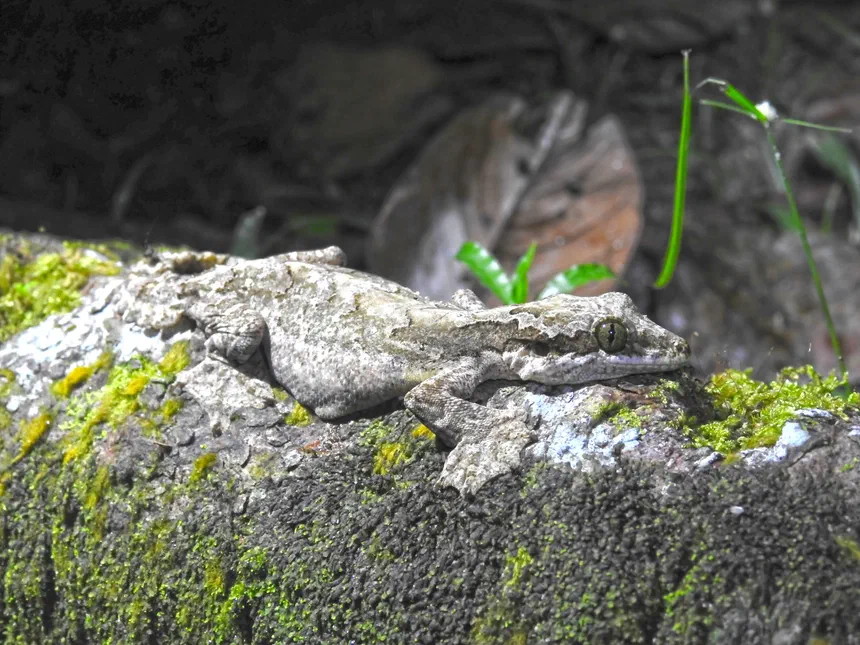
Image: Sundar — CC BY-SA 4.0 · source
What Is a Flying Gecko?
The flying gecko (Gekko kuhli, long known as Ptychozoon kuhli) is a nocturnal, tree-dwelling lizard native to the rainforests of Southeast Asia. Despite its name it does not truly fly; instead it uses flaps of loose skin along its body, limbs, and tail to glide and parachute between trees. It is also commonly called Kuhl’s flying gecko or the parachute gecko.
Appearance and Identification
This is a medium-sized gecko, typically reaching about 7 to 8 inches (18 to 20 cm) in total length, with the tail making up roughly half of that. Its coloration is a mottled mix of gray, brown, and cream that closely mimics tree bark and lichen, giving it superb camouflage against a trunk. The most distinctive features are the webbed feet and the fringed flaps of skin running along the sides of the body, the edges of the limbs, and the flattened, scalloped tail. When the gecko presses itself flat against bark, these flaps break up its outline and eliminate shadow, helping it disappear from predators. Like other geckos, it has large lidless eyes with vertical pupils and adhesive toe pads for climbing smooth surfaces.
Habitat and Range
The flying gecko lives in tropical rainforests across parts of Southeast Asia, including Peninsular Malaysia, Thailand, and nearby regions, with related and formerly conflated populations extending through parts of Indonesia. It favors lowland and hill forest, where it spends its life among the trunks and branches of the canopy and understory. Warm temperatures and high humidity are essential to it, and it is rarely found far from dense forest cover.
Diet
Flying geckos are insectivores. They hunt at night for a variety of small invertebrates, including crickets, moths, beetles, cockroaches, spiders, and other insects they can ambush on tree bark. They are sit-and-wait predators, remaining motionless until prey wanders close, then snapping it up with a quick lunge. Occasional intake of soft plant material or nectar has been reported but is not a significant part of the diet.
Behavior
This species is strictly nocturnal and arboreal, resting flattened against bark by day and becoming active after dark. When threatened, it may leap from a branch and spread its skin flaps and webbed feet to slow and control its descent, gliding at an angle toward a neighboring trunk rather than falling straight down. It can steer somewhat during these glides and usually lands lower on an adjacent tree. Like many geckos it can also shed its tail to escape a grasping predator, later regrowing a shorter replacement. Males are territorial and communicate with chirps and other vocalizations.
Life Cycle and Reproduction
Flying geckos are egg-layers. A female typically produces small clutches of one or two hard-shelled eggs, which she glues to bark, inside a crevice, or under loose vegetation. She may lay several clutches over a breeding season. The eggs are left to develop unattended and hatch after roughly two to three months, depending on temperature and humidity. Hatchlings emerge as miniature versions of the adults, already equipped with skin flaps, and are independent from birth. In good conditions these geckos may live around five to eight years.
Conservation Status
The flying gecko has not been formally assessed for the IUCN Red List, and no single global status applies to it. It remains reasonably widespread within suitable forest, but it depends on intact rainforest and is therefore sensitive to logging and habitat loss. Collection for the international pet trade is an additional pressure in some areas. Protecting mature forest is the most important measure for keeping populations healthy.
Frequently Asked Questions
Can a flying gecko actually fly? No. It glides and parachutes using flaps of skin to slow its fall and steer between trees, but it cannot generate powered flight like a bird or bat.
Is the flying gecko dangerous to people? Not at all. It is a small, harmless insect-eater that is shy and non-venomous, and it poses no threat to humans.
Where do flying geckos live in the wild? They inhabit tropical rainforests of Southeast Asia, spending nearly all their time on tree trunks and branches in warm, humid forest.