Reptiles Guide
Florida Softshell Turtle
What Is a Florida Softshell Turtle? The Florida softshell turtle (Apalone ferox) is a large freshwater turtle native to the southeastern United States and best known for its flattened, leathery shell and long, tube-like …
At a glance
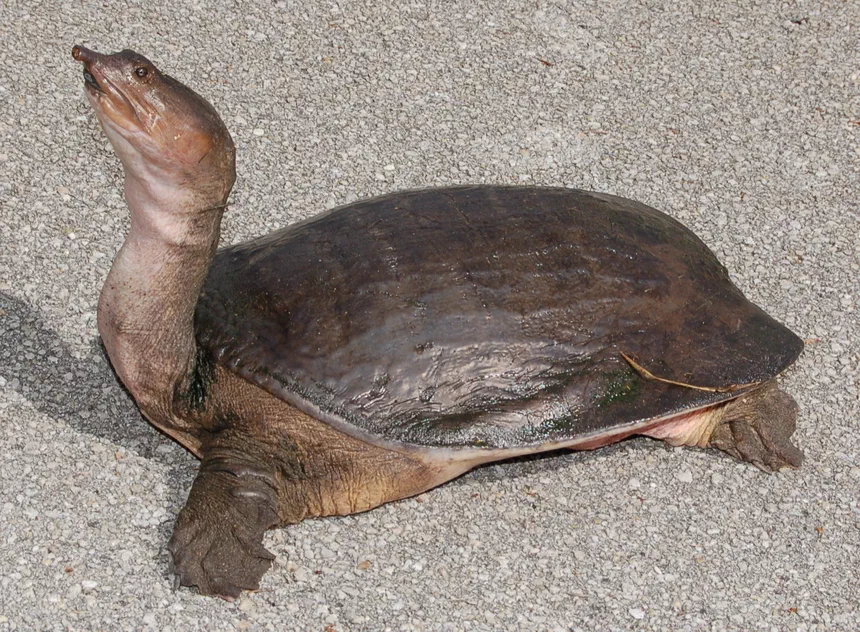
Image: Johnskate17 — CC BY-SA 4.0 · source
What Is a Florida Softshell Turtle?
The Florida softshell turtle (Apalone ferox) is a large freshwater turtle native to the southeastern United States and best known for its flattened, leathery shell and long, tube-like snorkeling snout. Unlike the hard, plated carapace of most turtles, its shell is covered in tough, rubbery skin, giving it a distinctly pancake-like appearance. It is the largest of the North American softshell turtles.
Appearance and Identification
This species has a low, rounded shell that lacks the horny scutes seen on typical turtles, feeling more like flexible leather than bone. The carapace ranges from dark brown to olive or gray, often with a slightly darker, rougher texture near the front margin. The underside is pale, usually cream to grayish white. The head tapers into an elongated, pointed snout tipped with tubular nostrils that let the turtle breathe at the surface while its body stays submerged. Its limbs are broadly webbed for swimming, and the feet bear sharp claws. Females grow dramatically larger than males, sometimes reaching a shell length near 24 inches (60 cm), while males typically stay under about half that size.
Habitat and Range
The Florida softshell is centered on the Florida peninsula but also occurs across parts of southern Georgia, Alabama, and South Carolina. It favors quiet, warm freshwater with soft, muddy or sandy bottoms, including ponds, lakes, marshes, sluggish rivers, sloughs, and the many drainage canals of the region. Muddy substrate is important because the turtle spends much of its time buried, and it readily uses human-made waterways such as retention ponds and canals wherever suitable water and prey are available.
Diet
The Florida softshell is primarily carnivorous. It preys on fish, snails, freshwater clams and other invertebrates, crayfish and shrimp, amphibians, and the occasional small waterbird or duckling. Snails and other hard-shelled mollusks are a favored food, crushed with strong jaws. The turtle hunts partly by ambush, lying buried in the bottom sediment with only its eyes and snorkel snout exposed, then striking quickly when prey passes within reach. It also actively forages along the bottom.
Behavior
Highly aquatic, the Florida softshell rarely ventures far from water except when a female travels overland to nest. It spends long periods buried in soft sediment in shallow water, extending its long neck to breathe air through its raised nostrils; the species can also absorb some oxygen through the skin and lining of its throat, allowing extended stays underwater. Basking is less conspicuous than in many turtles, though individuals do sun themselves on banks and mudflats. When threatened, a softshell can be surprisingly fast in the water and delivers a strong, painful bite, so it defends itself readily if cornered.
Life Cycle and Reproduction
Breeding generally takes place in the warmer months. A female leaves the water to dig a nest in sandy or loose soil, often on a bank or open sunny site, and lays a clutch of roughly a dozen to two dozen or more spherical, brittle-shelled eggs; larger females may nest more than once in a season. There is no parental care after the eggs are covered. As in many reptiles, incubation lasts a couple of months and hatchlings dig their way out and head for water on their own. Young turtles are vulnerable to raccoons, wading birds, fish, and other predators, and only a fraction survive to adulthood.
Conservation Status
The Florida softshell turtle is common across much of its range and is listed as Least Concern by the IUCN. It tolerates altered and artificial water bodies well, which helps sustain its numbers. Even so, it faces pressures from road mortality when females cross roads to nest, habitat loss, water pollution, and harvest for food and the pet trade. Nest predation by raccoons and other animals can be locally heavy. Ongoing monitoring of collection levels helps ensure populations stay healthy.
Frequently Asked Questions
Is the Florida softshell turtle dangerous to people? It is not aggressive by nature, but a large individual can inflict a powerful, painful bite if handled or cornered, so it is best observed rather than touched.
Why does it have such a long, pointed snout? The tube-like snout acts as a snorkel, letting the turtle rest buried in the bottom while reaching the surface to breathe with only its nostrils exposed.
How big can they get? Females are the giants of the species, occasionally approaching a two-foot shell length and weights around 40 pounds, while males remain considerably smaller.