Reptiles Guide
Fire Skink
What Is a Fire Skink? The fire skink (Lepidothyris fernandi) is a medium-sized, ground-dwelling lizard from the forests of tropical Africa, prized for its vivid coloring. It belongs to the large skink family (Scincidae) …
At a glance
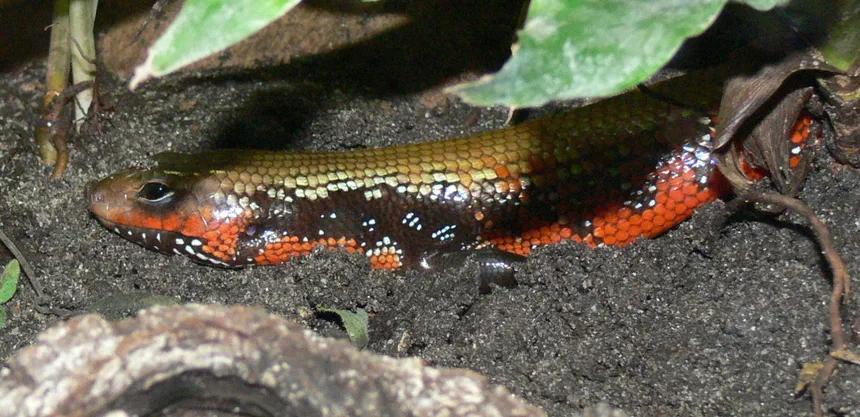
Image: Haplochromis — CC BY-SA 3.0 · source
What Is a Fire Skink?
The fire skink (Lepidothyris fernandi) is a medium-sized, ground-dwelling lizard from the forests of tropical Africa, prized for its vivid coloring. It belongs to the large skink family (Scincidae) and is one of the more striking terrestrial reptiles kept in the exotic-pet trade, though wild populations remain the heart of the species.
Appearance and Identification
The fire skink earns its name from the flame-like colors along its sides. The back is typically a rich coppery or golden-brown, while the flanks carry bold bars of bright red, black, and silvery-white, often edged crisply against one another. The belly is paler, and the tail may show black-and-white banding. The body is elongated and cylindrical with smooth, glossy scales, short but sturdy legs, and a tapering tail. Adults usually reach about 12 to 15 inches (30 to 37 cm) in total length, with roughly half of that being tail. There is little obvious difference between the sexes, though males may be somewhat broader-headed.
Habitat and Range
This species occurs across West and Central Africa, from Guinea and other parts of West Africa eastward through the Congo basin, including the island of Bioko (formerly Fernando Po, which gives the species its name fernandi). Fire skinks live on the floor of humid tropical and subtropical forests, favoring areas with deep leaf litter, loose soil, and abundant cover such as rotting logs and buttress roots. They spend much of their time hidden in this warm, moist ground layer, where humidity stays high and temperatures are stable.
Diet
Fire skinks are opportunistic feeders, best described as omnivores that lean heavily toward an insect diet. The bulk of their food consists of invertebrates such as crickets, beetles, grasshoppers, worms, and other small arthropods they encounter while foraging through the litter. They will also take small amounts of soft fruit and other plant matter when available, and larger individuals may occasionally eat tiny vertebrates. Their sharp senses and quick lunges make them effective ambush and pursuit hunters at close range.
Behavior
Despite their bright appearance, fire skinks are secretive and often shy. They are primarily diurnal, becoming active to bask and forage during warmer daylight hours, but they retreat quickly into burrows or leaf litter at any disturbance. Much of their day is spent digging and tunneling through soft substrate, and they are strong burrowers. They are generally solitary and can be territorial toward others of their kind, particularly males, which may display or wrestle over space. When threatened, a fire skink can shed part of its tail to escape a predator, later regrowing it.
Life Cycle and Reproduction
Fire skinks are egg-laying (oviparous). After mating, the female typically deposits a small clutch of eggs, often around five to ten, in a concealed, humid spot such as under logs or within moist soil. In some cases females remain near the eggs. Incubation lasts on the order of one to two months depending on temperature and humidity, after which fully formed, miniature versions of the adults hatch and are independent from birth. Fire skinks are relatively long-lived for their size; with good conditions they can survive well over a decade, and lifespans approaching or exceeding 20 years have been reported in captivity.
Conservation Status
The fire skink has not been formally assessed by the IUCN Red List, so it carries no official conservation category. It remains fairly widespread across its African forest range and is not currently considered threatened at a broad scale. The main pressures it faces are habitat loss from deforestation and collection for the international pet trade. Maintaining healthy tropical forest habitat is the most important factor for the species’ long-term security.
Frequently Asked Questions
Why is it called a fire skink? The name comes from the vivid flame-colored red, black, and white markings along the animal’s sides, which contrast sharply with its coppery back.
Are fire skinks dangerous to people? No. They are non-venomous, shy, and pose no threat to humans; a startled one is far more likely to flee and burrow than to bite.
Where do fire skinks live in the wild? They inhabit the leaf-littered floor of humid tropical forests across West and Central Africa, including the island of Bioko.