Reptiles Guide
Fer-de-Lance
What Is a Fer-de-Lance? The fer-de-lance (Bothrops asper) is a large, venomous pit viper native to the tropics of Central and northern South America. Also called the terciopelo, it is among the region’s most medically …
At a glance
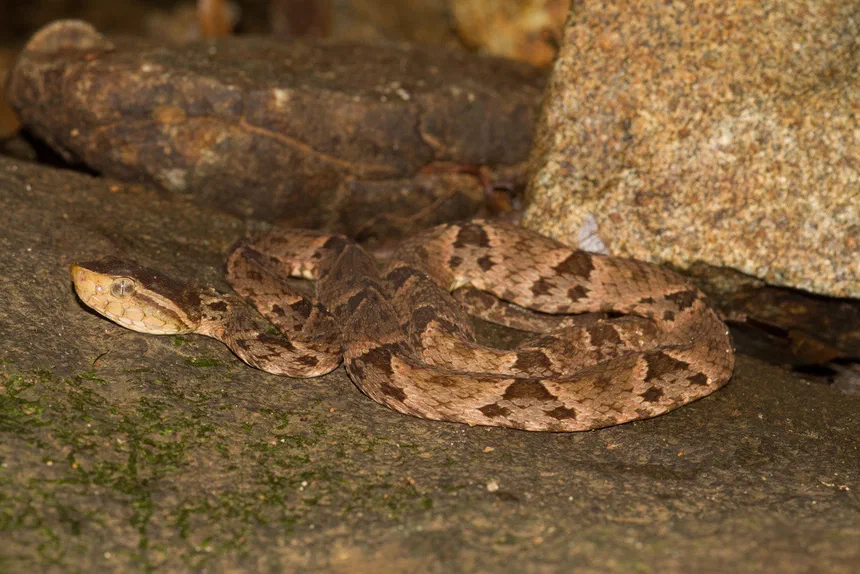
What Is a Fer-de-Lance?
The fer-de-lance (Bothrops asper) is a large, venomous pit viper native to the tropics of Central and northern South America. Also called the terciopelo, it is among the region’s most medically important snakes and is responsible for a substantial share of serious snakebites within its range.
Appearance and Identification
This heavy-bodied viper is typically brown, olive, or grayish, marked along the back with a series of dark, pale-edged triangles or diamond shapes that often form an X or hourglass pattern along the flanks. The head is broad, triangular, and clearly set off from a narrow neck, and the snout tapers to a point. Like other pit vipers, it has heat-sensing pits between the eye and nostril, vertical pupils, and long, hinged fangs that fold against the roof of the mouth. Most adults measure roughly 4 to 6 feet (1.2 to 1.8 meters), though large females can grow considerably longer and noticeably bulkier than males. Juveniles frequently have a yellow-tipped tail, which they use to lure prey.
Habitat and Range
The fer-de-lance ranges from southern Mexico through much of Central America and into parts of Colombia, Venezuela, and Ecuador. It favors humid lowland environments, including tropical rainforest, forest clearings, riverbanks, and the edges of streams. It is also common in disturbed and agricultural landscapes such as plantations, pastures, and the margins of villages, where rodents are plentiful. This tolerance for human-altered habitat is one reason it so often comes into contact with people. It occurs mostly at lower elevations but can be found on humid mountain slopes.
Diet
An opportunistic carnivore, the fer-de-lance feeds mainly on small mammals such as rats and mice, along with frogs, lizards, birds, and occasionally other snakes. Young snakes take a larger proportion of cold-blooded prey like frogs and lizards, shifting toward rodents as they grow. It is an ambush hunter, lying motionless and striking rapidly when prey passes within range. The venom quickly immobilizes the victim, and the snake then swallows it whole, tracking it by scent if it moves off after the bite.
Behavior
The fer-de-lance is primarily nocturnal, hunting and moving most actively after dark and sheltering by day among leaf litter, logs, or vegetation, where its patterning provides excellent camouflage. It is largely solitary and terrestrial, though younger individuals may climb into low vegetation. The species has a reputation for being alert and quick to defend itself; when threatened it may vibrate its tail, hold its ground, and deliver fast, powerful strikes. Its potent venom, willingness to enter farmland, and tendency to remain still until closely approached make it a serious hazard to agricultural workers.
Life Cycle and Reproduction
The fer-de-lance is viviparous, giving birth to live young rather than laying eggs. Females are highly prolific, and large individuals can produce big litters, sometimes numbering several dozen or more offspring at once. Newborns are fully formed, independent, and venomous from birth, measuring around 12 inches (30 centimeters). They receive no parental care and must hunt on their own immediately, using their bright tail tips to attract small prey. In the wild, individuals may live roughly 15 to 20 years.
Conservation Status
The fer-de-lance has not been formally assessed by the IUCN, but it is widespread, adaptable, and locally abundant across much of its range, and is not considered threatened. Its ability to thrive in farmland and secondary forest helps sustain healthy populations. Because it is a leading cause of venomous snakebite in Latin America, much of the attention it receives centers on public health and antivenom rather than conservation concern.
Frequently Asked Questions
Is the fer-de-lance dangerous to humans? Yes. Its venom is potent, it frequently lives near farms and settlements, and it accounts for many serious snakebites in its range. Prompt medical treatment with antivenom is important after any bite.
Why is it called a fer-de-lance? The name is French for “spearhead” or “lance head,” a reference to the snake’s distinctly pointed, triangular head. In much of its range it is also known by the Spanish name terciopelo.
Does the fer-de-lance lay eggs? No. Females give birth to live young, often in large litters, and the newborns are venomous and self-sufficient right away.