Reptiles Guide
False Water Cobra
What Is a False Water Cobra? The false water cobra (Hydrodynastes gigas) is a large, semi-aquatic snake native to the wetlands of central South America. It earns its name from its ability to flatten its neck into a hood …
At a glance
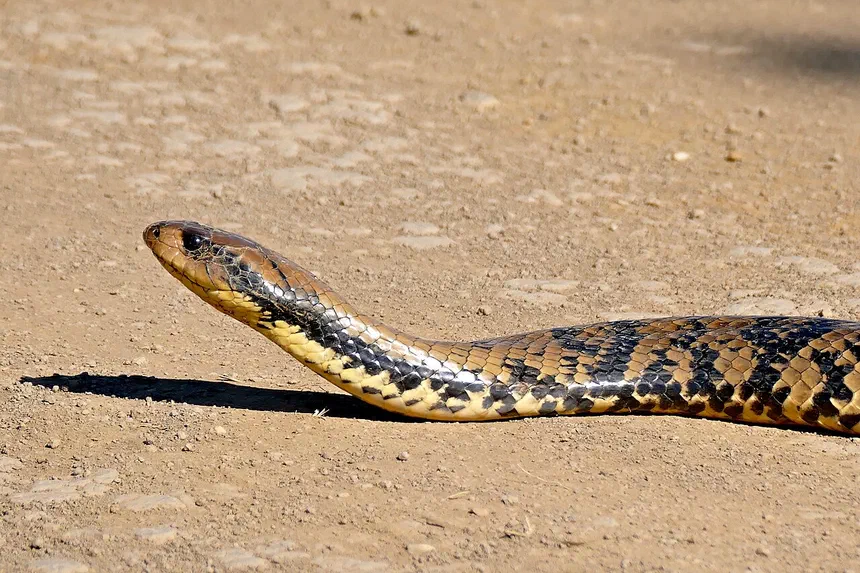
Image: Bernard DUPONT — CC BY-SA 2.0 · source
What Is a False Water Cobra?
The false water cobra (Hydrodynastes gigas) is a large, semi-aquatic snake native to the wetlands of central South America. It earns its name from its ability to flatten its neck into a hood when threatened, giving it a superficial resemblance to a true cobra, though it is not closely related to those elapids. It is a rear-fanged colubrid whose mild venom poses little serious threat to humans.
Appearance and Identification
This is one of the largest colubrid snakes, with adults commonly reaching 6 to 8 feet in length and occasionally longer. The body is stout and muscular, colored in shades of olive, brown, or tan overlaid with dark bands, blotches, and speckling that fade toward the tail. Large individuals can weigh several pounds. Its most distinctive feature is the flattened hood it displays when alarmed, which spreads horizontally rather than vertically as in a true cobra. The head is broad with prominent eyes, and rear-positioned enlarged teeth deliver a weak venom used mainly on prey.
Habitat and Range
The false water cobra inhabits the tropical and subtropical lowlands of central South America, spanning parts of Brazil, Bolivia, Paraguay, Argentina, and neighboring areas, with the Pantanal wetlands forming a core stronghold. As a semi-aquatic species, it favors marshes, swamps, flooded grasslands, slow rivers, and vegetated pond margins. It is an excellent swimmer and is rarely found far from permanent water, though it will bask and forage along shorelines.
Diet
An opportunistic carnivore, the false water cobra preys on a wide range of animals. Fish and amphibians such as frogs and toads make up much of its diet, but it also takes small mammals, birds, reptiles, and eggs. Active during the day, it hunts both in water and on land, using its mild venom and constriction-like body pressure to subdue prey before swallowing it whole. Its broad appetite makes it a flexible and effective predator across wetland habitats.
Behavior
Unlike many snakes, the false water cobra is largely diurnal, actively foraging and basking during daylight hours. It is a strong, confident swimmer that readily takes to water to hunt or escape danger. When threatened it may flatten its neck into a hood, hiss, and lunge, but it is not considered highly dangerous; bites are uncommon and its venom typically causes only mild local reactions in humans. In captivity the species is known for being alert, active, and relatively curious compared with many other large snakes.
Life Cycle and Reproduction
The false water cobra is oviparous, meaning females lay eggs rather than giving live birth. Breeding usually follows the seasonal cycle of the wetlands, and after mating a female may deposit a clutch that often numbers a dozen or more eggs, sometimes considerably more in large females. The eggs are laid in moist, sheltered sites and incubate for roughly two to three months before hatching. Hatchlings are independent from birth and grow quickly given the abundant prey of their wetland homes. Individuals may live well over a decade, with some reaching around twenty years.
Conservation Status
The false water cobra has not been formally assessed by the IUCN, so it carries no official conservation category. It remains fairly widespread across its range and is common in parts of the Pantanal and surrounding wetlands. It is also popular in the exotic pet trade, where it is bred in captivity. As with many wetland species, habitat drainage, agricultural expansion, and water pollution represent potential long-term pressures worth monitoring.
Frequently Asked Questions
Is the false water cobra venomous? Yes, but only mildly. It is a rear-fanged snake whose venom is adapted for subduing prey. Bites to humans are rare and usually cause only minor swelling or irritation, though sensitive individuals should still seek medical advice.
Is it a true cobra? No. Despite the hooding display that gives it its name, it is a colubrid, not an elapid, and is not closely related to true cobras. The hood spreads horizontally rather than rising vertically.
Where does it live? It is found in the wetlands of central South America, including the Pantanal region of Brazil, Bolivia, Paraguay, and Argentina, always near marshes, swamps, and slow waterways.