Reptiles Guide
Eyelash Viper
What Is a Eyelash Viper? The eyelash viper (Bothriechis schlegelii) is a small, venomous arboreal pit viper native to the forests of Central and South America. It takes its name from the cluster of raised, spiny scales …
At a glance
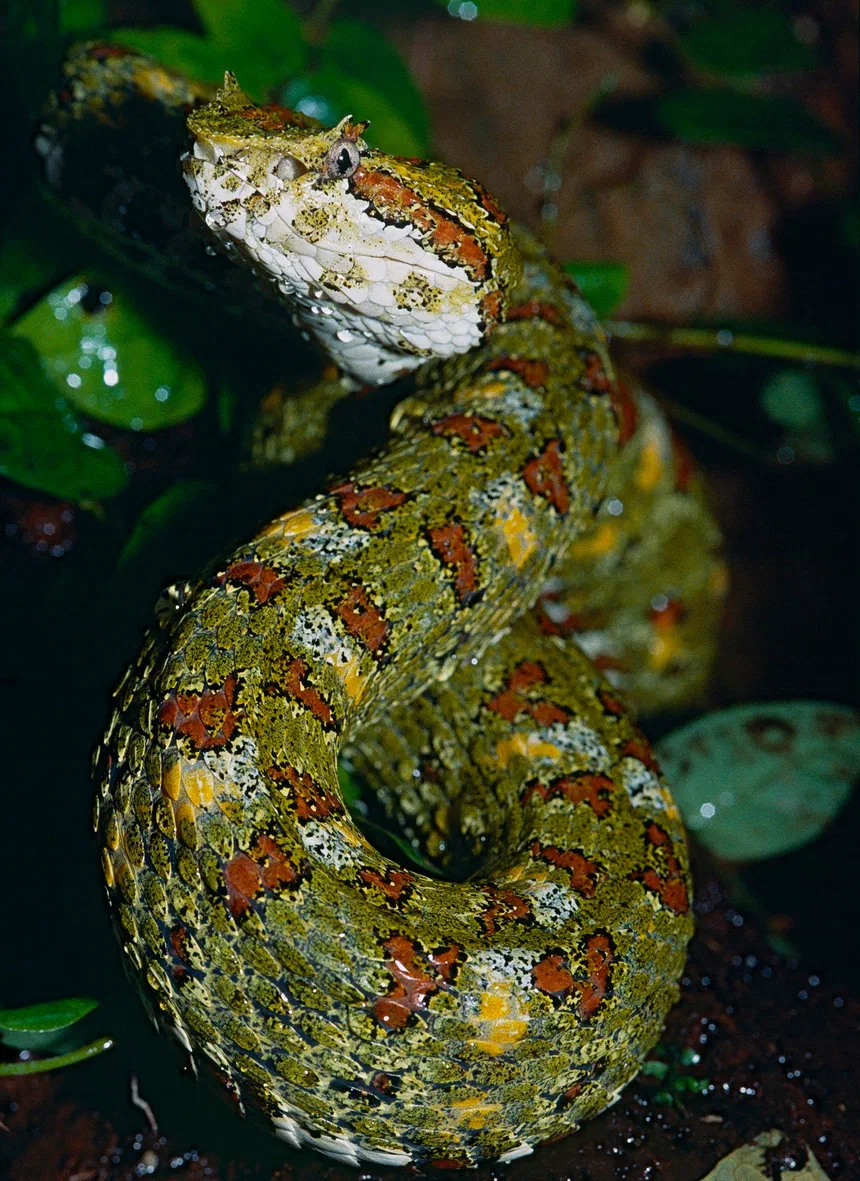
Image: Bernard DUPONT from FRANCE — CC BY-SA 2.0 · source
What Is a Eyelash Viper?
The eyelash viper (Bothriechis schlegelii) is a small, venomous arboreal pit viper native to the forests of Central and South America. It takes its name from the cluster of raised, spiny scales that sit above each eye, resembling delicate eyelashes. Renowned for its striking range of colors, it is one of the most recognizable and frequently photographed snakes in the Neotropics.
Appearance and Identification
This is a modestly sized snake, with most adults measuring roughly 22 to 32 inches (55 to 82 cm). Females are generally larger and heavier than males. The species is famous for its extraordinary color variation: individuals may be bright golden-yellow, leaf green, muted brown, dusky gray, or a soft pinkish hue, sometimes flecked with reddish or black speckling. The signature feature is the fringe of modified, superciliary scales above the eyes that gives the animal its “eyelashes.” Like other pit vipers, it has a broad, triangular head, vertical pupils, and heat-sensing pits between the eye and nostril. Its prehensile tail helps it grip branches.
Habitat and Range
The eyelash viper occupies humid lowland and montane forests, including tropical rainforest and cloud forest, and it readily persists in shaded plantations such as coffee, banana, and cacao. Its range extends from southern Mexico down through the Central American isthmus and into portions of Colombia, Ecuador, Venezuela, and Peru. Highly arboreal, it spends most of its life in shrubs, vines, and low tree branches, often near streams, though it can also be found closer to the ground.
Diet
As an ambush predator, the eyelash viper feeds on a variety of small vertebrates. Its prey includes frogs, lizards, small birds, and rodents; hatchlings often take insects, frogs, and small lizards, while larger adults can subdue mice and nesting birds. The snake typically coils motionless on a branch, sometimes for days, waiting for prey to approach before striking with a rapid bite that delivers venom to immobilize the animal.
Behavior
The eyelash viper is largely nocturnal and sedentary, relying on camouflage and patience rather than active pursuit. During the day it commonly rests coiled among foliage or flowers, where its coloration blends with the surroundings. Brightly colored individuals are sometimes drawn to flowering plants that attract insects, frogs, and hummingbirds. Though not aggressive, the snake will strike defensively if disturbed, and its venom is medically significant to humans, capable of causing pain, swelling, and tissue damage. Bites are rarely fatal with prompt medical care.
Life Cycle and Reproduction
The eyelash viper is ovoviviparous, meaning females retain the eggs internally and give birth to live young rather than laying eggs. After a gestation period of several months, a female typically produces a litter of around 6 to 20 offspring, though litter sizes vary with her size and condition. Newborns measure only a few inches long and are fully independent, equipped with venom from birth. There is no parental care once the young are born.
Conservation Status
The eyelash viper is listed as Least Concern by the IUCN, reflecting its wide distribution, broad habitat tolerance, and generally stable populations. It adapts well to disturbed and agricultural landscapes, which buffers it against many pressures. Localized threats include habitat loss and collection for the exotic pet trade, but neither currently poses a rangewide risk to the species.
Frequently Asked Questions
Are eyelash vipers dangerous to humans? Yes, they are venomous, and a bite can cause significant pain, swelling, and tissue damage. However, they are not aggressive and bites are uncommon; most occur when the snake is accidentally handled or stepped on. Prompt medical treatment makes fatalities rare.
Why do they come in so many colors? Color in this species is genetically determined and highly polymorphic, ranging from vivid yellow to green, brown, gray, and pink. The different morphs help individuals blend into varied backgrounds such as flowers, foliage, and bark.
What are the “eyelashes” for? The raised scales above the eyes are thought to help break up the snake’s outline for camouflage and may protect the eyes as it moves through dense vegetation.