Reptiles Guide
Emerald Tree Boa
What Is a Emerald Tree Boa? The emerald tree boa (Corallus caninus) is a slender, non-venomous snake of the Amazon rainforest, celebrated for its vivid green coloration and strongly arboreal lifestyle. It belongs to the …
At a glance
What Is a Emerald Tree Boa?
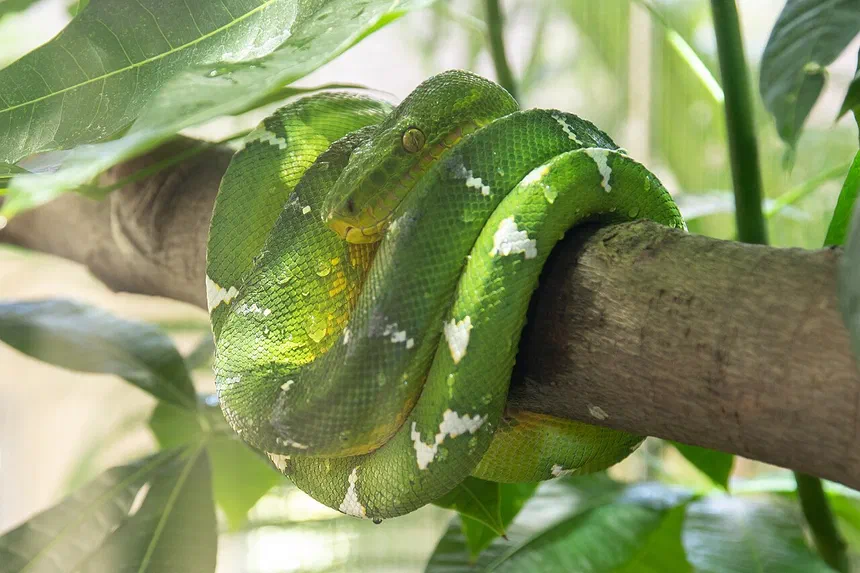
The emerald tree boa (Corallus caninus) is a slender, non-venomous snake of the Amazon rainforest, celebrated for its vivid green coloration and strongly arboreal lifestyle. It belongs to the boa family, giving birth to live young rather than laying eggs, and spends nearly its entire life coiled among the branches of the forest canopy.
Appearance and Identification
Adult emerald tree boas are a striking bright green, broken by a series of irregular white or cream markings running down the back that are sometimes described as a lightning-bolt pattern. The belly is pale yellow to white. This species has a notably large, triangular head set off from a slender neck, along with prominent, deep heat-sensing pits along the jaws that help it detect warm-blooded prey. Adults typically reach around 6 feet (1.8 meters), with some individuals a bit longer, and weigh roughly 1 to 3 pounds. Newborns are quite different in color, hatching brick red, orange, or yellow before gradually shifting to green over several months to a year, a change known as ontogenetic color change.
Habitat and Range
The emerald tree boa inhabits the lowland tropical rainforests of the Amazon Basin, ranging across parts of Brazil, Colombia, Ecuador, Peru, Venezuela, Guyana, Suriname, and French Guiana. It is a canopy specialist, favoring humid, densely vegetated forest where it can move and rest among horizontal branches. A closely related and very similar-looking species, the northern or Amazon green tree python, is actually a distant relative in Australia and New Guinea; the resemblance is a famous example of convergent evolution rather than close kinship.
Diet
As a carnivore, the emerald tree boa preys chiefly on small mammals such as rodents, along with birds, and occasionally lizards and frogs. It is an ambush predator, anchoring its tail to a branch and draping its body in tidy, symmetrical coils while holding its head poised to strike. Its long front teeth and heat-sensing pits make it especially effective at seizing warm-blooded prey in low light. Like other boas, it kills by constriction, wrapping around the animal and tightening until the prey stops breathing, then swallowing it whole.
Behavior
This is a nocturnal, largely solitary snake that hunts and moves at night and rests by day. During daylight hours it adopts its characteristic pose, coiled in neat loops over a branch with its head resting in the center. Emerald tree boas are highly arboreal and rarely descend to the ground. They can be defensive if disturbed, and their long teeth deliver a memorable bite, though they are not venomous and pose no serious danger to people. Their green coloration and habit of staying motionless provide excellent camouflage against the leaves.
Life Cycle and Reproduction
Emerald tree boas are ovoviviparous, meaning the female retains the eggs inside her body and gives birth to live young. After a gestation period of several months, she produces a litter that commonly ranges from a handful to around a dozen or more neonates, though litter size varies. The young are independent at birth and display their bright red or orange juvenile coloration, which transitions to adult green as they mature. Sexual maturity is reached after a few years. In the wild, emerald tree boas are thought to live around 15 to 20 years, and they can live longer under human care.
Conservation Status
The emerald tree boa is listed as Least Concern by the IUCN, reflecting its wide distribution across the Amazon and generally stable populations. It is not considered globally threatened, though like many rainforest species it can be affected locally by habitat loss and by collection for the exotic pet trade. International trade is monitored under CITES, which offers some safeguard against unsustainable harvest.
Frequently Asked Questions
Is the emerald tree boa venomous? No. It is a non-venomous constrictor. It has long teeth and can bite defensively, but it subdues prey by squeezing rather than with venom.
Why are baby emerald tree boas red instead of green? Newborns hatch in shades of red, orange, or yellow and gradually turn green over several months to a year. This ontogenetic color change is normal and may help camouflage juveniles in different parts of the forest.
How is it different from the green tree python? They look remarkably alike but are only distantly related, living on opposite sides of the world. Their shared appearance is a classic case of convergent evolution driven by similar arboreal, ambush-hunting lifestyles.