Reptiles Guide
Eastern Fence Lizard
What Is a Eastern Fence Lizard? The eastern fence lizard (Sceloporus undulatus) is a small, spiny-scaled reptile native to the eastern and central United States. A member of the family Phrynosomatidae, it is one of the …
At a glance
What Is a Eastern Fence Lizard?
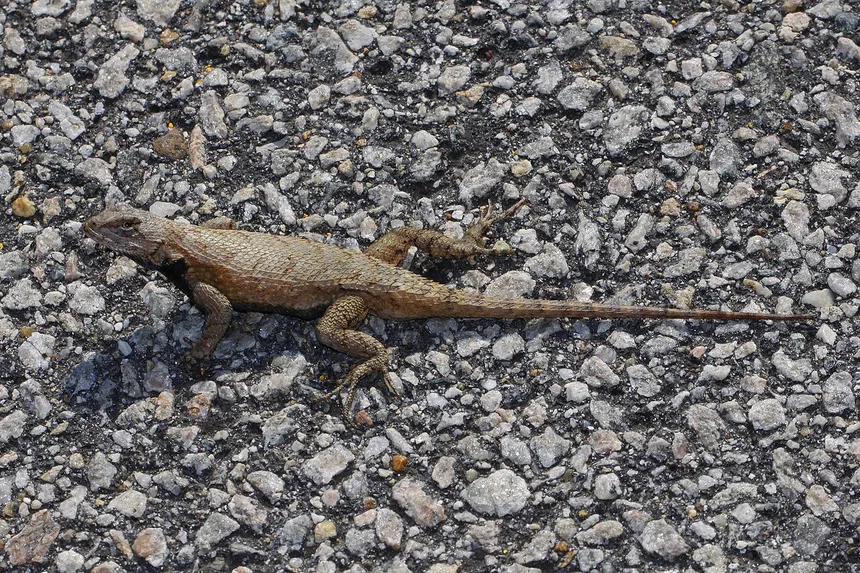
The eastern fence lizard (Sceloporus undulatus) is a small, spiny-scaled reptile native to the eastern and central United States. A member of the family Phrynosomatidae, it is one of the most familiar “spiny lizards,” often spotted basking on wooden fences, rock piles, and fallen logs. It belongs to a widespread genus whose taxonomy has been revised several times, so populations once grouped together are now recognized as separate species.
Appearance and Identification
This lizard has a stout body covered in rough, strongly keeled scales that give it a distinctly bristly, “armored” look. Adults typically reach about 4 to 7.5 inches (10 to 19 cm) in total length, with much of that made up of the tail. Background coloration ranges from gray to grayish-brown, helping the animal blend against tree bark and stone. Females often show wavy, dark crossbands along the back, while males tend to be plainer above but display striking iridescent blue patches on the throat and along each side of the belly. These blue markings, bordered with black, are used in social signaling and are far more vivid in breeding males.
Habitat and Range
Eastern fence lizards occupy a broad swath of the eastern and central United States, from parts of the Northeast and mid-Atlantic south to the Gulf states and west into the Great Plains. They favor dry, sunny environments such as open pine and hardwood forests, woodland edges, rocky outcrops, and old fields. As their name suggests, they readily use human-made structures like wooden fences, stone walls, and log piles as basking and lookout perches. Well-drained soils and abundant vertical surfaces for climbing and sunning are common features of their preferred habitat.
Diet
The species is primarily insectivorous, feeding on a wide range of small invertebrates. Beetles, ants, spiders, grasshoppers, and other arthropods make up the bulk of the diet. As a sit-and-wait predator, the lizard often perches on an elevated surface and darts out to seize prey that wanders within range. Foraging activity is tied closely to temperature, peaking during warm, sunny parts of the day when the lizard is most active.
Behavior
Eastern fence lizards are diurnal and heliothermic, relying on the sun to warm their bodies to an active temperature. They are strong climbers and, when threatened, typically dash to the nearest tree or fence and scramble to the far side, keeping the trunk between themselves and the intruder. Males are territorial during the breeding season and perform conspicuous “push-up” displays, bobbing the body to flash their blue underside coloration at rivals and potential mates. In cooler northern parts of the range, these lizards enter a period of winter dormancy, sheltering under bark, rocks, or leaf litter.
Life Cycle and Reproduction
Breeding generally takes place in spring after emergence from winter dormancy. Eastern fence lizards are egg-laying (oviparous); females deposit a clutch of roughly 3 to 16 eggs in loose, moist soil or under debris, and warmer southern populations may produce more than one clutch per season. The eggs incubate for several weeks with no parental care, and hatchlings are fully independent, miniature versions of the adults. Sexual maturity is usually reached within a year or two, and individuals commonly live around 3 to 5 years in the wild.
Conservation Status
The eastern fence lizard is widespread and generally common across its range, and the IUCN lists it as Least Concern. It tolerates a variety of habitats, including edges of human-altered landscapes, which helps sustain its populations. Localized threats include habitat loss, pesticide use that reduces insect prey, and predation by domestic and feral animals. Notably, some populations have shown behavioral and physical adaptations in response to invasive fire ants, an example of ongoing natural selection in the wild.
Frequently Asked Questions
Are eastern fence lizards dangerous to people? No. They are harmless, non-venomous insect eaters. If handled they may bite defensively, but the bite is tiny and causes no real harm.
Why do the males have blue bellies? The blue throat and belly patches are social signals used mainly by males to defend territory and attract mates, which is why they earn the nickname “blue-bellies.”
Where are you most likely to see one? Look on sunny wooden fences, rock walls, log piles, and tree trunks in open woodland or forest-edge habitat during warm daytime hours.