Reptiles Guide
Eastern Diamondback Rattlesnake
What Is a Eastern Diamondback Rattlesnake? The eastern diamondback rattlesnake (Crotalus adamanteus) is the largest venomous snake in North America and one of the most iconic pit vipers of the American Southeast. Named …
At a glance
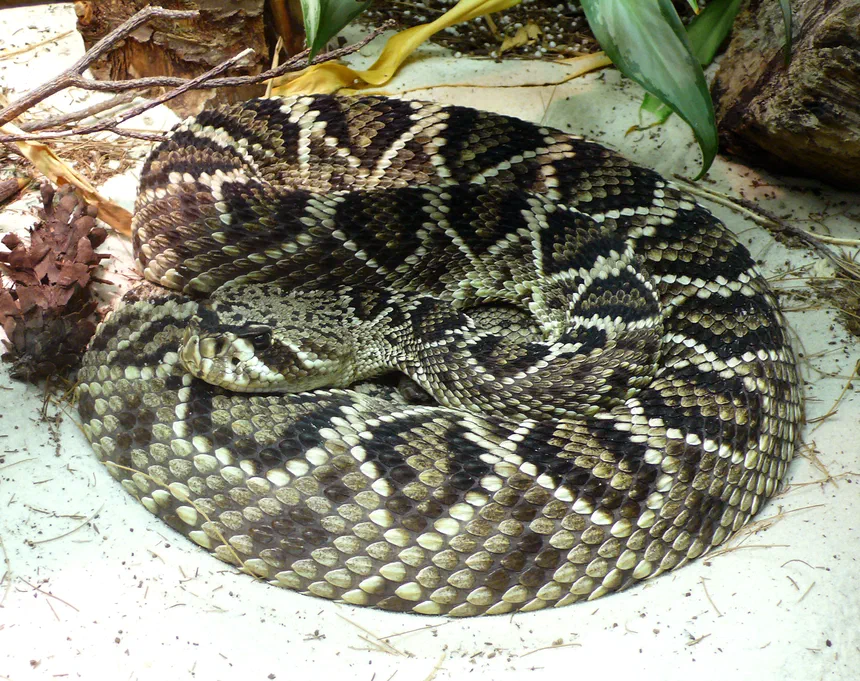
Image: TimVickers — Public domain · source
What Is a Eastern Diamondback Rattlesnake?
The eastern diamondback rattlesnake (Crotalus adamanteus) is the largest venomous snake in North America and one of the most iconic pit vipers of the American Southeast. Named for the bold, light-bordered diamond pattern running down its back, it is a heavy-bodied predator equipped with a segmented tail rattle and highly effective venom.
Appearance and Identification
This is a robust, thick-bodied snake, with most adults measuring roughly 4 to 6 feet in length, though exceptional individuals can approach 7 feet or more. Ground color ranges from brownish tan to olive or gray, overlaid with a series of dark diamonds that are each outlined by a border of lighter, cream or yellowish scales. A distinctive pair of diagonal light stripes crosses the face near the eyes. The tail ends in a rattle of loosely interlocking keratin segments, and like other pit vipers, the snake has a broad, triangular head, vertical pupils, and heat-sensing facial pits between the eye and nostril.
Habitat and Range
The eastern diamondback is found across the coastal plain of the southeastern United States, from southeastern North Carolina south through Florida and west along the Gulf Coast to Louisiana. It favors dry, sandy uplands including longleaf pine flatwoods, sandhills, coastal scrub, and dense palmetto thickets. Gopher tortoise burrows, stump holes, and mammal burrows are frequently used as shelter and as refuges from temperature extremes and fire.
Diet
An ambush predator, the eastern diamondback feeds mainly on warm-blooded prey. Rabbits, cotton rats, mice, squirrels, and ground-dwelling birds make up the bulk of its diet. The snake often lies coiled and motionless along game trails or near burrows, striking rapidly to inject venom, then releasing larger prey and following the scent trail until the animal succumbs before swallowing it whole. Large adults can go weeks between substantial meals.
Behavior
Eastern diamondbacks are generally solitary and are most active during warmer months, adjusting their activity between day and night to avoid heat. When threatened, the snake may hold its ground, raise the forward part of its body into an S-shaped coil, and vibrate its rattle as a warning. Despite a fearsome reputation, it typically prefers to avoid confrontation and will retreat if given the opportunity. In the cooler parts of its range, it shelters during winter in burrows and other underground retreats.
Life Cycle and Reproduction
The species is ovoviviparous, meaning the female retains the eggs internally and gives birth to live young. Mating generally occurs in late summer and early fall, and after a gestation of several months a female produces a litter that commonly ranges from around 7 to 20 young, though numbers vary. Newborns are fully equipped with functional fangs and venom and are independent almost immediately, receiving no parental care beyond birth. Females typically reproduce only every two to three years because of the high energy cost of gestation.
Conservation Status
The eastern diamondback is currently listed by the IUCN as Least Concern, but populations have declined across much of the historic range. Loss and fragmentation of longleaf pine habitat, road mortality, and deliberate killing, including organized rattlesnake roundups, have all reduced numbers in many areas. Conservation of fire-maintained pine ecosystems and gopher tortoise burrows is closely tied to the long-term health of this species.
Frequently Asked Questions
Is the eastern diamondback dangerous to humans? Its venom is potent and a bite is a genuine medical emergency requiring prompt treatment, but the snake is not aggressive and bites are uncommon when the animal is left undisturbed.
How big do eastern diamondbacks get? Most adults are about 4 to 6 feet long, making this the largest rattlesnake and the heaviest venomous snake in North America.
Do they always rattle before striking? No. While the rattle is a warning signal, a startled snake may strike without rattling first, so caution is warranted in their habitat.