Reptiles Guide
Eastern Coral Snake
What Is a Eastern Coral Snake? The Eastern coral snake (Micrurus fulvius) is a slender, brightly banded venomous snake native to the southeastern United States. It belongs to the family Elapidae, the same group that …
At a glance
What Is a Eastern Coral Snake?
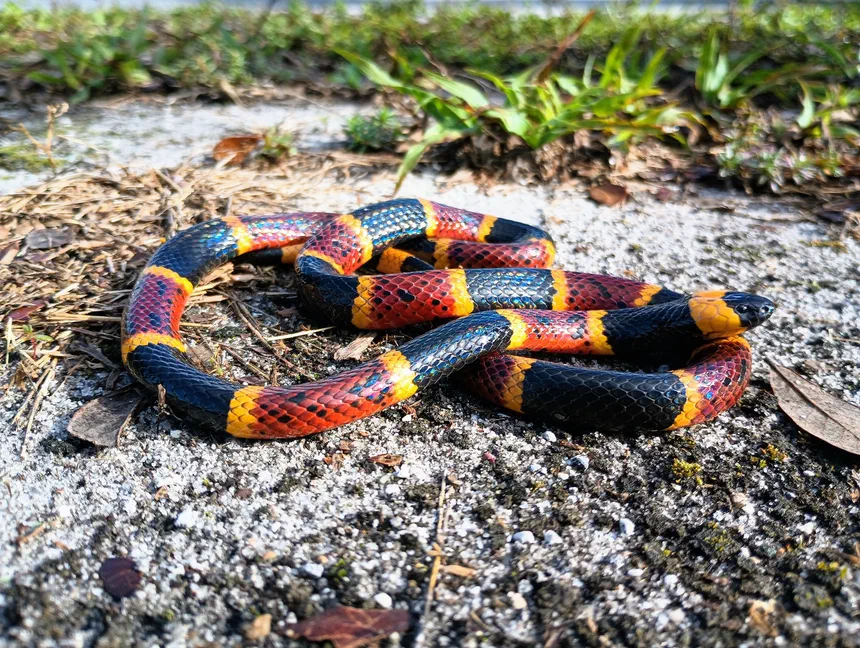
The Eastern coral snake (Micrurus fulvius) is a slender, brightly banded venomous snake native to the southeastern United States. It belongs to the family Elapidae, the same group that includes cobras and mambas, and is one of only a handful of highly venomous snakes found in North America. Despite its potent venom, it is shy, secretive, and rarely encountered by people.
Appearance and Identification
This snake is unmistakable when seen clearly. Its smooth, glossy body is ringed with wide bands of red and black separated by narrower bands of bright yellow, and it has a blunt, black snout. The order of the colors is the key identifier: on the Eastern coral snake, the red and yellow bands touch one another. This has given rise to the folk rhyme “red touches yellow, kills a fellow,” which helps distinguish it from harmless mimics such as the scarlet kingsnake, on which red bands touch black. Adults are typically slim and average about 2 to 3 feet in length, with females often slightly larger than males.
Habitat and Range
The Eastern coral snake occupies a range across the coastal plain of the southeastern United States, from the Carolinas south through Florida and west along the Gulf Coast into parts of Louisiana and eastern Texas. It favors well-drained, sandy environments including longleaf pine flatwoods, scrubby oak areas, and the edges of hardwood hammocks. Much of its life is spent hidden beneath leaf litter, in loose soil, or under logs and debris, so it is far more common than sightings would suggest.
Diet
As a specialized predator, the Eastern coral snake feeds primarily on other snakes, especially smaller species, as well as lizards. It hunts by probing through ground cover and burrows, using its keen sense of smell to locate prey. Once it seizes a victim in its jaws, it delivers venom through short, fixed fangs at the front of its mouth, chewing to work the toxin in. It then swallows the prey whole, usually head first.
Behavior
The Eastern coral snake is reclusive and non-aggressive, spending most of the day underground or under cover and becoming more active in the morning and evening, particularly after rains. When threatened it tends to flee or hide rather than confront, and it may curl the tip of its tail and elevate it as a distraction display. Bites to humans are uncommon and usually occur only when the snake is handled or accidentally pressed against the skin. Its fangs are small, so its venom is delivered less efficiently than that of a viper, but the neurotoxic venom is medically significant and any bite warrants prompt medical care.
Life Cycle and Reproduction
Unlike many North American snakes, the Eastern coral snake is egg-laying. Mating generally takes place in spring and sometimes again in autumn, and females deposit a small clutch of several eggs, often around half a dozen, in early summer. The eggs are typically hidden in moist soil or rotting vegetation and receive no parental care. Hatchlings emerge after a couple of months, arriving fully independent and already equipped with functional venom, and measuring only a few inches long. They grow slowly and reach maturity over a period of a couple of years.
Conservation Status
The Eastern coral snake is not currently considered globally threatened and is generally regarded as a species of Least Concern. However, like many reptiles of the southeastern pinelands, it is sensitive to habitat loss from development, agriculture, and fire suppression that degrades its preferred open, sandy woodlands. Because it is secretive and hard to survey, population trends in some areas are poorly known, and continued protection of native longleaf pine habitat benefits this and many other native species.
Frequently Asked Questions
Is the Eastern coral snake dangerous to humans? It carries a potent neurotoxic venom, but bites are rare because the snake is shy and its small fangs make envenomation less efficient. Any confirmed bite should still be treated as a medical emergency.
How can I tell it apart from a harmless lookalike? Look at the band order. On the Eastern coral snake, the red and yellow bands touch, whereas on harmless mimics like the scarlet kingsnake, red bands are bordered by black.
What does the Eastern coral snake eat? It preys mainly on other, smaller snakes and on lizards, hunting through leaf litter and burrows and swallowing its prey whole.