Reptiles Guide
Dumeril's Boa
What Is a Dumeril’s Boa? The Dumeril’s boa (Acrantophis dumerili) is a medium-to-large, nonvenomous constricting snake native to the drier regions of Madagascar. Named after the French zoologist André Marie Constant …
At a glance
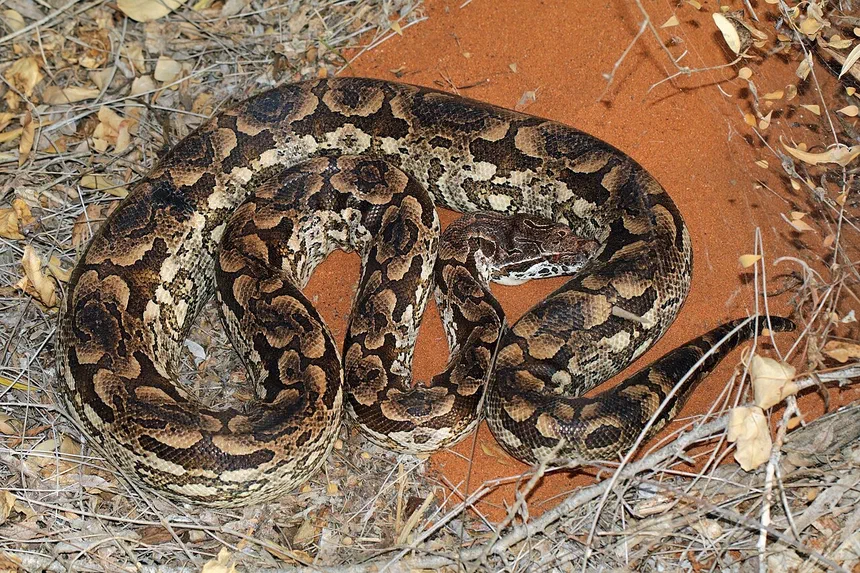
Image: Charles J. Sharp — CC BY-SA 4.0 · source
What Is a Dumeril’s Boa?
The Dumeril’s boa (Acrantophis dumerili) is a medium-to-large, nonvenomous constricting snake native to the drier regions of Madagascar. Named after the French zoologist André Marie Constant Duméril, it is one of two boa species in its genus and is prized among reptile keepers for its calm temperament and intricately patterned skin.
Appearance and Identification
This boa has a heavy, muscular body and a distinctly triangular head set off from a narrow neck. Its base color ranges from tan and grayish-brown to pinkish, overlaid with a series of dark brown or reddish blotches and diamond-like markings that break up its outline. This cryptic patterning is highly effective camouflage against the leaf litter and dry soil of its habitat, where the snake spends much of its time partly hidden. Most adults reach between 4 and 6.5 feet (about 1.2 to 2 meters) in length, with females typically larger and heavier than males.
Habitat and Range
The Dumeril’s boa is endemic to Madagascar, meaning it is found nowhere else on Earth. It occupies the southern and southwestern portions of the island, favoring dry deciduous forests, wooded savannas, and semi-arid scrubland. Unlike some tropical boas, this species is adapted to seasonally dry, warm environments rather than dense rainforest. It is largely terrestrial and often shelters among fallen leaves, beneath brush, or in shaded, humid pockets during the hottest parts of the day.
Diet
As an ambush predator, the Dumeril’s boa is a carnivore that feeds on warm-blooded prey. Its diet consists mainly of small mammals such as rodents, along with birds and occasionally reptiles. Rather than actively pursuing prey, the snake typically lies motionless and camouflaged, then strikes suddenly when an animal wanders within reach. Like all boas, it kills by constriction, coiling around its prey and tightening its grip until the animal can no longer breathe, before swallowing it whole.
Behavior
Dumeril’s boas are generally slow-moving, secretive, and most active around dawn and dusk. They are known for a docile disposition, which is one reason the species is popular in captivity. When threatened, an individual is more likely to remain still and rely on camouflage than to flee, though it may hiss or strike defensively if provoked. These snakes are solitary for most of the year, coming together only during the breeding season.
Life Cycle and Reproduction
Like other boas, the Dumeril’s boa is ovoviviparous, meaning females retain their eggs internally and give birth to live young rather than laying eggs. Breeding usually follows the cooler, drier season, and after a gestation period of several months a female may produce a litter typically numbering from a handful to more than a dozen neonates, though larger litters are possible. Newborns are fully independent at birth and measure roughly a foot or more in length. In the wild these boas are thought to live around 20 years, and well-cared-for captive individuals can reach or exceed 30 years.
Conservation Status
The Dumeril’s boa is currently listed as Least Concern by the IUCN, reflecting a relatively wide range and stable populations across suitable habitat. Nonetheless, it faces pressures from habitat loss as Madagascar’s dry forests are cleared for agriculture and grazing, as well as some collection for the pet trade. International trade is regulated under CITES, and captive-breeding programs have reduced demand for wild-caught animals. Continued protection of Madagascar’s dry forest ecosystems remains important for the species’ long-term security.
Frequently Asked Questions
Is the Dumeril’s boa venomous? No. It is a nonvenomous constrictor that subdues prey by squeezing rather than by injecting venom, and it poses no serious danger to people.
Where does the Dumeril’s boa live? It is found only on the island of Madagascar, primarily in the dry forests and scrublands of the south and southwest.
How big do Dumeril’s boas get? Most adults grow to between about 4 and 6.5 feet long, with females generally larger and more heavily built than males.