Reptiles Guide
Diamondback Terrapin
What Is a Diamondback Terrapin? The diamondback terrapin (Malaclemys terrapin) is a small to medium-sized turtle famous for the diamond-shaped, concentrically grooved rings that mark each plate of its upper shell. It is …
At a glance
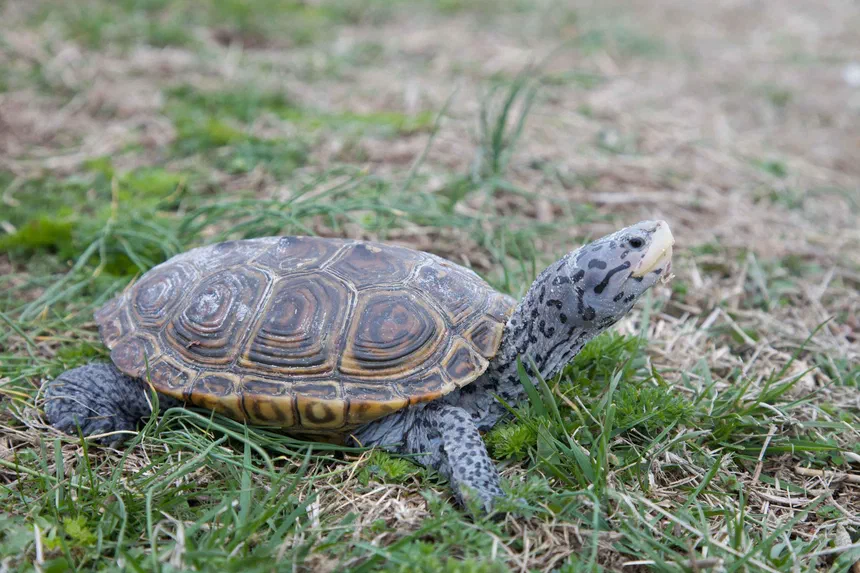
Image: Ryan Hagerty, U.S. Fish and Wildlife Service — Public domain · source
What Is a Diamondback Terrapin?
The diamondback terrapin (Malaclemys terrapin) is a small to medium-sized turtle famous for the diamond-shaped, concentrically grooved rings that mark each plate of its upper shell. It is the only North American turtle that spends its entire life in the brackish waters of coastal salt marshes, occupying a niche between fully freshwater and fully marine reptiles.
Appearance and Identification
The terrapin’s carapace (upper shell) ranges from gray and olive to nearly black, with each scute etched by the sculpted, diamond-like growth rings that give the species its name. The skin is strikingly pale, from gray to almost white, and is peppered with dark spots, flecks, and streaks that vary widely between individuals. Females are considerably larger than males, reaching a carapace length of roughly 6 to 9 inches (15 to 23 cm), while males typically stay around 4 to 5.5 inches (10 to 14 cm). Females also have broad heads and stout jaws suited to crushing hard-shelled prey. Both sexes have webbed feet, and the species carries specialized salt glands near the eyes that let it shed excess salt.
Habitat and Range
Diamondback terrapins live along the eastern seaboard and Gulf coast of the United States, from Cape Cod in Massachusetts south through Florida and west along the Gulf to Texas. They are restricted to coastal wetlands: tidal salt marshes, estuaries, lagoons, and mangrove-lined tidal creeks. This reliance on brackish water is unusual among turtles, and it ties the species closely to healthy, intact coastal ecosystems. Several regional subspecies are recognized across this range, differing subtly in shell shape and coloration.
Diet
Terrapins are carnivores, and their strong jaws are built for a menu of hard-bodied invertebrates. Common prey includes periwinkle snails, marsh crabs, fiddler crabs, mussels, clams, and marine worms. Larger females can crush thicker shells than males, so the sexes often exploit slightly different prey. By feeding heavily on periwinkle snails, terrapins can help protect cordgrass marshes from being over-grazed, giving them an ecological role beyond their own survival.
Behavior
Diamondback terrapins are active during the day and time much of their movement to the tides, foraging in flooded marsh at high water and resting in creeks or burrowing into mud at low water. In the colder parts of their range they brumate through winter, settling into the mud of tidal creeks until temperatures rise. They are generally solitary, though large numbers may gather in favorable feeding areas or, in spring, at courtship sites. Their salt glands and behavioral tricks, such as drinking the thin freshwater layer that floats on the surface after rain, help them manage life in salty water.
Life Cycle and Reproduction
Mating takes place in the water in spring. In early summer, females leave the marsh and climb onto sandy dunes, beaches, or the upper edges of the marsh to dig nests, laying clutches of roughly 4 to 18 eggs. A female may nest more than once in a season. As in many turtles, incubation temperature influences the sex of the hatchlings, with warmer nests tending to produce females. Eggs hatch after about two to three months, and the tiny hatchlings are highly vulnerable to birds, crabs, and mammals. Terrapins grow slowly and may take several years to mature, with females maturing later and at a larger size than males. Individuals can live for several decades in the wild.
Conservation Status
The diamondback terrapin is listed as Vulnerable on the IUCN Red List, and it faces a range of pressures across its coastal home. Historically it was hunted heavily as a food delicacy. Today the main threats include drowning in crab traps, road mortality of nesting females, loss and hardening of shoreline habitat, and collection for the pet trade. Conservation measures such as bycatch reduction devices on crab pots, protection of nesting beaches, and legal limits on collection are used in various states to help stabilize populations.
Frequently Asked Questions
Is a diamondback terrapin the same as a diamondback rattlesnake? No. Despite the shared name, the terrapin is a harmless coastal turtle, while the diamondback rattlesnake is a venomous snake. The word “diamondback” simply refers to the diamond pattern on each.
Can diamondback terrapins live in the ocean or in fresh water? They are specialists of the in-between. Terrapins thrive in brackish coastal marshes and can tolerate salt thanks to special glands, but they are not true marine turtles and do not live full-time in either the open sea or fresh water.
Why are they important to salt marshes? By preying on periwinkle snails and other grazers, terrapins help keep marsh vegetation from being overeaten, supporting the health of the cordgrass ecosystems they depend on.