Reptiles Guide
Desert Tortoise
What Is a Desert Tortoise? The desert tortoise (Gopherus agassizii) is a land-dwelling reptile native to the arid landscapes of the American Southwest. It belongs to the gopher tortoise family, a group of burrowing …
At a glance
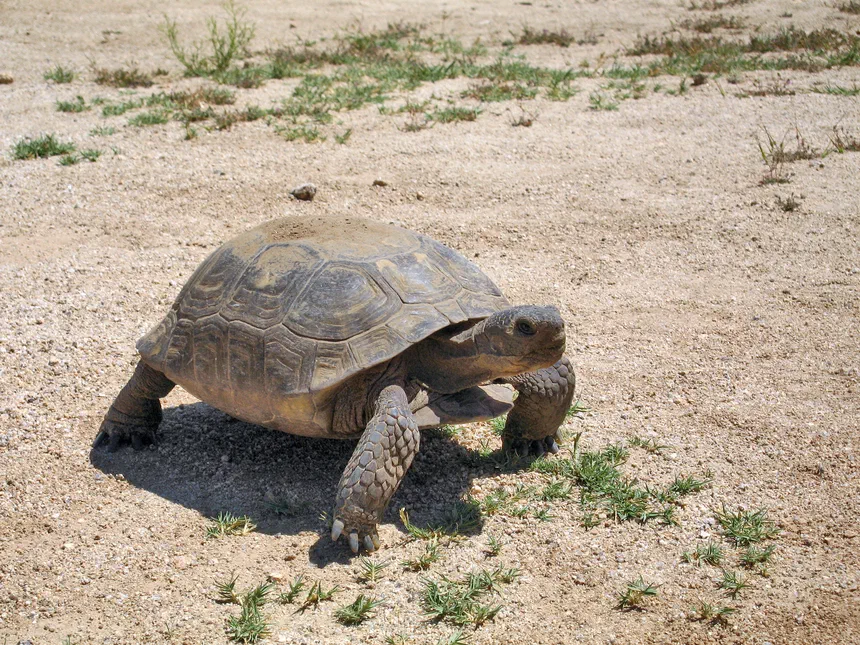
Image: Robb Hannawacker (Joshua Tree National Park) — Public domain · source
What Is a Desert Tortoise?
The desert tortoise (Gopherus agassizii) is a land-dwelling reptile native to the arid landscapes of the American Southwest. It belongs to the gopher tortoise family, a group of burrowing tortoises known for spending much of their lives underground. Superbly adapted to heat and drought, it is one of the most iconic residents of the Mojave and Sonoran deserts.
Appearance and Identification
This tortoise has a high, rounded shell that ranges from brown and tan to dull gray, with visible growth rings on each large scute. Adults typically measure about 9 to 15 inches (23 to 38 cm) in shell length and weigh roughly 8 to 15 pounds (3.5 to 7 kg). The front legs are flattened and heavily armored with thick scales, an adaptation for digging, while the elephantine hind legs support the domed body. Males tend to be somewhat larger than females and have a concave underside (plastron) and a longer gular projection beneath the neck, used in combat with rival males.
Habitat and Range
Desert tortoises occupy dry, open country including creosote flats, rocky foothills, sandy washes, and the gentle slopes of desert bajadas. Their range spans the southwestern United States, chiefly southern California, Nevada, Arizona, and Utah, extending south into northwestern Mexico. They favor terrain with soil loose enough to dig into yet firm enough to hold a stable burrow. These underground shelters are central to survival, buffering the animal against searing summer heat and winter cold.
Diet
The desert tortoise is a strict herbivore. It grazes on native grasses, the leaves and blossoms of wildflowers, herbaceous plants, and occasionally the pads and fruit of cactus. Much of the water it needs comes directly from this vegetation, and a tortoise can store water in its bladder to draw on during long dry spells. Feeding is concentrated in spring when annual plants flush after seasonal rains, allowing the animal to build fat and moisture reserves.
Behavior
Desert tortoises are solitary and spend a striking portion of their lives inside burrows, which they excavate themselves or share along established networks. They are most active in the cooler hours of morning and late afternoon, retreating underground during the harshest midday heat. In the hottest, driest months many enter a dormant state called estivation, and in winter they brumate, the reptilian equivalent of hibernation. When threatened they withdraw into the shell, and a startled tortoise may empty its bladder, which can be dangerous in dry conditions if it cannot soon replace the lost water.
Life Cycle and Reproduction
Mating generally occurs in spring and again in late summer. Females lay clutches of roughly 2 to 14 eggs, often depositing them in a nest dug near the mouth of a burrow, and may produce more than one clutch in a favorable year. The eggs incubate for around 90 to 120 days, with the surrounding temperature influencing the sex of the hatchlings. Young tortoises emerge with soft shells and face heavy predation, so survival to adulthood is low. Growth is slow, and individuals may not reach breeding age until 15 to 20 years old, but those that survive can live for many decades.
Conservation Status
The desert tortoise is listed as Vulnerable on the IUCN Red List, and the Mojave population is federally protected as threatened in the United States. Major pressures include habitat loss from development, roads, and off-road vehicle use, along with disease, raven predation on the young, and the spread of non-native plants that alter their food supply. Because the species is protected, it is illegal to collect wild individuals, and conservation efforts focus on protecting large tracts of intact desert.
Frequently Asked Questions
How long can a desert tortoise live? In the wild it commonly lives 50 to 80 years, and some individuals in protected conditions may live even longer.
How does it survive without much water? It gets most of its moisture from plants, stores water in its bladder, and shelters in burrows to reduce heat and water loss during dry periods.
Is it legal to keep a wild desert tortoise? No. It is a protected species, and taking one from the wild is illegal; captive-care programs are regulated by state wildlife agencies.