Reptiles Guide
Common Death Adder
What Is a Common Death Adder? The common death adder (Acanthophis antarcticus) is a venomous snake native to Australia and one of the most distinctive members of the elapid family. Despite its viper-like appearance and …
At a glance
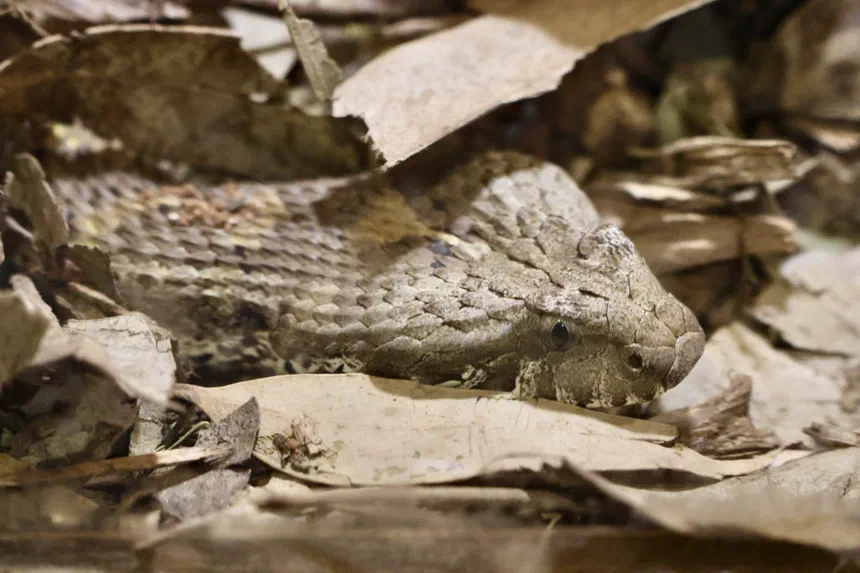
What Is a Common Death Adder?
The common death adder (Acanthophis antarcticus) is a venomous snake native to Australia and one of the most distinctive members of the elapid family. Despite its viper-like appearance and ambush habits, it is closely related to cobras, mambas, and other front-fanged elapids rather than to true vipers.
Appearance and Identification
The common death adder has a short, stout body that is unusually broad for its length, giving it a squat, muscular build. Adults typically measure between 20 and 40 inches (50 to 100 centimeters). The head is broad and triangular, and the eyes have vertical, cat-like pupils. Coloration ranges from gray and yellowish to reddish-brown, patterned with darker crossbands along the back. One of its most striking features is the tail, which narrows abruptly into a thin, soft-scaled tip that often contrasts in color with the rest of the body. This tail is used as a lure, and its viper-like form is a classic example of convergent evolution rather than close kinship with actual vipers.
Habitat and Range
This species is found across much of eastern and southern Australia, from coastal regions to drier inland areas. It occupies a wide variety of habitats, including open woodland, heathland, sclerophyll forest, and grassland, generally favoring places with abundant leaf litter, loose soil, or low vegetation in which it can conceal itself. Its preference for ground cover allows it to bury its body while leaving only the head and tail-tip exposed. Because it relies so heavily on camouflage and remaining motionless, it is often difficult to detect even where populations are healthy.
Diet
The common death adder is a carnivore that preys on small vertebrates, including lizards, frogs, birds, and small mammals. Rather than actively hunting, it is a classic ambush predator. It partially buries itself in soil or leaf litter and wriggles the thin tip of its tail to imitate a small worm or grub. When a curious animal approaches to investigate this lure, the snake strikes with remarkable speed, delivering a rapid venomous bite before withdrawing to wait for the prey to succumb.
Behavior
This snake is largely sedentary and can remain in the same ambush position for days at a time, waiting for prey to pass within reach. It is most active at dusk and during the night, particularly in warmer months, and tends to shelter during the heat of the day. Unlike many Australian snakes that flee when disturbed, the death adder usually relies on camouflage and stays still, which unfortunately raises the risk of accidental encounters with people. Its strike is among the fastest of any Australian snake, and its venom is a potent neurotoxin. Before the development of effective antivenom, bites were frequently fatal, hence the common name.
Life Cycle and Reproduction
Unlike most elapid snakes, which lay eggs, the common death adder is viviparous, giving birth to live young. After mating, the female carries developing embryos internally and typically produces a litter of around a dozen offspring, though larger litters are possible. The newborns are fully independent at birth and equipped with functional venom, allowing them to hunt small prey almost immediately. Growth is relatively slow, and individuals may take several years to reach maturity.
Conservation Status
The common death adder is currently listed as Least Concern by the IUCN, reflecting its broad distribution across Australia. However, local populations face pressure from habitat loss, land clearing, and road mortality. The introduced cane toad poses a particular threat, as death adders that attempt to eat these toxic amphibians can be poisoned and killed. In some regions, populations have declined noticeably, and continued monitoring is important to ensure the species remains secure.
Frequently Asked Questions
Is the common death adder a true viper? No. Despite its viper-like body and ambush behavior, it is an elapid, related to cobras and mambas. Its resemblance to vipers is the result of convergent evolution.
How dangerous is its bite? Its venom is a strong neurotoxin, and untreated bites can be life-threatening. With modern antivenom and prompt medical care, however, fatalities are now rare.
Why is it called a “death adder”? The name reflects its historically high bite fatality rate before antivenom, combined with its adder-like appearance. The spelling is sometimes said to derive from “deaf adder,” but “death adder” is the accepted form.