Reptiles Guide
Cottonmouth
What Is a Cottonmouth? The cottonmouth (Agkistrodon piscivorus) is a venomous, semiaquatic pit viper native to the southeastern United States. It is often called the water moccasin, a name that reflects its strong …
At a glance
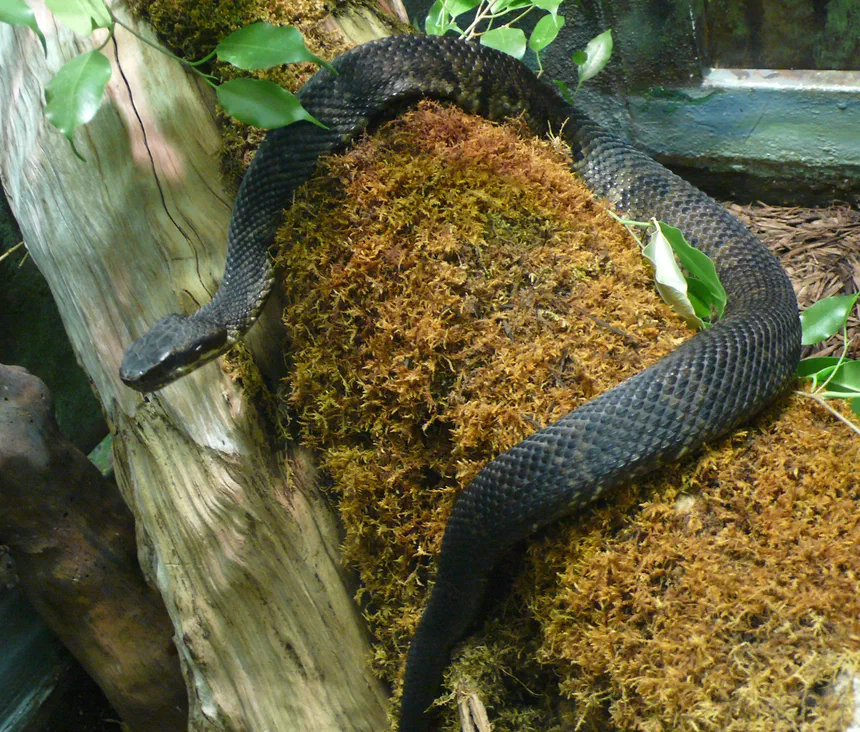
Image: TimVickers — Public domain · source
What Is a Cottonmouth?
The cottonmouth (Agkistrodon piscivorus) is a venomous, semiaquatic pit viper native to the southeastern United States. It is often called the water moccasin, a name that reflects its strong association with wetlands and slow-moving water. The species gets its common name from the startling white lining of its mouth, which it displays as a warning when threatened.
Appearance and Identification
Adult cottonmouths are heavy-bodied snakes, typically ranging from about 2 to 4 feet in length, with large individuals occasionally exceeding that. Coloration varies from olive and tan to dark brown or nearly black, usually with darker crossbands that can fade with age; older animals may look almost uniformly dark. The head is broad and blocky, clearly wider than the neck, and the eyes have vertical, cat-like pupils. Like other pit vipers, cottonmouths have a heat-sensing pit between each eye and nostril. Juveniles are more boldly patterned and have a bright yellow or greenish tail tip, which they wiggle to lure prey. The species is often confused with harmless watersnakes, but cottonmouths tend to hold their heads higher and swim with their bodies riding atop the water.
Habitat and Range
Cottonmouths occupy a wide variety of wetland habitats, including swamps, marshes, cypress sloughs, drainage ditches, and the margins of streams, ponds, and lakes. They range across the southeastern United States, from southeastern Virginia south through Florida and west into eastern Texas, extending up the Mississippi River valley into parts of the central states. Although strongly tied to water, they will also travel over land and can be found in floodplain forests and other damp lowland areas.
Diet
As a carnivore, the cottonmouth eats a broad range of prey. Fish and amphibians such as frogs make up much of its diet, but it also takes small mammals, birds, lizards, other snakes, and even carrion. It is an opportunistic feeder and one of the few North American snakes known to scavenge readily. Prey is subdued with a venomous bite, and the snake locates and tracks food using its vision, chemical cues gathered by its tongue, and heat-sensing pits.
Behavior
Cottonmouths are most active from spring through fall and may be seen basking on logs, banks, and overhanging branches or foraging in the water. They are often more sedentary than the fast-moving watersnakes they resemble. When cornered, a cottonmouth typically stands its ground rather than fleeing, coiling its body, vibrating its tail, and gaping to reveal the pale interior of its mouth as a clear warning. Despite a fearsome reputation, they generally bite only when handled or stepped on. Their venom is tissue-destroying and medically significant, so bites warrant prompt medical care.
Life Cycle and Reproduction
Cottonmouths mate primarily in spring, and courtship can involve males competing with one another. Females give birth to live young rather than laying eggs, usually producing a litter of roughly 3 to 12 offspring in late summer or early fall. Females typically reproduce only every other year or so, depending on food availability and body condition. Newborns are fully independent and venomous from birth, and they use their brightly colored tail tips to attract prey. Individuals may live around 10 to 15 years in the wild, and sometimes longer in captivity.
Conservation Status
The cottonmouth is listed as Least Concern by the IUCN, reflecting a broad range and generally stable populations. Even so, local declines can occur where wetlands are drained, developed, or polluted, and the snakes are frequently killed on roads or out of fear. Because they help control populations of fish, amphibians, and rodents, cottonmouths play a useful role in wetland ecosystems, and conserving healthy wetlands benefits the species along with many others.
Frequently Asked Questions
Are cottonmouths aggressive toward people? Not really. They may stand their ground and display when threatened, but studies show they rarely strike unless handled or stepped on, usually preferring to warn intruders and escape.
How can I tell a cottonmouth from a harmless watersnake? Cottonmouths have a thick body, a blocky head wider than the neck, vertical pupils, and often swim high on the water. Watersnakes are more slender, have round pupils, and tend to flee quickly.
Where are cottonmouths found? They live in wetlands across the southeastern United States, from Virginia through Florida and west to Texas, wherever there is suitable slow or standing water.