Reptiles Guide
Corn Snake
What Is a Corn Snake? The corn snake (Pantherophis guttatus) is a slender, nonvenomous rat snake native to the southeastern and central United States. Known for its bold orange-and-red patterning and calm temperament, it …
At a glance
What Is a Corn Snake?
The corn snake (Pantherophis guttatus) is a slender, nonvenomous rat snake native to the southeastern and central United States. Known for its bold orange-and-red patterning and calm temperament, it is one of the most widely kept pet snakes in the world. In the wild it plays a valuable role as a rodent predator.
Appearance and Identification
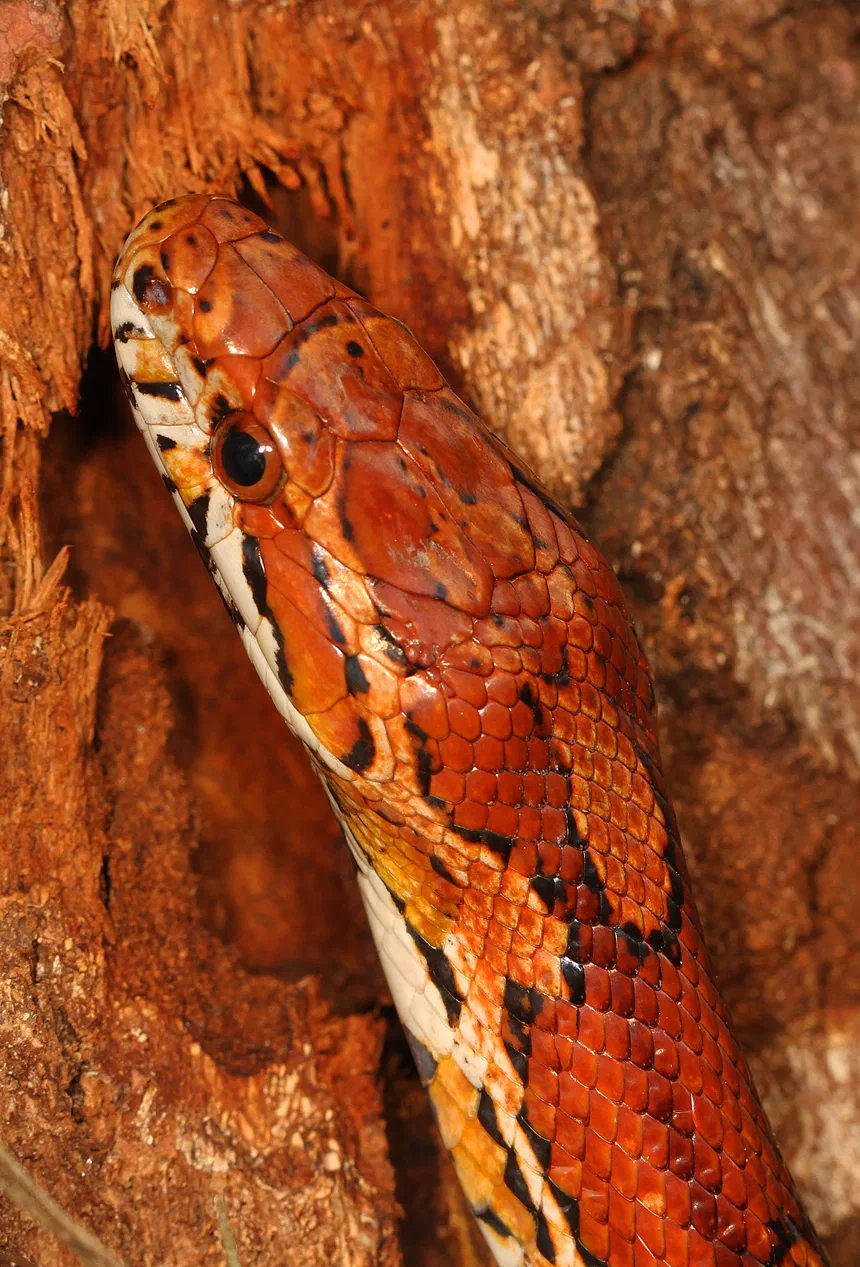
Corn snakes are moderately sized, typically reaching 2 to 6 feet (0.6 to 1.8 m) in length, with most adults falling between 3 and 5 feet. The ground color ranges from orange and reddish to brownish-yellow, overlaid with a series of large red-orange, black-bordered blotches down the back and smaller ones along the sides. The belly is famously marked with a bold black-and-white checkerboard pattern that resembles the kernels of Indian corn, a feature often cited as the source of the common name. Their bodies are relatively slim, their heads only slightly wider than the neck, and their eyes have round pupils. Decades of captive breeding have produced hundreds of color and pattern variations, or “morphs,” but wild individuals show the classic orange-blotched look.
Habitat and Range
This species occupies a broad swath of the eastern and central United States, from New Jersey south through Florida and west into Louisiana, Kentucky, and parts of the surrounding states. Corn snakes are adaptable and use a wide range of habitats, including pine and hardwood forests, overgrown fields, rocky hillsides, and the edges of farmland. They are frequently found around barns, abandoned buildings, and grain stores, where rodents are plentiful. Although often described as terrestrial, they are capable climbers and may ascend trees or structures in search of prey or shelter.
Diet
Corn snakes are carnivores and skilled ambush and active foragers. Their diet is dominated by small rodents such as mice and rats, but they also take birds and their eggs, and younger snakes may eat lizards, frogs, and other small prey. Like other rat snakes, they are constrictors: they seize prey with their teeth, wrap coils around it, and tighten until the animal can no longer breathe before swallowing it whole. By preying heavily on rodents, corn snakes help limit populations of agricultural pests.
Behavior
Corn snakes are generally shy and secretive, spending much of their time hidden beneath logs, rocks, leaf litter, or underground in rodent burrows. They are most active around dawn and dusk and become more nocturnal during hot weather. When threatened, a corn snake may vibrate its tail against dry vegetation, producing a buzzing sound reminiscent of a rattlesnake, though it lacks venom and rattle. Because of their docile disposition, they rarely bite people and are considered harmless. In cooler parts of their range they enter a period of winter dormancy known as brumation.
Life Cycle and Reproduction
Breeding usually takes place in spring, after snakes emerge from brumation. Corn snakes are oviparous: a female typically lays a clutch of around 10 to 30 eggs in early summer, choosing warm, moist, hidden sites such as rotting logs, compost, or leaf piles. She provides no parental care after laying. The eggs incubate for roughly two months before the hatchlings emerge, each measuring around 8 to 14 inches (20 to 36 cm) long and fully independent. Young corn snakes grow quickly and generally reach sexual maturity in about 18 months to three years. Wild individuals commonly live around 6 to 8 years, while those in captivity often survive well into their teens or beyond.
Conservation Status
The corn snake is listed as Least Concern by the IUCN, reflecting its wide range and generally stable populations. It remains common across much of the southeastern United States. Localized declines can occur from habitat loss, road mortality, and killing by people who mistake it for a venomous species such as the copperhead. Overall, however, the corn snake is not considered threatened and thrives in many human-altered landscapes.
Frequently Asked Questions
Are corn snakes venomous or dangerous? No. Corn snakes are nonvenomous and kill prey by constriction. They are gentle and pose no real danger to humans, which is why they are popular pets.
Why are they called corn snakes? The most common explanation is the checkerboard belly pattern that resembles kernels of Indian corn. The name may also relate to their habit of hunting rodents in and around grain stores.
How can you tell a corn snake from a copperhead? Corn snakes have round pupils, a slimmer body, and bright orange-red blotches with a checkered belly, whereas copperheads have hourglass-shaped bands and a broad, distinctly triangular head.